Colloid Milium Pathology: Expert Guide To Diagnosis & Treatment
Detailed pathology of colloid milium: subtypes, histology, diagnosis, and clinical insights for dermatologists.
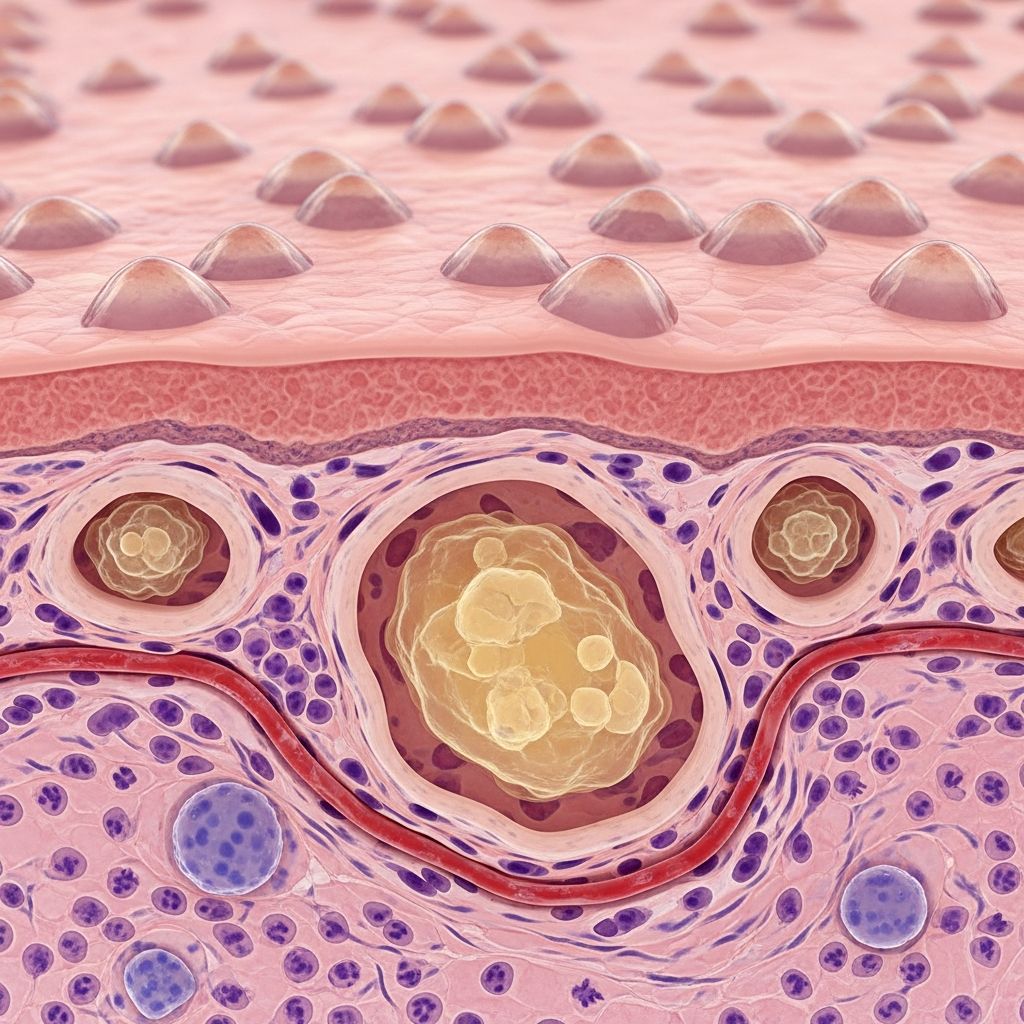
Colloid milium encompasses a spectrum of rare, degenerative cutaneous deposition disorders characterized by the accumulation of amorphous, hyaline-like material in the dermis, primarily on sun-exposed areas. These disorders manifest as yellowish-brown, translucent papules or plaques, with distinct subtypes differing in clinical presentation, etiology, and histopathological features.
Introduction
Colloid milium, also known as colloid degeneration of the skin or dermal hyalinosis, represents a group of uncommon dermatological conditions involving the deposition of colloid material in the dermal papillae. First described nearly 150 years ago, it primarily affects sun-exposed regions such as the face, neck, dorsum of hands, and ears. The condition is degenerative in nature, with uncertain pathogenesis, but strongly linked to chronic ultraviolet (UV) exposure, elastic fiber degeneration, and occasionally chemical irritants.
The hallmark is the presence of homogenous, eosinophilic, fractured colloid deposits in the superficial dermis, often with cleft-like spaces. While benign and not associated with systemic disease in most cases, accurate diagnosis relies on histopathology to differentiate it from mimics like amyloidosis.
Classification
Colloid milium is classified into several subtypes based on clinical, demographic, and pathological features:
- Adult colloid milium: Most common, linked to chronic sun exposure.
- Juvenile colloid milium: Rare, onset in childhood, associated with severe sunburns.
- Pigmented colloid milium: Features grey-black papules, often due to hydroquinone exposure and ochronosis.
- Nodular colloid degeneration: Larger solitary or few nodules, primarily facial.
- Acral keratosis with eosinophilic dermal deposits: Hyperkeratotic papules on acral sites without elastosis.
These variants share core pathological elements but differ in deposit location, staining patterns, and associated changes.
Demographics
Adult colloid milium predominantly affects fair-skinned individuals (Fitzpatrick skin types I-II) aged 30-60 years, with a slight male predominance. It is rare in darker skin types, though cases in Fitzpatrick III have been reported, often with seasonal variation—worsening in summer due to UV exposure.
Juvenile colloid milium occurs in children and young adults, without strong racial predilection but linked to early intense sun exposure. Pigmented forms are more common in populations using hydroquinone-based skin lighteners. Nodular and acral variants lack specific demographic skews but follow sun-exposure patterns.
Causes
The etiology varies by subtype but centers on dermal degeneration:
- Adult form: Chronic UV radiation causes elastin fiber rupture, leading to fibroblast-derived protein accumulation or solar elastosis.
- Juvenile form: Degeneration of UV-altered keratinocytes.
- Pigmented form: Exogenous ochronosis from hydroquinone, compounded by sun exposure, producing banana-shaped ochronotic fibers.
- Nodular degeneration: Uncertain UV role; may involve actinic elastic degeneration.
- Acral variant: Localized papillary dermal deposits without clear triggers.
Additional factors include petroleum products, phenols, and trauma, promoting photodynamic damage.
Clinical features
Lesions typically develop slowly as 1-2 mm yellowish-brown, translucent, dome-shaped papules or plaques on sun-exposed sites: periorbital, malar cheeks, nose, ears, neck, dorsum of hands. They are soft, puncturable with gelatinous content, and symmetric. Dermoscopy shows yellow-brown clods.
| Subtype | Key Clinical Features | Common Sites |
|---|---|---|
| Adult | Multiple small translucent papules | Face, hands, neck |
| Juvenile | Similar but earlier onset | Sun-exposed face |
| Pigmented | Grey-black clustered papules | Face |
| Nodular | 50 mm plaques/nodules | Face, scalp, trunk |
| Acral | Hyperkeratotic papules | Fingers (palmar/dorsal) |
Lesions peak within 3 years and stabilize, occasionally pruritic.
Complications
Adult and nodular forms have no systemic complications. Juvenile colloid milium may associate with ligneous conjunctivitis (wood-like pseudomembranes on ocular mucosae) and periodontitis, though causality is unclear. Pigmented variants risk from ongoing hydroquinone use. Cosmetic disfigurement is the primary issue across subtypes.
Related Stories



Diagnosis
Diagnosis requires clinical correlation and full-thickness skin biopsy. Light microscopy reveals amorphous, eosinophilic material in upper/mid-dermis with clefts/fissures; epidermis intact or hyperkeratotic. A Grenz zone (clear band under epidermis) is typical in adult form but absent in juvenile.
Special stains:
- PAS-positive, diastase-resistant.
- Elastin stain-positive in adult/nodular.
- Congo red-negative (vs. amyloid).
Immunohistochemistry distinguishes subtypes: adult positive for IgG/IgM/NK1, negative for cytokeratins; juvenile positive for cytokeratins, keratin antibodies.
Electron microscopy shows fibrillary material from elastic microfibrils (adult) or keratinocyte debris (juvenile).
Differential diagnoses
- Amyloidosis: Congo red-positive, apple-green birefringence; positive for light chains.
- Actinic elastosis: Solar-damaged elastic fibers, no colloid.
- Ochronosis: Banana fibers in pigmented form, but clinical history differentiates.
- Lichen amyloidosus: Hyperkeratotic, keratin-positive.
- Degos disease: Porcelain-white papules with infarction.
Histology and IHC are definitive.
Treatment
No curative therapy exists; management is cosmetic:
- Sun protection: Broad-spectrum sunscreen, protective clothing.
- Physical ablation: Dermabrasion, CO2 laser resurfacing, fractional lasers—effective for superficial lesions.
- Topical retinoids: May slow progression.
- Discontinue irritants: Hydroquinone, petroleum.
Lesions persist post-treatment but improve cosmetically.
Outcome
Benign course; lesions stabilize after 3 years, unchanging thereafter. No malignant potential or systemic spread. Recurrence possible post-ablation without sun protection. Regular follow-up advised for cosmesis and monitoring.
Frequently Asked Questions
Q: Is colloid milium cancerous?
A: No, it is a benign degenerative condition with no malignant potential.
Q: Can colloid milium be prevented?
A: Strict sun avoidance and protection from childhood reduce risk, especially for adult and juvenile forms.
Q: How is colloid milium diagnosed?
A: Skin biopsy with special stains and immunohistochemistry confirms diagnosis and subtype.
Q: Does colloid milium affect internal organs?
A: Generally no, except rare associations in juvenile form with ligneous conjunctivitis.
Q: Is laser treatment permanent?
A: Ablative lasers provide cosmetic improvement, but sun exposure can lead to recurrence.
References
- Colloid milium – Rare cutaneous condition — PMC/NCBI. 2013-08-22. https://pmc.ncbi.nlm.nih.gov/articles/PMC3748639/
- Colloid milium — DermNet NZ. Accessed 2026. https://dermnetnz.org/topics/colloid-milium
- Colloid Milium: A Review and Update — Journal of Drugs in Dermatology. 2007. https://jddonline.com/articles/colloid-milium-a-review-and-update-S1545961607P0293X
- Colloid milium — VisualDx. Accessed 2026. https://www.visualdx.com/visualdx/diagnosis/colloid+milium?diagnosisId=51299&moduleId=101
- Colloid Degeneration of the Skin (Colloid Milium) — JAMA Dermatology. 1958. https://jamanetwork.com/journals/jamadermatology/fullarticle/526009
Similar Articles








Read full bio of medha deb