Colorectal Cancer Treatment: What You Need To Know in 2025
Comprehensive guide to colorectal cancer treatments, from surgery and chemotherapy to immunotherapy and emerging therapies.
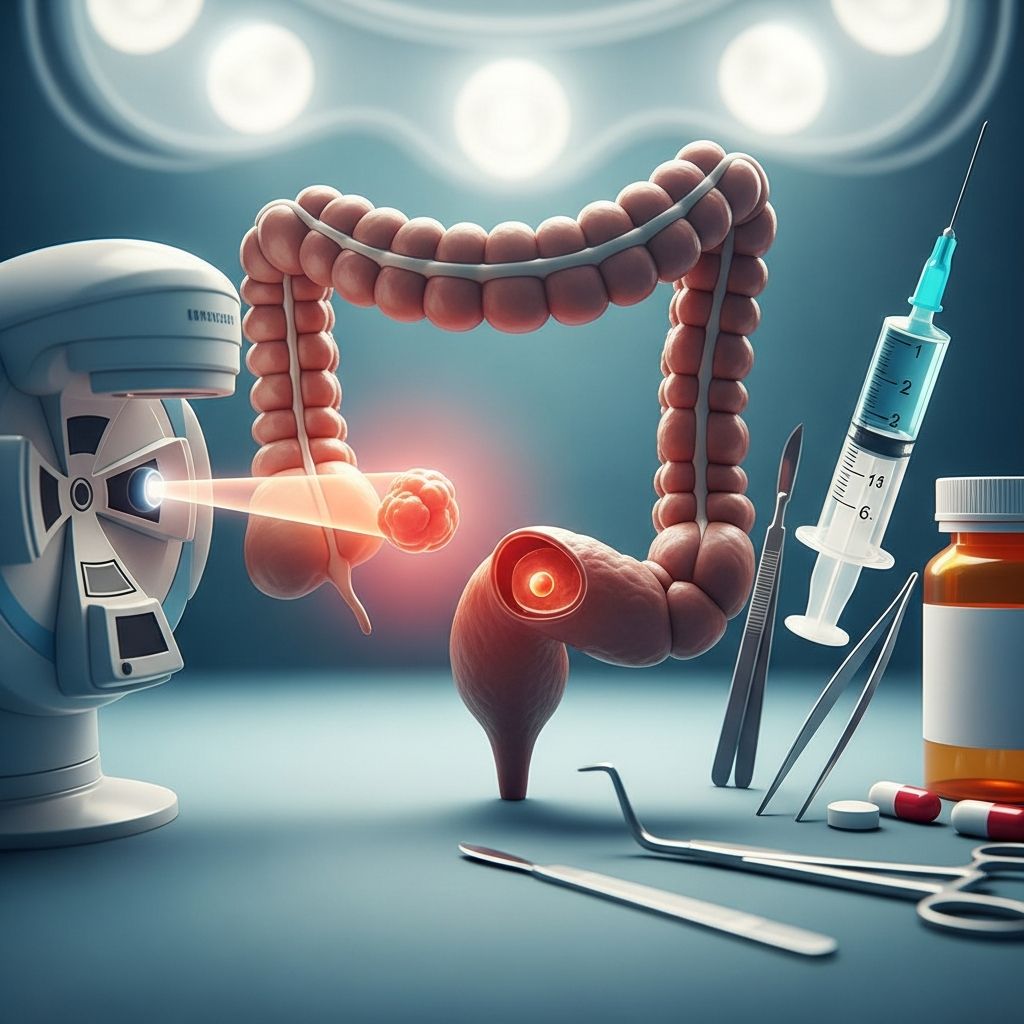
Colorectal cancer, encompassing both colon and rectal cancers, is treated through a multimodal approach depending on the stage, location, and patient health. Treatments aim for cure in early stages and control in advanced disease, with five-year survival rates around 65-66% across stages due to improved detection and therapies like surgery, chemotherapy, and chemoradiotherapy.
Surgery for Colorectal Cancer
Surgery remains the cornerstone of curative treatment for localized colorectal cancer. For
colon cancer
, open surgical resection is primary for stages 0-III, removing the tumor and nearby lymph nodes. Inrectal cancer
, procedures like low anterior resection or abdominoperineal resection preserve sphincter function when possible, often preceded by neoadjuvant chemoradiation to shrink tumors.- Stage 0 and I: Polypectomy or local excision suffices for superficial tumors.
- Stage II-III: Colectomy with lymph node dissection; laparoscopic approaches reduce recovery time.
- Advanced disease: Liver metastasis may require hepatectomy or local ablation.
Post-surgical surveillance is crucial for detecting recurrence early, as emphasized in survivorship care.
Chemotherapy Options
**Adjuvant chemotherapy** follows surgery in stage III colon cancer, improving survival by 30% with 5-fluorouracil (5-FU) and up to 20% more with added oxaliplatin (e.g., FOLFOX regimen). For stage II, it’s controversial but considered for high-risk patients like those with obstruction or perforation.
| Stage | Chemotherapy Regimen | Evidence |
|---|---|---|
| Stage III Colon | 5-FU/Leucovorin + Oxaliplatin (FOLFOX) | 12% absolute OS benefit |
| Rectal Cancer | Neoadjuvant 5-FU + Radiation | Improved local control |
| Metastatic | mFOLFOX6 + Bevacizumab | PFS improvement |
In metastatic settings, regimens like mFOLFOX6 combined with biologics extend progression-free survival (PFS). For deficient mismatch repair (dMMR)/microsatellite instability-high (MSI-H) cases, combinations yield median PFS of 24.5 months versus 5.3 months with immunotherapy alone.
Radiation Therapy
Radiation is standard for rectal cancer, often as
neoadjuvant chemoradiotherapy
to reduce local recurrence. It’s less common in colon cancer unless high-risk features like T4 tumors exist. Trials show no OS benefit in select colon cases due to limited accrual, but it’s vital for rectal tumors.- Short-course radiation (5 days) for operable rectal cancers.
- Long-course with chemotherapy for locally advanced disease.
Targeted Therapies and Immunotherapy
**Targeted drugs** like bevacizumab (anti-VEGF) inhibit tumor blood supply, combined with chemo for metastatic disease. For dMMR/MSI-H metastatic colorectal cancer,
immunotherapy
such as atezolizumab (PD-L1 inhibitor) shines, especially with chemo: complete response rates reach 36.1% in combinations versus 18.9% monotherapy.Trials like COMMIT demonstrate synergy, reducing primary progression to 2.8%. Pembrolizumab is standard for MSI-H but faces 40% resistance, addressed by triplets like mFOLFOX6/bevacizumab/atezolizumab.
Treatment by Stage
Stage 0 Colon Cancer
Local excision or polypectomy cures most cases without further therapy.
Stage I Colon Cancer
Surgical resection alone yields excellent outcomes.
Related Stories



Stage II Colon Cancer
Surgery primary; adjuvant chemo under evaluation for high-risk features.
Stage III Colon Cancer
Surgery plus adjuvant chemo (FOLFOX); clinical trials recommended.
Stage IV and Recurrent
Systemic therapy, surgery for resectable mets, immunotherapy for MSI-H.
Rectal Cancer Specifics
Neoadjuvant chemoradiation improves survival and sphincter preservation. Total mesorectal excision (TME) is surgical gold standard.
Clinical Trials and Emerging Treatments
Enrollment in trials is encouraged across stages, testing novel combos like immunotherapy triplets showing superior PFS in MSI-H disease.
Side Effects and Management
Chemo causes neuropathy (oxaliplatin), nausea (5-FU); radiation leads to bowel issues. Survivorship focuses on late toxicities, healthy lifestyle, and surveillance.
Survivorship Care
Post-treatment, coordinate care plans for recurrence monitoring, toxicity management, diet, and preventive screenings. Improved therapies boost longevity, necessitating tailored follow-up.
Frequently Asked Questions (FAQs)
What is the main treatment for early-stage colorectal cancer?
Surgery is the primary curative treatment for stages 0-II colon cancer and early rectal cancer.
Is chemotherapy always needed after surgery?
No, but adjuvant chemo is standard for stage III and select high-risk stage II cases, improving survival.
How does immunotherapy work for colorectal cancer?
It’s highly effective for dMMR/MSI-H tumors, boosting immune response; combinations enhance PFS dramatically.
What are survival rates for colorectal cancer?
Five-year rates are 65% for colon and 66% for rectal cancer, thanks to better detection and treatments.
Can colorectal cancer be cured if metastatic?
Yes, in select cases with resectable metastases via surgery and systemic therapy.
References
- The Challenges of Colorectal Cancer Survivorship — National Center for Biotechnology Information (PMC). 2011-05-24. https://pmc.ncbi.nlm.nih.gov/articles/PMC3110673/
- Colon Cancer Treatment (PDQ®)–Health Professional Version — National Cancer Institute (NCI). 2026 (accessed). https://www.cancer.gov/types/colorectal/hp/colon-treatment-pdq
- mFOLFOX/Bevacizumab/Atezolizumab Improves PFS in dMMR/MSI-H Colorectal Cancer — Targeted Oncology. 2026-01-01. https://www.targetedonc.com/view/mfolfox-bevacizumab-atezolizumab-improves-pfs-in-dmmr-msi-h-colorectal-cancer
Similar Articles








Read full bio of medha deb