Common Skin Lesions: Comprehensive Diagnosis & Management Guide
Comprehensive guide to identifying, diagnosing, and managing common skin lesions from benign naevi to skin cancers.
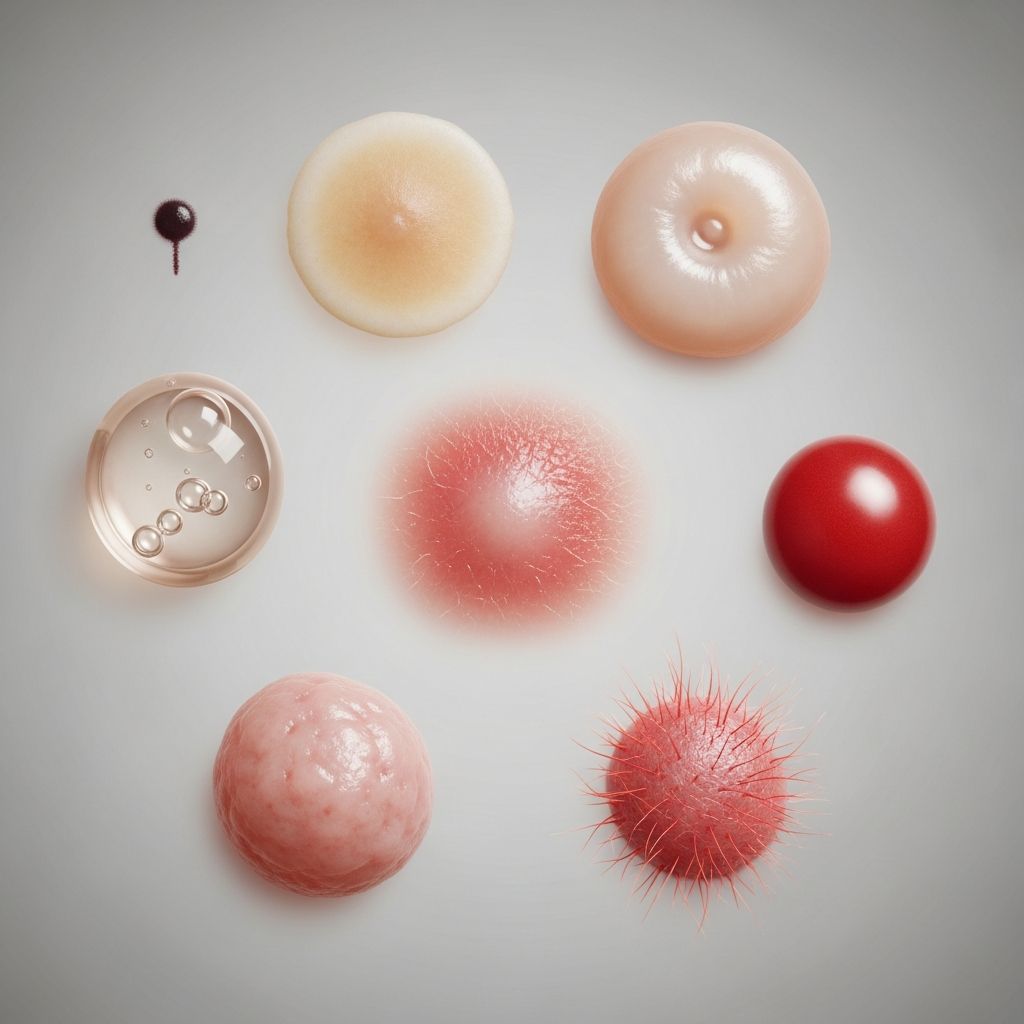
This comprehensive course covers the epidemiology, clinical features, diagnosis, and management of common skin lesions encountered in clinical practice. From benign changes in ageing skin to malignant tumours like basal cell carcinoma (BCC), squamous cell carcinoma (SCC), and melanoma, understanding these lesions is essential for timely intervention and optimal patient outcomes.
Ageing Skin
Skin undergoes significant changes with age, influenced by both intrinsic factors (genetics, chronological ageing) and extrinsic factors (primarily ultraviolet radiation exposure, known as photoageing). Intrinsic ageing results in smoother, thinner skin with fine wrinkles, while photoageing leads to coarser texture, deep wrinkles, dyspigmentation, telangiectasia, and actinic keratoses. Common lesions in ageing skin include solar lentigines (age spots), seborrhoeic keratoses, and cherry angiomas.
Solar lentigines appear as tan to brown macules on sun-exposed areas like the face, hands, and forearms. Seborrhoeic keratoses are waxy, ‘stuck-on’ plaques that increase in number and size with age, often on the trunk. Cherry angiomas are small bright red papules, extremely common after middle age, especially on the trunk. These benign lesions are harmless but may prompt patients to seek evaluation due to cosmetic concerns or itchiness.
Epidemiology of Non-Melanoma Skin Cancer
Non-melanoma skin cancers (NMSC), primarily basal cell carcinoma (BCC) and squamous cell carcinoma (SCC), are the most common cancers worldwide. Incidence rises with age, fair skin type, and cumulative UV exposure. In high-UV regions like New Zealand and Australia, rates are exceptionally high. BCC accounts for about 80% of NMSC, while SCC comprises 20%. Risk factors include immunosuppression, chronic wounds, and genetic syndromes like xeroderma pigmentosum. Early detection is key as metastasis is rare for BCC but possible (2-5%) for high-risk SCC.
Squamous Cell Carcinoma
Squamous cell carcinoma (SCC) arises from epidermal keratinocytes, often preceded by actinic keratoses (AKs), precancerous scaly plaques from chronic sun damage. About 50,000 new NMSC cases occur annually in regions like New Zealand, with SCC showing potential for local invasion and metastasis, particularly from lower lip, ear, or scarred areas.
Clinical features include enlarging erythematous plaques, nodules, or ulcers with hyperkeratotic scale, induration, and tenderness. High-risk features: size >2cm, perineural invasion, recurrence, or poor differentiation. Diagnosis requires biopsy; treatment involves excision with 4-6mm margins, Mohs surgery for high-risk sites, or radiotherapy. Actinic keratoses can be managed with cryotherapy, topical 5-fluorouracil, imiquimod, or photodynamic therapy.
Basal Cell Carcinoma
Basal cell carcinoma (BCC) is the most common human cancer, arising in sun-exposed skin, especially the face. Superficial BCCs on trunk/limbs mimic eczema or psoriasis, presenting as large erythematous patches. Nodular BCCs form pearly domes with telangiectasia and rolled borders; ulcerated forms are ‘rodent ulcers’. Morphoeic (sclerosing) BCC appears as scar-like plaques on mid-face, deeply invasive and hard to delineate. Pigmented BCC resembles melanoma or seborrhoeic keratosis.
Recurrence risks are higher on mid-face (eyelids, nose, mouth) due to narrow margins for cosmesis. Morphoeic/micronodular subtypes recur post-inadequate treatment. Management prioritizes excision with 3-4mm margins for high-risk types; alternatives include Mohs micrographic surgery, cryotherapy, or topical therapies for superficial lesions. On legs, non-surgical options prevent ulceration.
Related Stories



Benign Melanocytic Lesions
Benign melanocytic naevi (moles) result from melanocyte proliferation, appearing as macules, papules, plaques, or nodules. Most are acquired postnatally, influenced by sun exposure and genetics; darker skin types have darker, more numerous lesions. Types include junctional (flat brown), compound (raised brown), and dermal (flesh-coloured or blue).
Congenital naevi may be macular or cobblestoned/hairy, with giant variants (>20cm) carrying 5-10% melanoma risk and neurocutaneous melanosis. Dysplastic naevi feature lentiginous proliferation, bridging nests, and lymphocytic infiltrate—major criteria for diagnosis. Acral/flexural/mucosal naevi may appear atypical but are usually benign. Suspicious lesions warrant excision with 2-3mm margins; send all removed lesions for histopathology.
Melanoma
Melanoma incidence is rising, with ~2,000 new invasive cases yearly in New Zealand (2001 data), age-standardized rate 35.8/100,000 males. ABCDE criteria guide suspicion: Asymmetry, irregular Border, colour Cvariation (red halo possible), Diameter >6mm, Evolving size/shape/colour or elevation.
| Feature | Description |
|---|---|
| A | Asymmetry of shape and pigment pattern |
| B | Well-defined irregular border |
| C | Variation in colour, often with red halo |
| D | Diameter over 6mm (smaller possible) |
| E | Evolving or elevation |
Subtypes: superficial spreading (most common), nodular (aggressive, ulcerated), lentigo maligna (face, elderly), acral lentiginous. Diagnosis via excision biopsy; histopathology assesses Breslow depth, ulceration, mitoses, regression. Melanoma in situ shows pagetoid spread; invasive has dermal nests. Re-excision: 1cm margins deep to fascia, Mohs for lentigo maligna. Multidisciplinary management for staging/metastases.
Dermal and Subcutaneous Lesions
Dermal/subcutaneous lesions include benign entities like dermatofibromas (firm nodules on legs post-insect bite, positive dimple sign) and cherry angiomas (common red/blue papules on trunk). Malignant examples: Merkel cell carcinoma, rare rapidly growing violaceous nodule with high recurrence (40% metastasis, 30% mortality at 5 years). Differentiation via dermoscopy and biopsy is crucial.
Surgical Procedures
Management of skin lesions often involves minor surgery. Shave excision suits superficial lesions (e.g., seborrhoeic keratosis) using scalpel or DermaBlade, but risks recurrence if incomplete. Curettage scrapes epidermal lesions (benign cysts, viral warts, superficial BCC) followed by electrosurgery for haemostasis; avoid for melanoma/SCC. Formal excision with margins is gold standard for malignancies. Cryotherapy, cautery, and grafts/flaps aid healing, especially on legs.
- Shave excision: For pedunculated or superficial lesions.
- Curettage: Epidermal benign lesions; add cautery for low-risk malignancies.
- Excision: Malignancies with predetermined margins.
Post-op care minimizes scarring; send all specimens for pathology.
Dermoscopy of Benign Melanocytic Lesions
Dermoscopy enhances diagnosis of melanocytic lesions. Benign naevi show symmetry, uniform globules/reticular pattern, single colour (black/brown/blue/pink). Elevated lesions exhibit ‘wobble sign’. Congenital naevi display cerebriform pattern, terminal hairs. Acral naevi: parallel furrow (side of foot), fibrillar (weight-bearing), lattice (arch). Halo naevi: central typical naevus with peripheral hypopigmentation. Asymmetry/multicolours warrant biopsy despite benign history.
Frequently Asked Questions (FAQs)
What causes most common skin lesions?
Sun exposure (UV radiation) is the primary cause for ageing changes, actinic keratoses, BCC, SCC, and many melanomas[10].
How to differentiate benign moles from melanoma?
Use ABCDE criteria and dermoscopy; biopsy changing/irregular lesions.
Is basal cell carcinoma dangerous?
BCC rarely metastasizes but locally invasive; early treatment prevents disfigurement.
What treatment for actinic keratoses?
Cryotherapy, topicals (5-FU, imiquimod), or PDT.
When to refer to dermatology?
For facial/high-risk lesions, diagnostic uncertainty, or poor healing.
References
- Common skin lesions. Basal cell carcinoma — DermNet NZ. 2023. https://dermnetnz.org/cme/lesions/basal-cell-carcinoma-cme
- Common skin lesions. Dermal and subcutaneous lesions — DermNet NZ. 2023. https://dermnetnz.org/cme/lesions/dermal-and-subcutaneous-lesions
- Common skin lesions. Benign melanocytic lesions — DermNet NZ. 2023. https://dermnetnz.org/cme/lesions/benign-melanocytic-lesions
- Common skin lesions. Surgical procedures — DermNet NZ. 2023. https://dermnetnz.org/cme/lesions/surgical-procedures
- Common skin lesions. Melanoma — DermNet NZ. 2023. https://dermnetnz.org/cme/lesions/melanoma
- Dermoscopy of benign melanocytic lesions — DermNet NZ. 2023. https://dermnetnz.org/cme/dermoscopy-course/dermoscopy-of-benign-melanocytic-lesions
- Common skin lesions. Contents page — DermNet NZ. 2023. https://dermnetnz.org/cme/lesions
Similar Articles








Read full bio of Sneha Tete