Comparative Dermoscopy Images: 13 Cases To Aid Diagnosis
Explore galleries of dermoscopy images comparing polarized and non-polarized views across skin lesions for enhanced diagnostic accuracy.
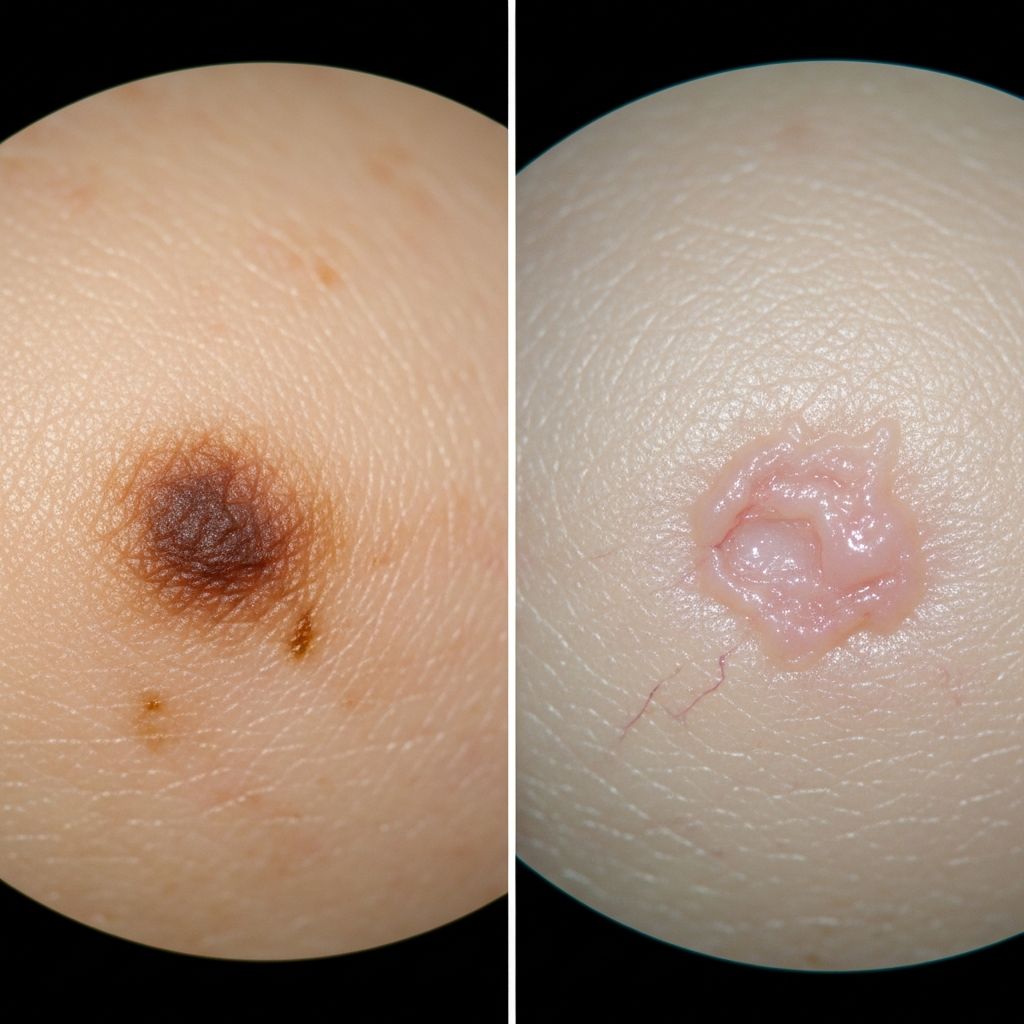
This comprehensive gallery presents high-resolution dermoscopy images of various skin lesions, captured using both
polarized
andnon-polarized
modes with multiple dermatoscopes and cameras. These comparative views highlight differences in visualization of structures, aiding dermatologists in accurate diagnosis and improving clinical confidence. Images are grouped by lesion type, showcasing melanocytic naevi, solar lentigines, seborrhoeic keratosis, basal cell carcinoma (BCC), squamous cell carcinoma in situ (SCCIS), and superficial spreading melanoma in situ.Introduction to Comparative Dermoscopy
Dermoscopy, also known as dermatoscopy, is a non-invasive imaging technique that uses a dermatoscope—a handheld device with high-magnification optics and polarized light—to examine skin lesions beyond what is visible to the naked eye. It magnifies skin structures up to 10-20 times, revealing patterns like pigment networks, vessels, and dots crucial for differentiating benign from malignant lesions. Comparative dermoscopy compares
polarized dermoscopy (PD)
andnon-polarized dermoscopy (NPD)
, which offer complementary insights. PD excels at deeper structures without contact, while NPD provides superior superficial detail with immersion fluid.Polarized light filters reduce surface glare, enabling visualization of dermal vessels, pink/red hues, white shiny structures, and variable pigmentation. Non-polarized mode, requiring gel or oil immersion and skin contact, better reveals blue-white veils, peppering, milia-like cysts, and comedo-like openings. Combining both modes boosts diagnostic accuracy, with studies showing high concordance for many structures but differences in others.
Devices Used in Comparative Imaging
Images in this gallery were captured using a range of professional dermatoscopes and camera attachments to demonstrate consistency and variations across devices. Key devices include:
- Polarized views: DermLite DL4, DL3, Hybrid, Hüd, GL, Illuco, Opticlar, iC1, Handyscope
- Non-polarized views: DermLite DL4, DL3, Hybrid, Illuco, Opticlar, iC1, Handyscope
Hybrid devices like DermLite DL3N allow switching between modes and use with or without fluid, offering versatility for capturing macro views, cross-polarized images, and fluid-enhanced details. DSLR cameras with crop sensors (DX) and 35mm lenses paired with these attachments provide optimal field of view (approx. 10.5mm x 15.73mm) and magnification (1.6:1). Mobile attachments enable high-resolution 4K imaging, standardized with consistent lighting and centering to include healthy skin borders.
| Device Type | Pros | Cons | Best For |
|---|---|---|---|
| DermLite DL3N (Hybrid) | Excellent quality; PD/NPD switchable; with/without gel | May require pressure management | All lesion types, vessels, networks |
| DermLite Foto II | Large contact plate; selective focus | Potential swivel; no PNCD | Larger lesions |
| Mobile Dermatoscope | Portable; high-res (4K); affordable | Focus challenges; edge artifacts | Field use, follow-up |
Not all captured images are shown due to patient privacy, lesion quality, or technical issues, but the gallery emphasizes standardized techniques: contact-polarized with gel for scale reduction, non-contact for vessels, and hybrid for comprehensive analysis.
Melanocytic Naevi (3 Cases)
Melanocytic naevi, or moles, exhibit high concordance between PD and NPD for pigment networks, globules, and dots. PD highlights irregular networks and deeper pigmentation, while NPD shows sharper epidermal details like cornflake-like scales if present.
- Case 1 (DermLite DL4): PD reveals blue-gray globules and thin vessels; NPD emphasizes milia-like cysts and peppering.
- Case 2 (iC1): PD displays white orthogonal lines; NPD accentuates comedo openings.
- Case 3 (Handyscope): Both modes confirm symmetrical globules, ruling out atypia.
Related Stories



These comparisons underscore PD’s advantage for vascular patterns in structure-poor naevi.
Solar Lentigines (3 Cases)
Solar lentigines, common sun-induced spots, show mottled pigmentation best in PD, with NPD superior for reticular patterns and pseudopods.
- Case 1 (DermLite DL3): PD: Faint dermal vessels; NPD: Sharp annular-granular pattern.
- Case 2 (Illuco): PD enhances red-blush; NPD reveals blue-white veil edges.
- Case 3 (Opticlar): Concordant moth-eaten borders in both.
PD increases sensitivity for lentigo maligna mimicry.
Seborrhoeic Keratosis
Seborrhoeic keratoses display stuck-on horns and crypts. NPD offers higher specificity, clearly showing comedo-like openings and milia-like cysts, while PD visualizes maternal fingerprints and shiny white tracks.
- Single Case (Hybrid Device): PD: White rails; NPD: Fingerprint-like ridges and fat drops.
Combining modes avoids misdiagnosis as melanoma.
Basal Cell Carcinoma (3 Cases)
BCCs feature arborizing vessels and ulceration. PD excels at tree-like vessels and pink structureless areas; NPD better for blue-gray ovoid nests and leaf-like structures.
- Case 1 (Hüd): PD: Prominent vessels; NPD: Ulcer edges.
- Case 2 (GL): PD: White dermis; NPD: Peppering.
- Case 3 (iC1): Both confirm translucency.
PD boosts detection of amelanotic BCC.
Squamous Cell Carcinoma In Situ (2 Cases)
SCCIS (Bowen’s disease) shows glomerular vessels and scaling. PD reveals dotted vessels and white structureless zones; NPD highlights surface scales and keratin.
- Case 1 (DermLite DL4): PD: Vascular blush; NPD: Cracked mud.
- Case 2 (Handyscope): PD: Shiny tracks; NPD: Yellow clods.
PD aids in structure-poor cases.
Superficial Spreading Melanoma In Situ
Melanoma in situ displays atypical networks and regression. PD uncovers white lines and peripheral vessels; NPD shows blue-white veils and peppering clearly.
- Single Case (Multiple Devices): PD: Regression structures; NPD: Atypical blotch and streaks.
Dual-mode analysis is critical for early detection.
Physics of Light in Dermoscopy
Understanding light refraction and reflection is key. Polarized light eliminates specular reflection, penetrating to dermo-epidermal junction; non-polarized relies on immersion to match refractive indices, viewing superficial epidermis. Structures like eccrine ducts on palms are NPD-optimal.
Clinical Applications and Advantages
- PD Advantages: No contact/fluid; deeper views; melanoma/BCC sensitivity.
- NPD Advantages: Superficial colors (blue-white); seborrhoeic keratosis specificity; acral lesions.
- Hybrid Use: Comprehensive imaging per IMI guidelines.
Sequential digital dermoscopy (SDDI) with these modes tracks changes over time.
Frequently Asked Questions (FAQs)
Why compare polarized and non-polarized dermoscopy?
They complement each other: PD for vessels and depth, NPD for surface details, increasing accuracy.
What devices are best for beginners?
Hybrid models like DermLite DL3N for versatility.
Is dermoscopy better than clinical exam alone?
Yes, it improves melanoma detection by 20-30%.
Can mobile phones suffice?
With attachments, yes, for high-res standardized images.
How to standardize imaging?
Use consistent lighting, center lesions, include healthy skin.
References
- A comparison of polarised and nonpolarised dermoscopy — DermNet NZ. 2023. https://dermnetnz.org/topics/a-comparison-of-polarised-and-nonpolarised-dermoscopy
- Dermatoscope comparative image gallery — DermNet NZ. 2023. https://dermnetnz.org/topics/comparative-dermoscopy-images
- IMI National Guidelines Dermoscopy — Institute of Medical Illustrators. 2022-10. https://www.imi.org.uk/wp-content/uploads/2022/10/National-Guideline-Dermoscopy-DRAFT.pdf
- DERM12345: A Large, Multisource Dermatoscopic Skin Lesion Dataset — PMC/NCBI. 2024. https://pmc.ncbi.nlm.nih.gov/articles/PMC11604664/
- Dermoscopy (Dermatoscopy) — DermNet NZ. 2023. https://dermnetnz.org/topics/dermoscopy
Similar Articles








Read full bio of medha deb