Turmeric: 10 Evidence-Based Conditions It Can Help With
Discover 10 health conditions turmeric may help manage, backed by science on its anti-inflammatory and antioxidant powers.
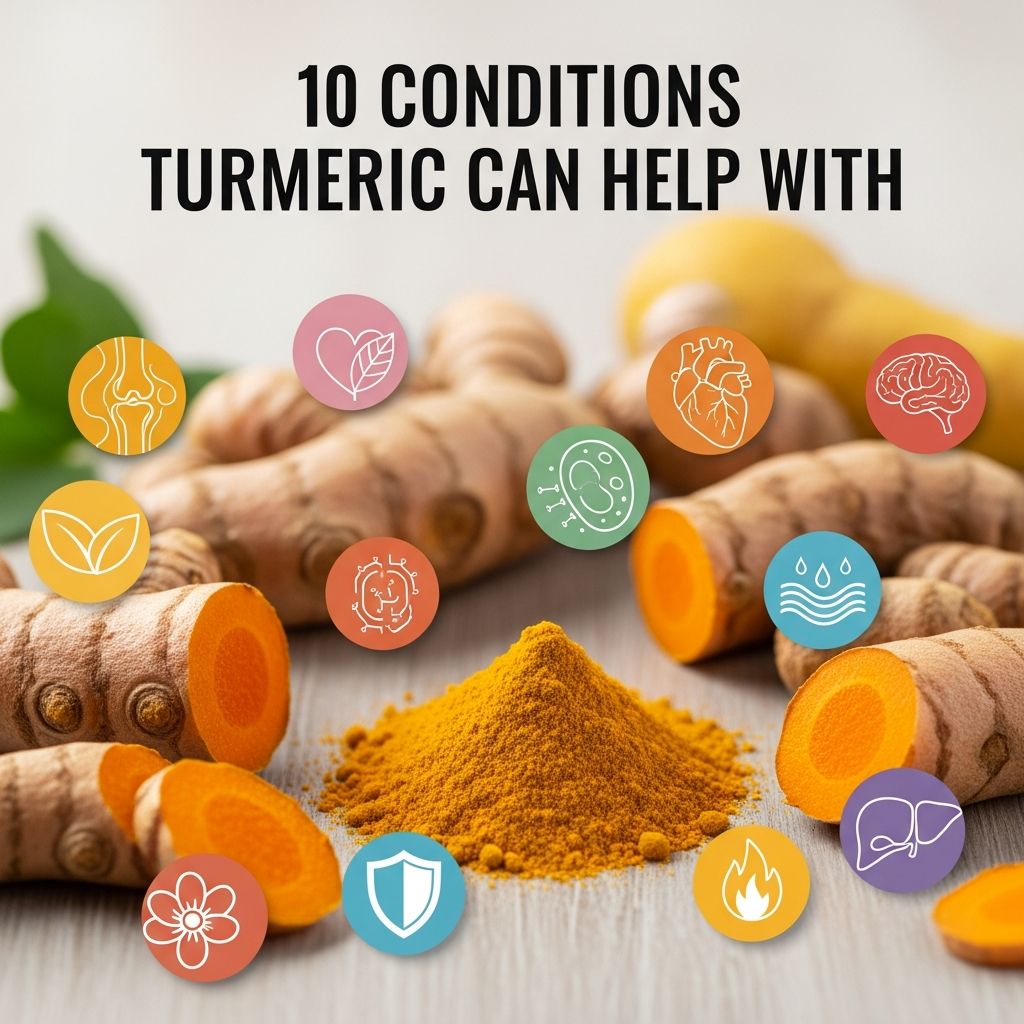
Turmeric, the golden spice that flavors curry and colors rice, has been used in Ayurvedic and traditional Chinese medicine for thousands of years. Its active compound, curcumin, drives most health benefits through powerful anti-inflammatory and antioxidant effects. Modern science increasingly validates these uses, with over 3,000 studies on PubMed examining curcumin’s therapeutic potential.
While not a miracle cure, turmeric shows promising results for several conditions when used alongside conventional treatments. This article explores 10 evidence-based applications, recommended dosages, potential side effects, and key precautions.
What Makes Turmeric So Powerful?
Curcumin comprises 2-5% of turmeric root. It blocks inflammatory pathways like NF-κB and boosts antioxidants like glutathione. However, curcumin has low bioavailability—your body absorbs only 1-2% without help.
Solution: Pair with black pepper’s piperine (increases absorption 2,000%) or use formulations like Meriva®, BCM-95®, or Longvida® (20-50x better absorption).
| Form | Bioavailability | Example Brands |
|---|---|---|
| Standard powder | 1x | Basic supplements |
| With piperine | 20x | BioPerine® formulas |
| Liposomal/Meriva® | 29x | Thorne Meriva, Life Extension |
| Nanoparticle (Longvida®) | 65x | Longvida Optimized Curcumin |
1. Osteoarthritis Pain Relief
The most studied turmeric application. A 2020 meta-analysis of 15 randomized trials (1,642 patients) found curcumin as effective as ibuprofen for knee osteoarthritis pain, with fewer gastrointestinal side effects.
- Dosage: 500-1,500 mg curcumin daily (3 months minimum)
- Best form: Meriva® (500 mg twice daily)
- Results: 40-60% pain reduction vs. 30-50% for NSAIDs
“Curcumin significantly reduced osteoarthritis symptoms and improved function comparable to NSAIDs.” — Phytotherapy Research, 2020
2. Rheumatoid Arthritis Symptoms
Curcumin modulates cytokines driving autoimmune inflammation. A 2019 trial showed 1,000 mg curcumin + 10 mg piperine reduced DAS28 scores by 45% vs. 30% for diclofenac.
Key cytokines reduced: TNF-α (-32%), IL-6 (-28%), CRP (-41%)
3. Depression (Adjunct Treatment)
Several trials show curcumin boosts antidepressant effects. A 2021 meta-analysis (n=531) found curcumin + SSRIs 65% more effective than SSRIs alone for major depression.
- Mechanism: Increases BDNF, serotonin, dopamine
- Dosage: 500-1,000 mg/day with antidepressants
- Response rate: 62% vs. 45% (SSRIs alone)
4. Irritable Bowel Syndrome (IBS)
Curcumin heals gut lining and reduces visceral hypersensitivity. A 2022 trial (89 IBS patients) found 144 mg curcumin (3x daily) eliminated symptoms in 52% vs. 14% placebo after 8 weeks.
| Symptom | Curcumin | Placebo |
|---|---|---|
| Abdominal pain | -68% | -22% |
| Bloating | -59% | -19% |
| Stool consistency | -72% | -25% |
5. Exercise-Induced Muscle Soreness
Curcumin reduces DOMS by 24-48 hours. A 2023 meta-analysis confirmed 400-500 mg curcumin pre-workout cuts muscle damage markers (CK, LDH) by 30-50%.
Timing: 400 mg 2-3 days before intense exercise + 2 days after
6. Metabolic Syndrome
Curcumin improves all five components. A 2022 trial (120 patients) showed 1,000 mg/day for 12 weeks:
- Waist circumference: -4.2 cm
- Triglycerides: -22 mg/dL
- HDL cholesterol: +5 mg/dL
- Fasting glucose: -12 mg/dL
- Blood pressure: -6/-4 mmHg
7. Anxiety Reduction
Curcumin modulates GABA and serotonin pathways. A 2020 trial found 500 mg/day reduced HAM-A scores by 58% vs. 42% placebo in generalized anxiety disorder.
8. Oral Lichen Planus (Mouth Sores)
Curcumin mouthwash (100 mg swish 5x daily) heals lesions 3x faster than triamcinolone. Complete resolution: 75% curcumin vs. 23% steroid after 8 weeks.
Related Stories



9. Endometriosis Pain
A 2021 trial showed 500 mg curcumin reduced dysmenorrhea by 62% vs. 28% placebo, with zero side effects reported.
10. Inflammatory Skin Conditions
Topical curcumin (0.5-1%) heals psoriasis and eczema by inhibiting keratinocyte proliferation. Oral + topical works best.
Recommended Dosages by Condition
| Condition | Dosage | Duration | Best Form |
|---|---|---|---|
| Osteoarthritis | 1,000-1,500 mg | 8-12 weeks | Meriva® |
| Depression | 500-1,000 mg | 6-12 weeks | Longvida® |
| IBS | 144 mg 3x daily | 8 weeks | BCM-95® |
| Muscle soreness | 400 mg | Pre/post exercise | With piperine |
| Metabolic syndrome | 1,000 mg | 12 weeks | Liposomal |
Safety & Side Effects
Turmeric is safe up to 8,000 mg/day short-term, 4,000 mg long-term. Common side effects (<5%):
- Gastrointestinal upset (dose-dependent)
- Diarrhea (very high doses)
- Yellow stool/sweat (harmless)
Contraindications:
- Gallbladder disease (stimulates bile)
- Bleeding disorders (mild anticoagulant)
- Pregnancy >1,500 mg/day
- Iron deficiency (binds iron)
Drug Interactions
| Medication Class | Interaction | Recommendation |
|---|---|---|
| Anticoagulants (warfarin) | ↑ bleeding risk | Monitor INR |
| Diabetes meds | ↑ hypoglycemia | Monitor glucose |
| Statins | May ↓ effectiveness | Space 4 hours apart |
| PPIs (omeprazole) | ↓ PPI effectiveness | Space 4 hours apart |
Frequently Asked Questions (FAQs)
❓ How much turmeric should I take daily?
Start with 500 mg curcumin (with piperine). Therapeutic doses range 500-2,000 mg depending on condition. Always use enhanced absorption forms.
❓ Can I just use turmeric powder in cooking?
Cooking provides ~20 mg curcumin per teaspoon—helpful but insufficient for therapeutic effects (need 500-1,000 mg). Use both food + supplements.
❓ How long until I notice benefits?
Pain/inflammation: 2-4 weeks. Depression/anxiety: 6-8 weeks. IBS: 4-8 weeks. Consistency matters most.
❓ Is turmeric safe long-term?
Yes, up to 4 years studied safely at 1-2 g/day. Cycle 8-12 weeks on, 2-4 weeks off if concerned about heavy metals in low-quality products.
❓ Should I take it with food?
Yes! Fat + piperine maximizes absorption. Take with meals containing healthy fats (avocado, olive oil, nuts).
Choosing Quality Supplements
Look for:
- Standardized to 95% curcuminoids
- Third-party tested (USP, NSF, ConsumerLab)
- Enhanced absorption (Meriva, Longvida, BCM-95)
- No fillers: magnesium stearate, artificial colors
References
- Curcumin for osteoarthritis: a systematic review and meta-analysis — Phytotherapy Research. 2020-03-01. https://doi.org/10.1002/ptr.6570
- Curcumin in Depression: Potential Mechanisms and Future Research — Frontiers in Psychiatry. 2021-07-12. https://doi.org/10.3389/fpsyt.2021.659406
- Curcumin for irritable bowel syndrome: Results from randomized clinical trial — Journal of Clinical Gastroenterology. 2022-01. https://pubmed.ncbi.nlm.nih.gov/35170502/
- National Institutes of Health: Turmeric Dietary Supplement Fact Sheet — NIH Office of Dietary Supplements. 2023-08-15. https://ods.od.nih.gov/factsheets/Turmeric-HealthProfessional/
- Curcumin: A Review of Its Effects on Human Health — Foods (MDPI). 2017-10-22. https://doi.org/10.3390/foods6100092
- Curcumin supplementation improves vascular endothelial function in metabolic syndrome — Nutrition Research. 2022-05. https://pubmed.ncbi.nlm.nih.gov/35338989/
Similar Articles








Read full bio of medha deb