Condyloma Acuminatum Pathology: Key Insights For Diagnosis
Detailed histopathological analysis of condyloma acuminatum, genital warts caused by HPV types 6 and 11.
Condyloma acuminatum, commonly known as genital warts, represents a benign epithelial proliferation induced by low-risk human papillomavirus (HPV) types, primarily 6 and 11. This condition manifests as exophytic lesions on anogenital mucosa and skin, characterized histologically by papillomatosis, koilocytosis, and squamous hyperplasia.
Clinical features
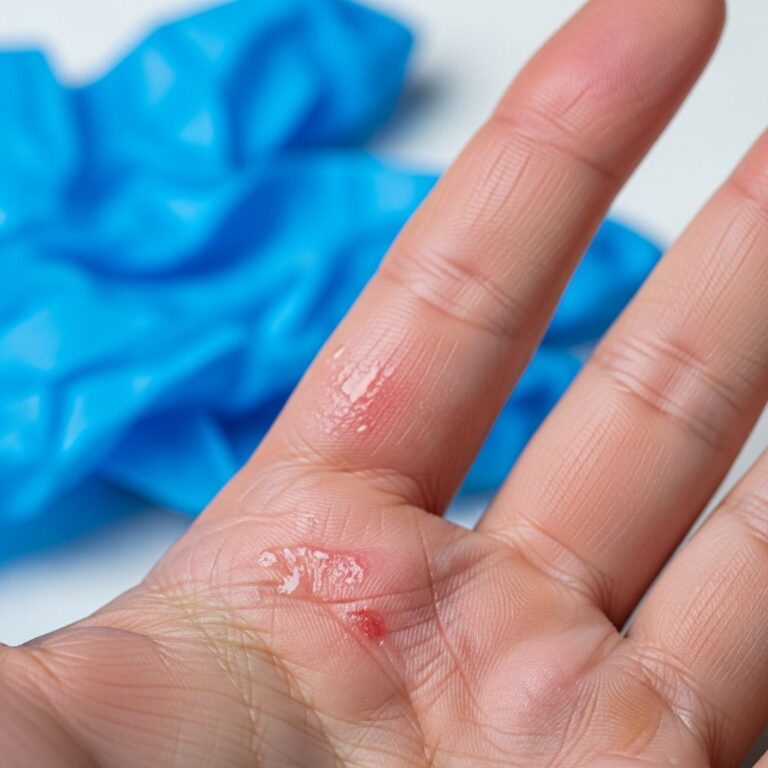
Condyloma acuminatum presents as soft, flesh-coloured papules or plaques with a verrucous, cauliflower-like surface. Lesions typically measure a few millimetres but can coalesce into larger aggregates spanning several centimetres. Common sites include the penile shaft, glans, vulva, perineum, perianal region, and less frequently, oral mucosa. Appearance varies from filiform projections to sessile plaques. Symptoms are often absent, though pruritus, irritation, or bleeding may occur with friction or trauma. In pregnancy, lesions may enlarge significantly, potentially obstructing delivery.
- Flesh-coloured or hyperpigmented papules/plaques
- Verrucous or cauliflower-like surface
- Moist mucosal surfaces (e.g., coronal sulcus, fourchette)
- Dry keratinized skin (e.g., penile shaft)
- Linear configuration along scratches (Koebner phenomenon)
Immunocompromised individuals, including those with HIV, exhibit more extensive, refractory lesions with higher recurrence rates.
Pathology
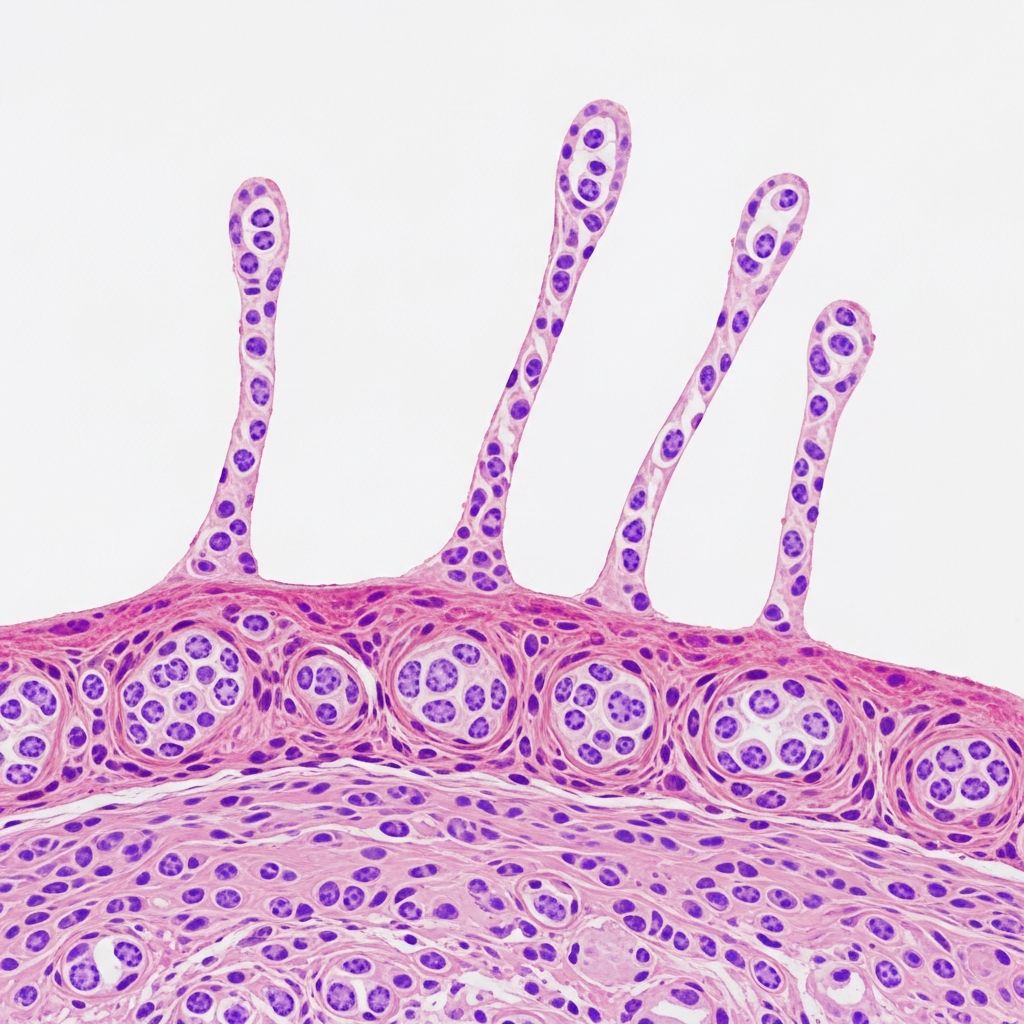
Microscopic examination reveals characteristic features confirming HPV-induced changes. The hallmark is acanthotic squamous epithelium arranged in papillary or verrucous architecture with elongated rete ridges forming finger-like projections.
Low power
At scanning magnification, condyloma acuminatum displays exophytic growth with marked papillomatosis. Dermal papillae are elongated and thickened, covered by hyperplastic stratified squamous epithelium. The silhouette resembles a church spire or cauliflower floret. Parakeratosis and hyperkeratosis are prominent on the surface.
High power
Epithelial cells exhibit koilocytosis: perinuclear halos surrounding hyperchromatic, irregular nuclei, often with binucleation. These HPV-infected cells have abundant eosinophilic cytoplasm and raisinoid nuclei. Mitotic figures may appear in the lower epithelium, but dysplasia is absent in pure condyloma.
- Papillomatosis: Upward elongation of dermal papillae
- Acanthosis: Thickened spinous layer
- Koilocytosis: Perinuclear clearing, nuclear atypia
- Parakeratosis/hyperkeratosis: Retained nuclei in stratum corneum
- Angiomatoid stroma: Dilated capillaries in papillae
Immunohistochemistry shows diffuse p16 negativity (distinguishing from high-risk HPV lesions) and positive HPV in situ hybridization for types 6/11.
Histopathology images
Scanning view demonstrates papillary architecture with koilocyte-filled epithelium (Figure 1). High-power image highlights perinuclear halos and binucleate cells (Figure 2). These features are diagnostic.
Differential diagnosis
Accurate differentiation relies on clinical-pathologic correlation. Key mimics include:
| Entity | Key Distinguishing Features |
|---|---|
| Seborrhoeic keratosis | Stuck-on appearance, basaloid cells, pseudohorn cysts; older patients |
| Squamous cell carcinoma | Full-thickness atypia, invasion, keratin pearls; high-risk HPV+ |
| Bowenoid papulosis | High-risk HPV (16/18), pagetoid spread, p16 diffuse+ |
| Molluscum contagiosum | Henderson-Patterson bodies, intracytoplasmic inclusions |
| Vulval intraepithelial neoplasia | Surface maturation, high-risk HPV markers |
Biopsy is essential for atypical, pigmented, or ulcerated lesions.
Diagnosis
Clinical diagnosis suffices for classic presentations. Confirmatory biopsy is indicated for diagnostic uncertainty, treatment failure, pigmentation, induration, ulceration, or immunocompromise. Colposcopy/aceto-whitening reveals subclinical lesions. HPV typing via PCR distinguishes low- vs high-risk strains.
Treatment
No therapy eradicates latent HPV; treatments target visible lesions. Patient-applied options include podophyllotoxin (0.5% solution/0.15% gel) and imiquimod 5% cream. Provider-administered therapies encompass cryotherapy (liquid nitrogen), trichloroacetic acid 80-90%, surgical excision, electrocautery, and CO2 laser ablation.
- Patient-applied: Podophyllotoxin (bid x3d/wk x4wk), Imiquimod (3x/wk x16wk)
- Provider-applied: Cryotherapy (q1-2wk), TCA (q1-2wk)
- Ablative: Curettage/electrodesiccation, laser, excision
HPV vaccination (Gardasil 9) prevents new infections but not active disease.
Related Stories



Prognosis and complications
Spontaneous regression occurs in one-third of immunocompetent patients within 12 months. Recurrence rates range 20-50% due to viral latency. Rare malignant transformation (<1%) reported in immunocompromised hosts.
Complications include autoinoculation, psychosexual distress, and pregnancy-related enlargement.
Frequently asked questions
What causes condyloma acuminatum?
Low-risk HPV types 6 and 11 via skin-to-skin contact, primarily sexual transmission.
Is condyloma acuminatum cancerous?
No, it is benign. Malignant transformation is exceedingly rare.
Do genital warts resolve spontaneously?
Yes, up to 30% regress without treatment, especially in young patients.
How is HPV transmission prevented?
Consistent condom use, HPV vaccination, partner screening.
Does treatment cure HPV infection?
No, it removes warts but virus persists latently; recurrence common.
Related topics
- Anogenital warts
- Sexually acquired human papillomavirus
- Vulval intraepithelial neoplasia
- Penile epithelial neoplasia
References
- Your pathology report for condyloma acuminatum — MyPathologyReport.ca / Jason Wasserman MD PhD FRCPC. 2024-11-14. https://www.mypathologyreport.ca/diagnosis-library/condyloma-acuminatum/
- Sexually acquired human papillomavirus — DermNet NZ. Accessed 2026. https://dermnetnz.org/topics/sexually-acquired-human-papillomavirus
- Condylomata Acuminata (Genital Warts) — StatPearls / NCBI Bookshelf. 2023. https://www.ncbi.nlm.nih.gov/books/NBK441884/
- Anogenital warts, human papillomavirus — DermNet NZ. Accessed 2026. https://dermnetnz.org/topics/anogenital-warts
- HPV external genital warts – clinical presentation, diagnosis and treatment — Sexual Health Guidelines NZ. Accessed 2026. https://guidelines.stief.org.nz/hpv-external-genital-warts-clinical-presentation-diagnosis
Similar Articles








Read full bio of medha deb