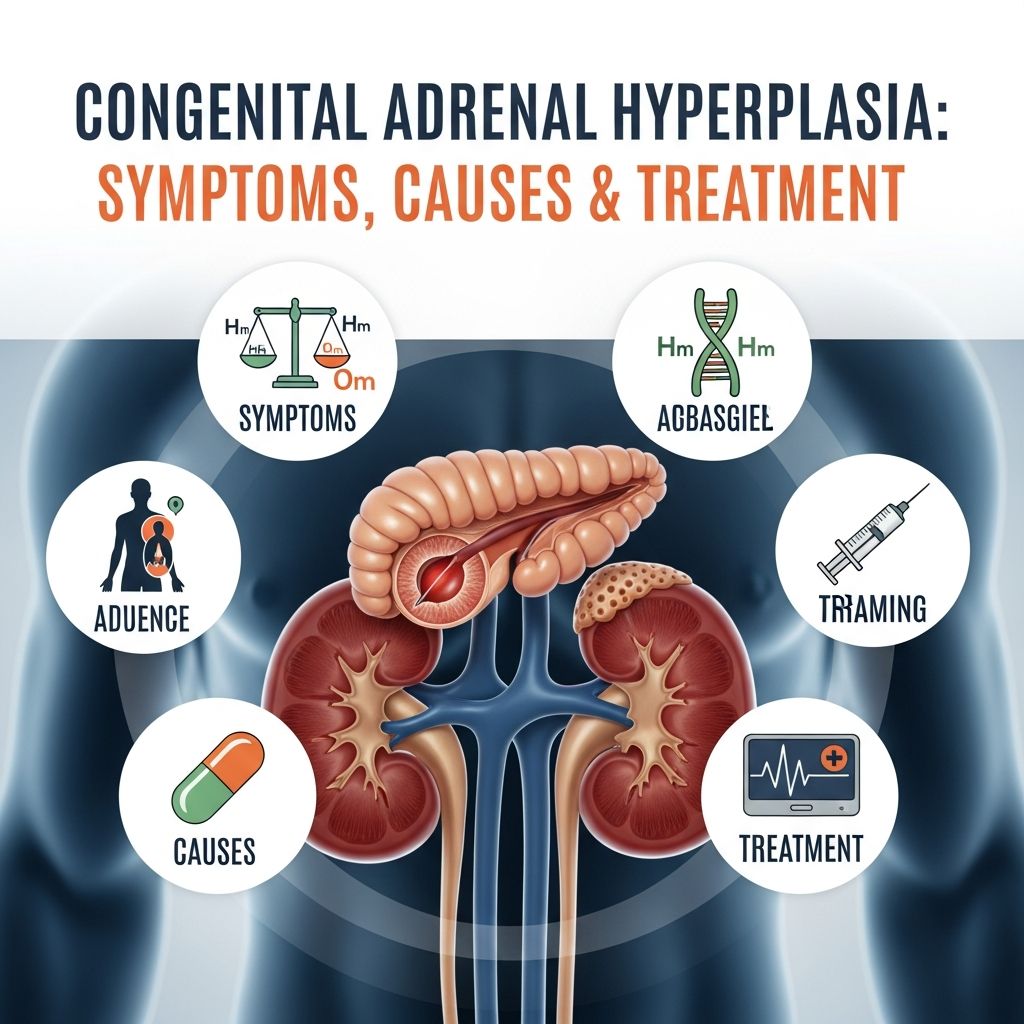
Congenital Adrenal Hyperplasia: Symptoms, Causes & Treatment
Comprehensive guide to understanding CAH: genetic condition affecting hormone balance and adrenal function.
Congenital Adrenal Hyperplasia: A Comprehensive Overview
Congenital adrenal hyperplasia (CAH) is a group of genetic conditions that affect the adrenal glands, which are small glands located on top of the kidneys. These glands are responsible for producing several important hormones that regulate blood pressure, blood sugar, and the body’s response to stress. When a person has CAH, the adrenal glands lack one or more enzymes needed to produce these hormones properly, leading to a hormonal imbalance that can have significant health implications. Understanding this condition is essential for patients, families, and healthcare providers to ensure proper diagnosis and management.
What Causes Congenital Adrenal Hyperplasia?
CAH is caused by mutations in genes that control the production of enzymes in the adrenal glands. This condition is inherited in an autosomal recessive pattern, meaning a person must inherit the mutated gene from both parents to develop CAH. The most common form of CAH, accounting for approximately 90 percent of cases, is caused by a deficiency of the enzyme 21-hydroxylase. When this enzyme is deficient or absent, the adrenal glands cannot produce adequate amounts of cortisol and aldosterone, while simultaneously producing excess androgens (male hormones). This hormonal imbalance is the root cause of the various symptoms associated with CAH.
Types of Congenital Adrenal Hyperplasia
CAH exists in two main forms, each with distinct characteristics and severity levels:
Classic CAH
Classic CAH is the more severe form and is typically detected at birth or during early infancy. This form is further subdivided into two categories based on the severity of enzyme deficiency and clinical presentation. Classic CAH can lead to significant health complications if not diagnosed and treated promptly.
Nonclassic CAH
Nonclassic CAH is a milder form of the condition that may not become apparent until childhood, adolescence, or even adulthood. Individuals with nonclassic CAH typically do not experience life-threatening salt-wasting crises, but they may still have hormonal imbalances that require management and monitoring.
Symptoms of Classic CAH
The symptoms of classic CAH vary depending on the specific enzyme deficiency and the severity of the condition. In newborns and infants, the presentation can be acute and potentially life-threatening. Key symptoms include:
In Newborns and Infants
Infants with classic salt-wasting CAH typically develop symptoms within the first two to three weeks of life. These early warning signs require immediate medical attention:
– Poor feeding or vomiting- Diarrhea and severe dehydration- Weight loss or failure to gain weight normally- Lethargy or excessive sleeping- Irritability and difficulty settling- Abnormal heart rate- In females, ambiguous or male-like genitalia at birth- In males, normal male genitalia at birth but possible hyperpigmentation
Adrenal Crisis
One of the most serious complications of classic CAH is an adrenal crisis, which occurs when the body lacks sufficient cortisol and aldosterone. This life-threatening condition can develop rapidly and requires emergency medical intervention. Symptoms of an adrenal crisis include severe dehydration, extremely low blood pressure, low blood sugar levels, confusion, seizures, shock, and potentially coma.
Growth and Development Issues
Children with classic CAH often experience accelerated growth during childhood, with bones that are more mature than expected for their age. However, despite this early rapid growth, their final adult height is typically shorter than average. This growth pattern is a distinctive characteristic of the condition and requires monitoring by healthcare providers.
Related Stories



Reproductive and Sexual Development
Due to excess androgens, classic CAH affects sexual development and reproductive function. Females with classic CAH may have irregular or absent menstrual periods and fertility challenges. Some women struggle to conceive naturally. Males may also experience fertility issues. Additionally, females may develop features such as facial hair, increased body hair, and a deeper voice due to androgen excess.
Symptoms of Nonclassic CAH
Nonclassic CAH presents with milder symptoms that typically emerge later in childhood or during adolescence. These symptoms include:
– Early puberty symptoms, such as premature growth of pubic or underarm hair- Serious acne and oily skin- Rapid growth during adolescence despite eventual short stature- Excessive facial and body hair in females- Male pattern baldness in females- Irregular or absent menstrual periods- Fertility problems in both males and females- Behavioral changes or mood swings
It is important to note that nonclassic CAH does not typically cause salt-wasting crisis or the acute life-threatening complications seen in classic CAH. However, the hormonal imbalances can still significantly impact quality of life and require medical management.
Diagnosis of Congenital Adrenal Hyperplasia
Early detection of CAH is crucial for preventing serious complications and ensuring proper treatment. Several diagnostic approaches are employed depending on when the condition is suspected.
Newborn Screening
All infants born in the United States are screened for congenital adrenal hyperplasia through a routine blood test. This screening is typically performed within the first few days of life using a small blood sample from the baby’s heel. Newborn screening has dramatically improved outcomes for infants with CAH by enabling early diagnosis and treatment before symptoms become severe. In females with classic CAH, diagnosis may also be made based on observation of atypical or ambiguous genitalia at birth.
Blood Tests and Hormonal Evaluation
If CAH is suspected, physicians order blood tests to measure hormone levels, including cortisol, aldosterone, and androgens, as well as their chemical precursors such as 17-hydroxyprogesterone (17-OHP). A very high concentration of 17-OHP is diagnostic of the most common form of CAH. Blood tests also measure sodium and potassium levels, which can be abnormal in salt-wasting forms of the condition. Additionally, renin levels are measured, as this enzyme signals the adrenal glands to produce aldosterone.
ACTH Stimulation Test
The corticotropin stimulation test, also known as the ACTH stimulation test, is considered the gold standard for hormonal diagnosis of CAH. In this test, a synthetic form of adrenocorticotropic hormone (ACTH) is administered intravenously, and blood samples are collected at baseline and sixty minutes after injection. The test measures the response of 17-OHP and other adrenal hormones to this stimulation. The results are plotted on published nomograms to determine disease severity and classify the type of CAH.
Imaging Studies
Healthcare providers may order imaging studies to visualize the adrenal glands and reproductive structures. Ultrasound imaging may be used in newborns to examine internal reproductive anatomy. X-rays can reveal advanced bone maturation typical of CAH. Computed tomography (CT) scans can identify adrenal gland abnormalities and size increases.
Genetic Testing
Genetic analysis can confirm the diagnosis of CAH by identifying specific gene mutations responsible for the condition. This testing helps determine whether a patient has the classic or nonclassic form of CAH and can provide information about disease severity.
Treatment and Management
Treatment of congenital adrenal hyperplasia focuses on replacing the deficient hormones and preventing complications. The specific treatment approach depends on the type and severity of CAH.
Hormone Replacement Therapy
The primary treatment for CAH involves taking synthetic glucocorticoids, typically in the form of prednisone or hydrocortisone, to replace the cortisol that the adrenal glands cannot produce. Patients with salt-wasting CAH also require mineralocorticoid replacement, usually fludrocortisone, to help maintain proper sodium and potassium balance. The dosage of these medications is carefully adjusted based on hormone levels and clinical response.
Emergency Treatment for Adrenal Crisis
Individuals with classic CAH must understand how to recognize and respond to an adrenal crisis. During times of physical stress, such as illness, fever, or surgery, cortisol requirements increase significantly. Patients and their families should be educated about increasing medication doses during such events and seeking immediate medical care if symptoms of crisis develop.
Monitoring and Follow-Up Care
Patients with CAH require regular follow-up appointments with an endocrinologist to monitor hormone levels, adjust medication doses, and assess growth and development. Blood tests are performed periodically to ensure that hormone levels remain within target ranges. This ongoing management helps prevent both the complications of undertreated CAH and the side effects of excessive hormone replacement.
Living with Congenital Adrenal Hyperplasia
Many individuals with CAH lead normal, healthy lives with proper diagnosis and management. Advances in newborn screening and treatment have significantly improved outcomes for people with this condition. However, CAH does require lifelong medication management and regular medical monitoring. Patients should work closely with their healthcare team to optimize their treatment plan and address any concerns related to growth, development, fertility, or quality of life.
Frequently Asked Questions About CAH
Q: Can congenital adrenal hyperplasia be cured?
A: CAH cannot be cured, as it is a genetic condition. However, with appropriate hormone replacement therapy and medical management, individuals with CAH can live healthy, normal lives with few complications.
Q: Is CAH life-threatening?
A: Classic CAH can be life-threatening if not diagnosed and treated promptly, particularly the salt-wasting form. However, with early detection through newborn screening and appropriate treatment, the prognosis is excellent. Nonclassic CAH is generally not life-threatening.
Q: Can people with CAH have children?
A: Many people with CAH can have children, although fertility may be affected. Women with CAH may experience irregular menstrual cycles and reduced fertility, while men may also face fertility challenges. Genetic counseling is recommended for couples where one or both partners have CAH.
Q: How often do people with CAH need to see a doctor?
A: The frequency of medical visits depends on the severity of CAH and how well the condition is controlled. Newly diagnosed infants and children typically require more frequent monitoring, while stable adult patients may require visits one to four times yearly. During times of illness or stress, additional medical consultation may be necessary.
Q: What should I do if I think my child has CAH symptoms?
A: If you notice signs of CAH in your child, such as poor feeding, vomiting, dehydration, or unexpected genital appearance in newborns, contact your pediatrician immediately. Early diagnosis is critical for preventing serious complications.
References
- Congenital Adrenal Hyperplasia: Symptoms and Causes — Mayo Clinic. 2024-05-18. https://www.mayoclinic.org/diseases-conditions/congenital-adrenal-hyperplasia/symptoms-causes/syc-20355205
- Congenital Adrenal Hyperplasia — Children’s Hospital of Philadelphia. 2024. https://www.chop.edu/conditions-diseases/congenital-adrenal-hyperplasia
- Congenital Adrenal Hyperplasia: Diagnosis and Emergency Treatment — National Center for Biotechnology Information (NCBI). 2024-03-10. https://www.ncbi.nlm.nih.gov/books/NBK279085/
- Congenital Adrenal Hyperplasia: Symptoms, Diagnosis, Treatment — Barrow Neurological Institute. 2024. https://www.barrowneuro.org/condition/congenital-adrenal-hyperplasia/
- Diagnosing Congenital Adrenal Hyperplasia — NYU Langone Health. 2024-06-15. https://nyulangone.org/conditions/congenital-adrenal-hyperplasia/diagnosis
- Congenital Adrenal Hyperplasia Information — Mount Sinai. 2024-04-22. https://www.mountsinai.org/health-library/diseases-conditions/congenital-adrenal-hyperplasia
- Congenital Adrenal Hyperplasia – Newborn Screening — U.S. Health Resources and Services Administration (HRSA). 2024-07-10. https://newbornscreening.hrsa.gov/conditions/congenital-adrenal-hyperplasia
Similar Articles








Read full bio of Sneha Tete