Congenital Cartilaginous Rests of the Neck
Rare benign neck anomaly from branchial arch remnants: presentation, diagnosis, and management insights.
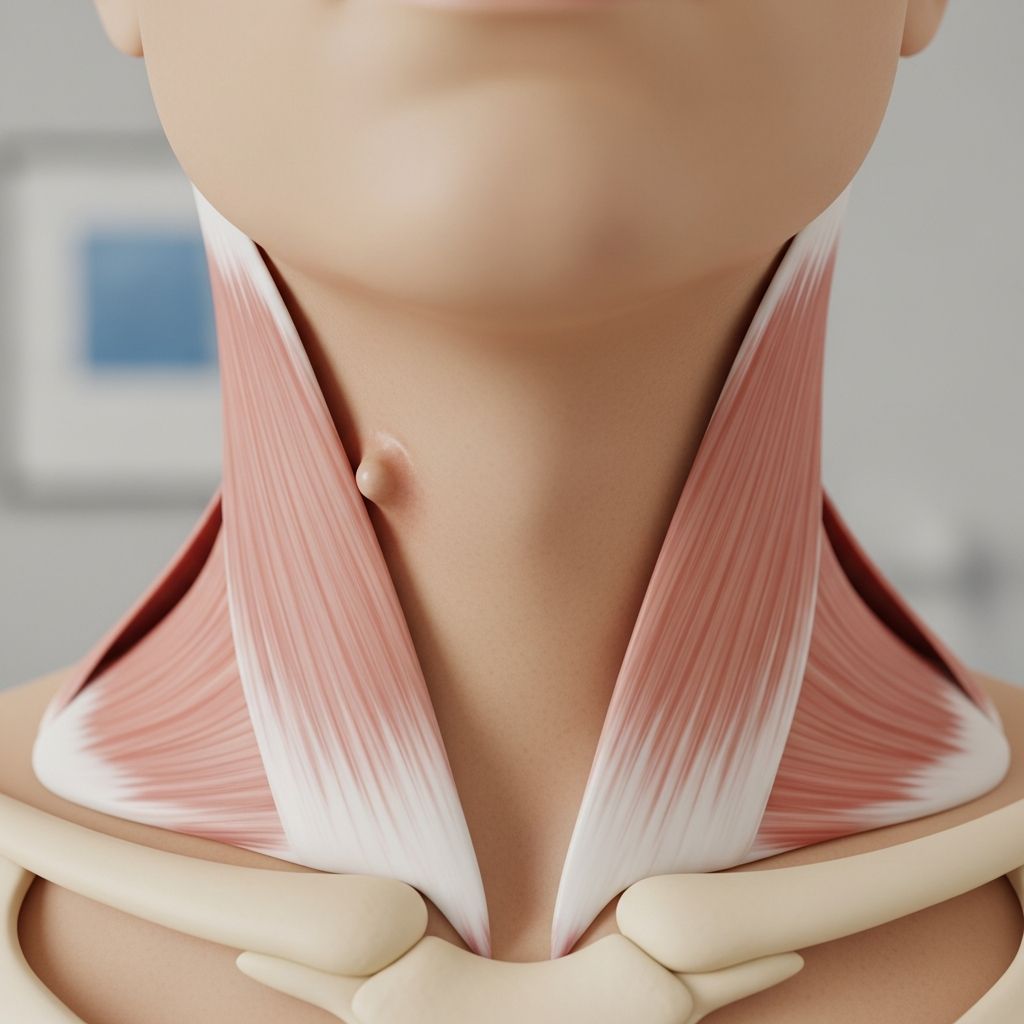
Congenital cartilaginous rests of the neck (**CCRN**), also known as cervical auricles, wattles, or persistent branchial cartilage, represent a rare benign developmental anomaly of the skin and subcutaneous tissue. These lesions manifest as firm, skin-coloured papules or nodules present at birth, typically located along the anterior border of the sternocleidomastoid muscle in the lower third of the neck. CCRN arises from incomplete fusion of the first and second branchial arches during embryonic development, making it a cervical variant of accessory tragus. Although asymptomatic and non-progressive, recognition is essential to differentiate from other neck masses and rule out syndromic associations.
What is Congenital Cartilaginous Rest of the Neck?
**Congenital cartilaginous rest of the neck (CCRN)** is a minor congenital cutaneous condition characterised by remnants of branchial arch-derived cartilage embedded in the skin. It is considered an ectopic auricular hillock that fails to migrate properly during the 5th-6th week of embryogenesis. Normally, six mesenchymal hillocks from the first (mandibular) and second (hyoid) branchial arches fuse to form the auricle, which ascends from the neck to its final position. In CCRN, these hillocks persist as cartilaginous nodules in the cervical region rather than incorporating into the ear.
The condition is exceedingly rare, with isolated case reports documenting unilateral or bilateral presentations. Prevalence is unknown but estimated lower than accessory tragus, which occurs in 1-2 per 1000 births. No racial or sex predilection is reported, and lesions do not enlarge postnatally or undergo malignant transformation. While most cases are sporadic, thorough evaluation for associated anomalies or syndromes is recommended.
Who gets Congenital Cartilaginous Rest of the Neck?
CCRN affects neonates and is diagnosed at birth or shortly thereafter. It occurs in otherwise healthy infants with unremarkable prenatal histories. Bilateral cases, as in a reported 5-year-old boy with symmetrical 4-10 mm pedunculated papules, are exceptionally rare, with only one prior literature case noted. No familial patterns or genetic associations have been established, though branchial apparatus anomalies can cluster in syndromes like Goldenhar or Treacher Collins—none directly linked to isolated CCRN.
- Primarily diagnosed in
neonates
(present since birth) - No sex or ethnic predisposition
- Rarely bilateral (fewer than 5 reported cases)
- Isolated finding in healthy children
Clinical Features
Lesions appear as asymptomatic,
skin-coloured
, firm subcutaneous papules or soft pedunculated nodules measuring 4-10 mm in diameter. They are located on the lower anterior neck, overlying or just anterior to the sternocleidomastoid muscle, without overlying hypertrichosis or discharge. Consistency is hard due to central cartilage, and mobility is fixed to underlying tissue; crucially, no movement occurs with tongue protrusion or swallowing, distinguishing from midline cysts.Skin surface is smooth, non-tender, and non-inflamed, with no regional lymphadenopathy or deep extension in most cases. Bilateral symmetrical nodules, as seen intraoperatively in infants, confirm chondrocutaneous nature. Systemic examination is normal, and growth does not occur with age.
| Feature | Description |
|---|---|
| Location | Anterior border sternocleidomastoid, lower neck |
| Size | 4-10 mm |
| Appearance | Skin-coloured, firm papule/nodule |
| Symptoms | Asymptomatic |
| Bilateral | Rare (<5 cases) |
Diagnosis
Diagnosis is primarily
clinical
, based on characteristic location, firm consistency, and congenital onset. Imaging supports but is not always required for superficial lesions.Ultrasonography
reveals hypoechoic subcutaneous areas without deep sinus tracts.CT scan
shows ill-defined, hyper- to isodense, mildly enhancing lesions anterior to sternocleidomastoid.**Histopathology** is confirmatory: elastic cartilage core surrounded by vellus hair follicles, collagen, eccrine glands, adipose tissue, and pilosebaceous units. No inflammation or atypia is seen. Biopsy is reserved for atypical or excised lesions.
Differential Diagnosis
Key differentials include midline and lateral neck masses.
Related Stories



- Thyroglossal duct cyst: Midline, moves with swallowing/tongue protrusion
- Hair follicle naevus: Solitary skin-coloured papule ± hypertrichosis
- Fibroepithelial polyp: Soft, fleshy, pedunculated
- Branchial cleft cyst: Cystic, may have sinus/fistula, upper chest/lower face
- Accessory tragus: Preauricular, softer
Systemic exam rules out syndromic branchial anomalies.
Investigations
- **Clinical exam**: Fixed nodule, no tongue movement
- **Ultrasound**: Hypoechoic subcutaneous mass, no tracts
- **CT/MRI**: Extent and deep involvement
- **Histopathology**: Cartilage + adnexa
Management
Benign and non-progressive,
observation
is appropriate for asymptomatic cases. Parents should be counselled on cosmetic concerns and low excision risk.Surgical excision
(complete, including cartilage) orlaser ablation
for pedunculated lesions. No recurrence reported post-excision.Complications
None inherent; rare infection if traumatised. No malignancy risk. Cosmetic disfigurement minimal but may prompt removal.
Prevention
Not preventable as congenital.
Prognosis
Excellent; lesions stable lifelong, no functional impact.
Main Differential Diagnoses Table
| Diagnosis | Location | Movement | Consistency | Other |
|---|---|---|---|---|
| CCRN | Lateral neck | No | Firm (cartilage) | Skin-coloured papule |
| Thyroglossal cyst | Midline | Yes (tongue) | Cystic | Swells if infected |
| Branchial cyst | Anterior neck | No | Cystic | Sinus possible |
| Polyp | Any | Pedunculated | Soft | Fleshy |
Frequently Asked Questions
Is CCRN cancerous?
No, CCRN is entirely benign with no malignant potential.
Does it grow with age?
No, lesions remain stable size postnatally.
Can it be bilateral?
Yes, though extremely rare; fewer than 5 cases reported.
Is treatment always needed?
No, conservative management is standard; excise for cosmesis.
What causes CCRN?
Failed fusion of branchial arch hillocks during embryogenesis.
References
- Bilateral congenital cartilaginous rest of the neck: A rare presentation of accessory tragus — Indian Journal of Dermatology, Venereology and Leprology. 2015. https://ijdvl.com/bilateral-congenital-cartilaginous-rest-of-the-neck-a-rare-presentation-of-accessory-tragus/
- Cutaneous cartilaginous rest — VisualDx (VisualDx diagnosis page). 2017-10-22. https://www.visualdx.com/visualdx/diagnosis/cutaneous+cartilaginous+rest?diagnosisId=53441&moduleId=24
- Congenital cartilaginous rest of the neck — Wikipedia (informed by primary sources). N/A. https://en.wikipedia.org/wiki/Congenital_cartilaginous_rest_of_the_neck
- Congenital cartilaginous rest of the neck — Dermatology Online Journal (UC Davis eScholarship). N/A. https://escholarship.org/content/qt43b4k7j6/qt43b4k7j6.pdf
- Unilateral Congenital Cartilaginous Rests of the Neck: A Case — PMC / NCBI. N/A. https://pmc.ncbi.nlm.nih.gov/articles/PMC12301167/
Similar Articles








Read full bio of medha deb