Congenital Melanocytic Naevus Pathology: Essential Guide
Comprehensive pathology of congenital melanocytic naevi: from clinical features to histological diagnosis and melanoma risk management.
Author: Dr Ian H. McColl, Dermatopathologist, Pathlab Bay of Plenty, Tauranga, New Zealand.
Introduction
Congenital melanocytic naevus (CMN) represents a benign proliferation of melanocytes present at birth, characterized by distinct pathological features that evolve over time. These lesions vary widely in size, from small macules to giant plaques covering extensive body surface areas, and carry risks of malignant transformation and neurological complications such as neurocutaneous melanosis (NCM). Understanding their pathology is crucial for accurate diagnosis, risk stratification, and management.
CMN arises from postzygotic somatic mutations, primarily in the NRAS gene, leading to clonal expansion of melanocyte precursors during embryogenesis. This results in ectopic collections of nevus cells in the skin, potentially extending to extracutaneous sites like the leptomeninges. The pathological examination reveals architectural patterns, cytological features, and genetic markers that differentiate CMN from acquired nevi and malignant melanoma.
Clinical features
CMN manifests at birth as tan, brown, or black macules or plaques, often with irregular borders and satellite lesions. Small CMN (<1.5 cm) are common, while medium (1.5–20 cm) and giant (>20 cm projected adult size) variants pose higher risks for complications. Surface changes include hypertrichosis, verrucous texture, and nodularity due to neurotization.
- Size classification: Small (<1.5 cm), medium (1.5–20 cm), giant (>20 cm adult size).
- Distribution: Trunk (most common, ‘bathing trunk’ pattern), head/neck, extremities.
- Satellite lesions: Multiple smaller CMN, increasing NCM risk if >20.
Over time, lesions expand proportionally with growth, developing speckled pigmentation, hairiness, and cobblestoning. Symptoms prompting evaluation include ulceration, bleeding, rapid growth, or neurological signs like seizures.
Pathology
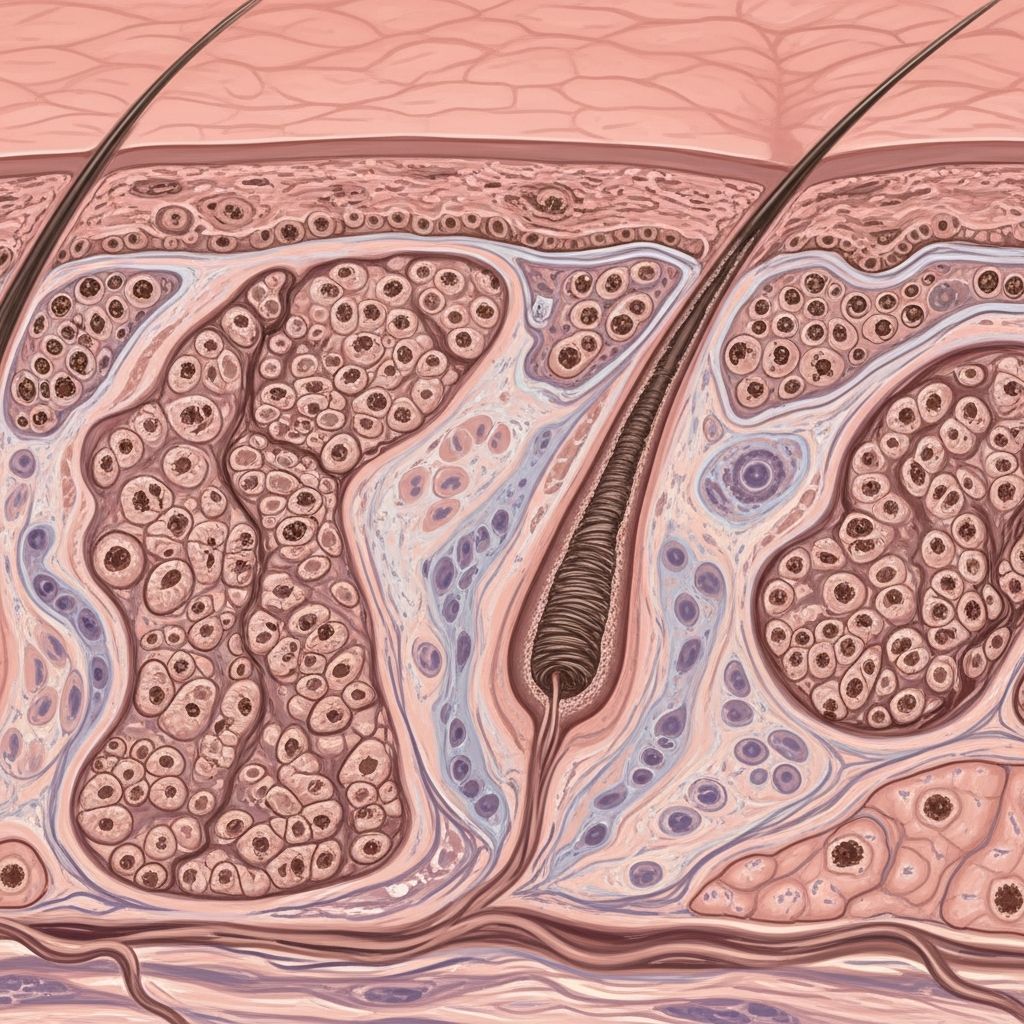
Histologically, CMN features nests and sheets of nevus cells extending from the epidermis through the dermis to subcutaneous tissue, often with adnexal involvement. Key pathological hallmarks include:
- Epidermal involvement: Lentiginous hyperplasia or junctional nests of uniform melanocytes.
- Dermal component: Type A (large epithelioid), Type B (small lymphocyte-like), Type C (spindled, neuroid) nevocytes; maturation with depth.
- Neurotization: Wagner-Meissner-like bodies, neurofibroma-like areas in older lesions.
- Architectural patterns: Splaying between collagen bundles, perivascular/periadnexal extension, rarely balloon cell change.
Melanophages and fibrosis are common in superficial dermis. Giant CMN show deeper infiltration and higher cellularity. Genetic analysis reveals NRAS mutations in >80% of cases, aiding diagnosis.
| Feature | Small/Medium CMN | Giant CMN |
|---|---|---|
| Depth of involvement | Superficial dermis | Subcutis, fascia, muscle |
| Nevus cell types | Mostly Type A/B | Predominantly Type C (neuroid) |
| Mitotic activity | Low (<1/mm²) | May be higher, but lacks atypia |
| Satellite lesions | Few/none | Numerous |
Histology of congenital melanocytic naevus
Microscopic examination shows melanocytic proliferation at the dermoepidermal junction with downward migration. Superficially, epithelioid cells predominate; deeper, cells become smaller, spindled, and less pigmented, demonstrating maturation—a reassuring feature against malignancy.
Common findings:
Related Stories



- Junctional nests bridging rete ridges.
- Dermal expansile sheets dissecting collagen.
- Adnexocentric growth around follicles and vessels.
- Scar-like fibrosis in regressed areas.
Immunohistochemistry: HMB-45 positivity decreases with depth; S100, Melan-A diffuse. Ki-67 proliferation index is low (<5%).
Symplastic (ancient) congenital melanocytic naevus
Symplastic CMN displays bizarre, multinucleated cells with nuclear pleomorphism, hyperchromasia, and rare mitoses, mimicking melanoma. However, symmetry, lack of necrosis, and low Ki-67 distinguish it as benign. This degenerative change occurs in longstanding lesions.
Complications
Melanoma
Malignant transformation risk is size-dependent: ~0% for small, 0–2.5% lifetime for giant CMN. Melanoma may arise in situ, dermally, satellites, or extracutaneously (NCM-related). Nodular growth, ulceration, or color change signals concern.
Neurocutaneous melanosis
NCM involves leptomeningeal melanocytosis, affecting 5–15% of giant CMN cases, symptomatic in half (hydrocephalus, seizures). MRI screening recommended for posterior axial giant CMN or >20 satellites.
Management
Multidisciplinary approach: dermatology, neurology, plastic surgery, oncology. Strategies include:
- Surveillance: Annual exams, photography, dermoscopy for changes.
- Imaging: Brain/spine MRI at diagnosis for high-risk features.
- Surgery: Staged excision for giant CMN, tissue expansion; curettage for small lesions.
- Laser: Q-switched for pigmentation, CO2 for texture (limited efficacy).
Patient education on self-monitoring and sunscreen use is essential.
Differential diagnosis
- Acquired melanocytic naevus: Absent at birth, uniform, no satellites.
- Spitz naevus: Symmetrical, Kamino bodies, younger patients.
- Blue naevus: Dermal dendritic melanocytes, no junctional component.
- Becker naevus: Hypertrichotic, smooth muscle hamartoma.
- Malignant melanoma: Atypia, mitoses, necrosis, asymmetry.
Investigations
Diagnosis is clinical/histological; biopsy for atypical features. High-risk: MRI brain/spine with gadolinium. Genetic testing (NRAS) confirmatory in ambiguous cases.
Frequently Asked Questions
What is a congenital melanocytic naevus?
A benign melanocytic proliferation present at birth, ranging from small moles to giant plaques with potential complications.
What is the melanoma risk in CMN?
Low overall (<1%), higher in giant CMN (up to 5% lifetime); monitor for changes.
Does every giant CMN need MRI?
Recommended for trunk/head lesions or >20 satellites to screen for NCM.
Can CMN be removed completely?
Small yes; giant often requires staged surgery due to size.
Are satellite lesions dangerous?
They increase NCM risk; >20 warrants neuroimaging.
References
- Congenital Melanocytic Naevus: Features & Management — The Plastics Fella. 2023. https://www.theplasticsfella.com/congenital-melanocytic-naevus/
- Congenital Melanocytic Nevi (CMN) — Nationwide Children’s Hospital. 2024-01-15. https://www.nationwidechildrens.org/conditions/congenital-melanocytic-nevi
- Giant Congenital Melanocytic Nevus — National Organization for Rare Disorders (NORD). 2023-05-10. https://rarediseases.org/rare-diseases/giant-congenital-melanocytic-nevus/
- Congenital melanocytic neoplasms: clinical, histopathological and genetic review — PMC (NCBI). 2023-11-20. https://pmc.ncbi.nlm.nih.gov/articles/PMC11782411/
- Congenital Melanocytic Nevi — StatPearls (NCBI Bookshelf). 2024-07-01. https://www.ncbi.nlm.nih.gov/books/NBK563168/
Similar Articles








Read full bio of Sneha Tete