Connective Tissue Naevi: Diagnosis, Types, Treatment Guide
Uncommon dermal hamartomas from abnormal collagen, elastin, or proteoglycans; often linked to genetic defects and syndromes.
A
connective tissue naevus
(American spelling nevus) is an uncommon skin lesion that occurs when the deeper layers of the skin do not develop correctly or the components of these layers occur in the wrong proportion. These hamartomatous proliferations primarily affect the dermis, involving abnormal amounts of its key structural elements:collagen
,elastin
, andproteoglycans
(glycosaminoglycans). Lesions may manifest as solitary nodules, plaques, or multiple eruptions, appearing at birth, during childhood, adolescence, or even adulthood. While many are benign and asymptomatic, some associate with inherited syndromes or systemic diseases, necessitating thorough evaluation.What are the clinical features of connective tissue naevi?
Connective tissue naevi present variably depending on the predominant dermal component. They are typically firm, skin-coloured to yellowish papules, nodules, or plaques with distinct textures such as peau d’orange (orange-peel) appearance, wrinkling, or induration. Common sites include the trunk (back, abdomen, buttocks), limbs, and occasionally the face or neck. Solitary lesions are often incidental findings, while multiple lesions raise suspicion for syndromic associations. Age of onset spans from congenital to late adulthood, with males comprising about 52% of reported cases.
- Solitary lesions: Single, well-defined nodules or plaques, often stable over time.
- Multiple lesions: Grouped or disseminated, frequently symmetric on the trunk.
- Textural changes: Rough, thickened, or dimpled surfaces mimicking cellulite or scar tissue.
Types of connective tissue naevi
Classification hinges on the excess extracellular matrix component: collagen (collagenomas), elastin (elastomas), glycosaminoglycans (mucinous naevi), smooth muscle (hamartomas), or adipose tissue (lipomatous naevi). Each subtype has unique histological and clinical hallmarks.
Collagenomas
**Collagenomas** arise from excessive, tightly packed collagen bundles in the dermis, resulting in firm, dome-shaped nodules. They may be isolated or familial.
- Eruptive collagenoma: Multiple small, firm papules erupting suddenly on the trunk or limbs in young adults; no systemic links.
- Familial cutaneous collagenoma: Autosomal dominant; lesions emerge in adolescence as multiple hard nodules over the upper back, sometimes linked to cardiac fibrosis or elastosis perforans.
- Shagreen patch: Pathognomonic for
tuberous sclerosis complex
(TSC), a genetic disorder from TSC1/TSC2 mutations. These large, leathery, orange-peel-textured plaques favour the lower back or sacral region, present from early childhood.
Elastomas (elastin naevi)
**Elastomas** feature clumped, abnormal elastic fibres, imparting a yellowish, wrinkled appearance.
- Nuchal elastoma: Solitary plaque on the nape of the neck in middle-aged women.
- Buschke-Ollendorff syndrome: Rare autosomal dominant disorder with dermal elastomas (firm, yellowish nodules or plaques on trunk/extremities) plus
osteopoikilosis
(spotty bone sclerosis on X-ray). Lesions often congenital or infantile; additional features include scoliosis, eye anomalies. - Elastosis perforans serpiginosa (EPS): Perforating disorder where altered elastic fibres traverse the epidermis, forming annular or serpiginous arrays of scaly papules on neck, arms, or face. Onset in adolescence; associates with
Marfan syndrome
,Ehlers-Danlos syndrome
,osteogenesis imperfecta
,pseudoxanthoma elasticum (PXE)
, orDown syndrome
.
Smooth muscle hamartomas
**Congenital smooth muscle hamartoma** appears as a single, hyperpigmented or skin-coloured plaque at birth, often with hypertrichosis (excess hair). It elicits transient piloerection (goosebumps) or wrinkling upon stroking (pseudodarier’s sign). Histology shows bundles of smooth muscle in the dermis.
Adipose tissue naevi
**Naevus lipomatosus superficialis** (fat naevus) presents as soft, yellowish papules or plaques in dermal fat, typically on buttocks or thighs. Congenital form links to
Michelin tyre baby
(generalised skin folds). Lesions are benign and stable.Other types
- Congenital fibromatosis (infantile myofibromatosis): Multiple nodules from myofibroblasts involving skin, bone, viscera; often regress spontaneously but visceral involvement can be fatal.
- Mucinous naevus: Mucin deposits cause gelatinous plaques, congenital or acquired.
- Fibroblastic connective tissue naevus: Rare plaque-like fibroblastic proliferation in children, extending to subcutis; CD34-positive, lacks storiform pattern or PDGF translocations distinguishing it from dermatofibrosarcoma protuberans.
Related Stories



Pathogenesis
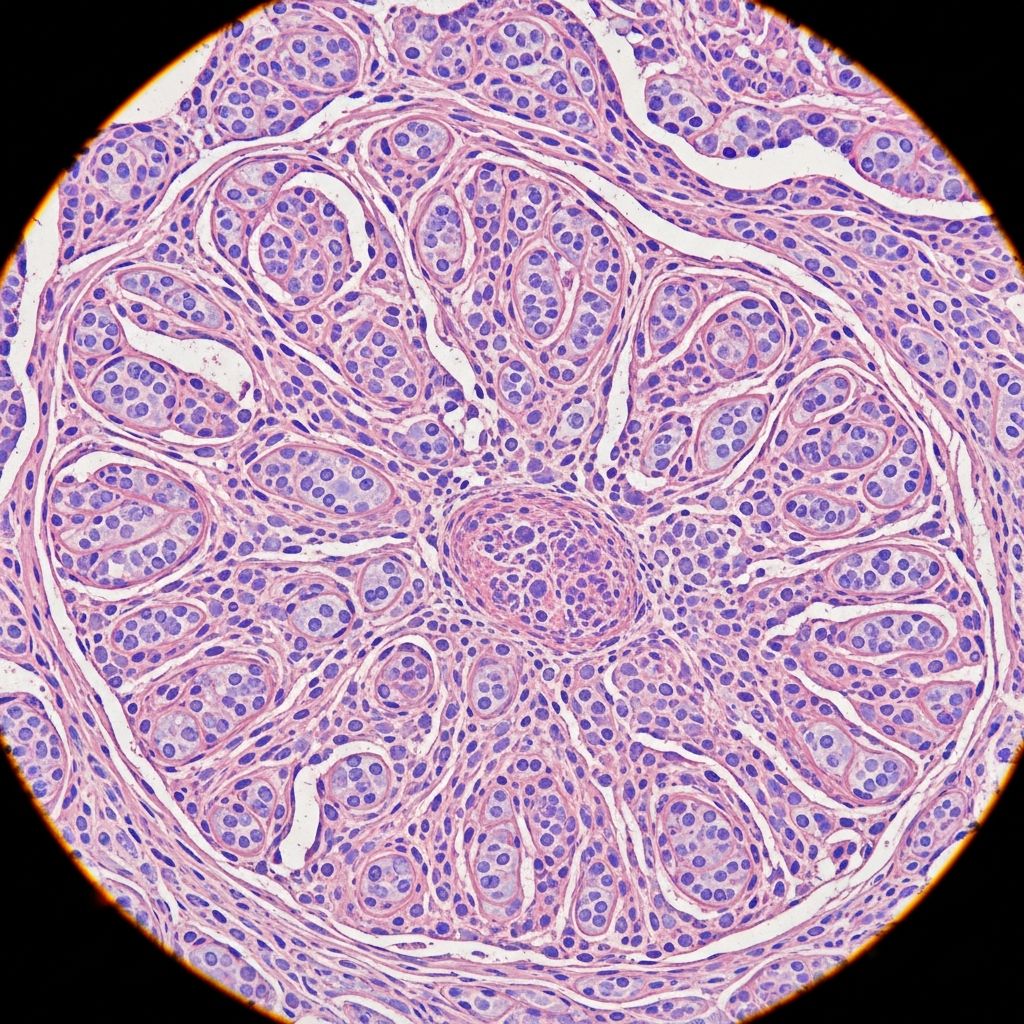
These naevi stem from somatic or germline mutations in mesenchymal cells during embryogenesis, leading to focal hamartomatous overgrowth. Genetic defects disrupt extracellular matrix synthesis: e.g., LEMD3 mutations in Buschke-Ollendorff, TGF-β pathway in collagenomas. Mosaicism explains segmental distributions. Histologically, collagenomas show thickened, hyalinised collagen; elastomas have increased, fragmented elastin (confirmed by Verhoeff-van Gieson stain); EPS displays transepidermal elastin elimination.
Syndromic associations
Beyond isolated lesions, connective tissue naevi signal multisystem disorders.
| Syndrome | Skin Finding | Other Features |
|---|---|---|
| Tuberous sclerosis | Shagreen patch | Angiofibromas, seizures, hamartomas |
| Buschke-Ollendorff | Elastomas | Osteopoikilosis, scoliosis |
| Marfan/Ehlers-Danlos | EPS | Joint hypermobility, aortic issues |
| Pseudoxanthoma elasticum | EPS | Angioid streaks, calcification |
| Infantile myofibromatosis | Fibromas | Visceral/bone tumours |
Rare links include chronic myelogenous leukaemia, syphilis, encephalocraniocutaneous lipomatosis.
Differential diagnosis
- Fibrosis/scar: History of trauma, less circumscribed.
- Lipoma: Softer, subcutaneous.
- Dermatofibroma: Epidermal hyperplasia, storiform pattern.
- Melanocytic naevi: Pigmented, epidermal involvement.
- Proteus syndrome: Asymmetric overgrowth.
Diagnosis
Relies on clinical suspicion, confirmed by skin biopsy. Routine histology suffices; special stains (e.g., elastic Van Gieson) highlight abnormalities. Molecular testing (e.g., for TSC genes) if syndromic. Imaging (X-ray for osteopoikilosis, echo for cardiac involvement) screens associations.
Treatment of connective tissue naevi
Isolated, asymptomatic naevi require no intervention; reassurance suffices. Symptomatic or cosmetic concerns prompt:
- Topical/intralesional corticosteroids: For inflammatory EPS (52% of treated cases).
- Surgical excision: 21% of cases; ideal for solitary lesions.
- Laser (CO2, Nd:YAG): Ablates plaques, especially shagreen or elastomas.
- Observation: Most common for benign types.
Syndromic management targets underlying disease (e.g., mTOR inhibitors for TSC).
Frequently asked questions about connective tissue naevi
Are connective tissue naevi cancerous?
No, they are benign hamartomas with no malignant potential.
Do connective tissue naevi itch or hurt?
Usually asymptomatic, but large plaques may cause cosmetic distress or rare pruritus.
Can they be removed?
Yes, via surgery or laser for bothersome lesions; recurrence is uncommon.
Should I get screened for syndromes?
Yes, multiple lesions or family history warrant full systemic evaluation.
What does a biopsy show?
Abnormal dermal matrix: e.g., increased collagen bundles or elastic fibres.
References
- Connective Tissue Nevi: A Review of the Literature — PubMed/NCBI. 2017-04-19. https://pubmed.ncbi.nlm.nih.gov/28426484/
- Connective tissue naevi — DermNet NZ. Accessed 2026. https://dermnetnz.org/topics/connective-tissue-naevi
- Connective tissue naevus image — DermNet NZ. Accessed 2026. https://dermnetnz.org/imagedetail/8644-connective-tissue-naevus
- Fibroblastic connective tissue naevus pathology — DermNet NZ. Accessed 2026. https://dermnetnz.org/topics/fibroblastic-connective-tissue-naevus-pathology
- Textbook of Dermatology — Rook A, Wilkinson DS, Ebling FJB, Champion RH, Burton JL (eds.). 1986. Blackwell Scientific Publications. (Classic authoritative text cited in DermNet)
Similar Articles








Read full bio of Sneha Tete