Continuous Glucose Monitoring (CGM): What It Is
Real-time glucose tracking for better diabetes management and control.
What Is Continuous Glucose Monitoring?
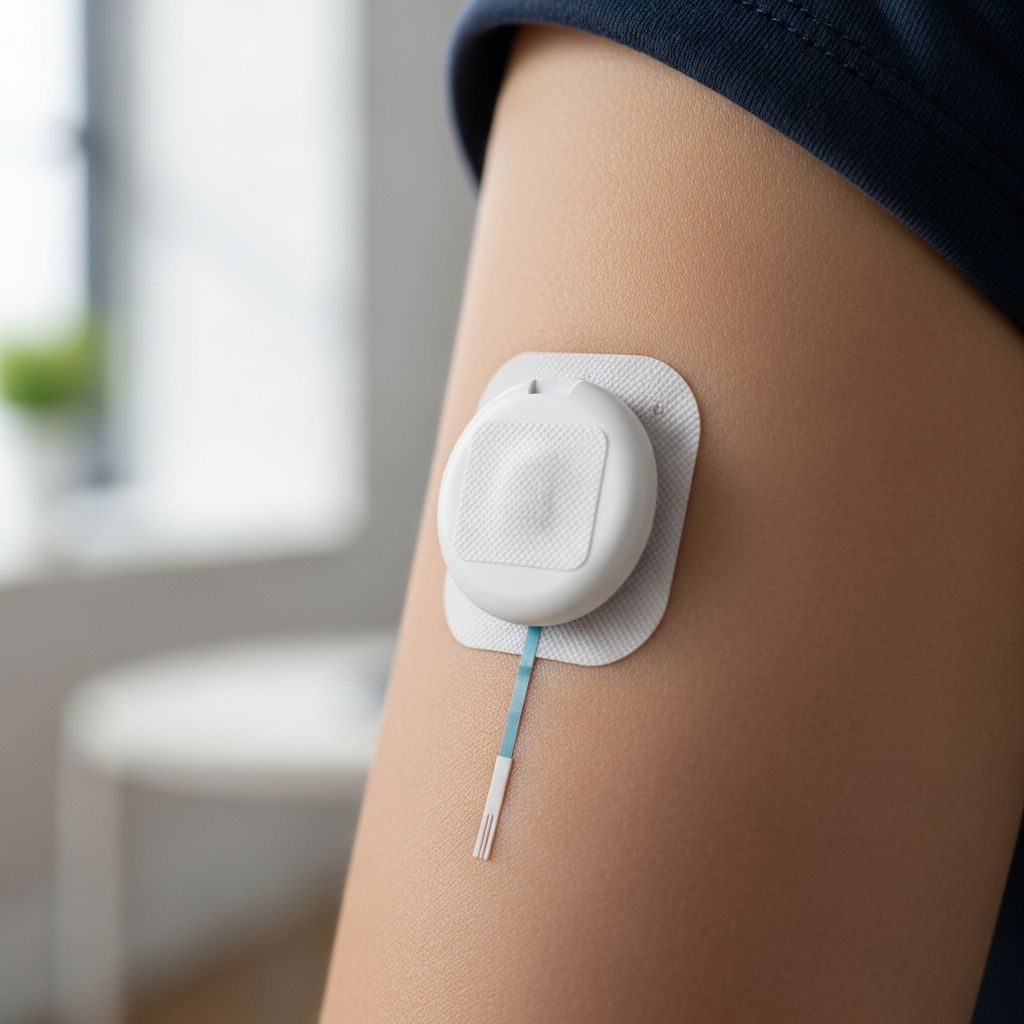
Continuous glucose monitoring (CGM) is wearable technology that tracks your glucose (sugar) levels over time. A continuous glucose monitor (CGM) is a wearable device that measures glucose in the interstitial fluid just under your skin 24 hours a day while you’re wearing the device. A sensor placed beneath your skin continuously measures glucose levels, and a transmitter sends this information to a wearable device or your cell phone so you can track changes to your glucose level in real time. This technology has revolutionized the way people with diabetes manage their condition, providing unprecedented access to glucose data throughout the day and night.
The sensor in a CGM goes just under your skin where interstitial fluid is located—not in a blood vessel. Glucose enters your bloodstream first and then leaks into the interstitial fluid. This means there may be a few minutes delay in your CGM sensor glucose readings compared with fingerstick (manual) blood glucose readings. Understanding this lag is important for proper interpretation of your glucose readings and making informed decisions about your diabetes management.
CGM technology was first developed in the early 2000s and has evolved significantly to include devices with longer wear times that do not require calibration with fingerstick blood glucose monitoring, along with dramatically improved ease of use and availability. Modern CGM devices have become increasingly sophisticated, user-friendly, and accessible to a broader population of people with diabetes.
How Does a CGM Work?
A CGM system operates through several integrated components working together seamlessly. The sensor, which is worn on the body (typically on the abdomen or arm), continuously monitors glucose levels in the interstitial fluid. This sensor collects data automatically throughout the day and night, even while you sleep, providing comprehensive glucose information that would be impossible to obtain through traditional fingerstick testing alone.
The transmitter, another key component, wirelessly communicates the glucose readings from the sensor to a receiver device or smartphone application. This real-time transmission allows you to see your glucose values instantly and understand how they’re changing. Many CGM systems display trend arrows that indicate whether your glucose is rising, falling, or remaining stable, giving you crucial context for your readings.
With point-in-time data, a patient with diabetes can view, on demand, a point-in-time glucose value, a trend arrow indicating whether the glucose is rising or falling, and a profile of recent glucose levels that typically represents 8 hours of data. This capability enables patients to see the immediate impact of diet choices, lifestyle decisions, and medications, allowing real-time physiologic feedback to directly guide management of diabetes day to day.
Types of CGM Devices
There are two main categories of personal CGM devices, each with distinct features and operational characteristics. Understanding the differences between these types can help you determine which might be most suitable for your needs and lifestyle.
Real-Time CGM Devices
Real-time CGM devices continuously measure and display glucose values while worn, providing constant access to your glucose information. These devices send alerts and notifications directly to your smartphone or receiver, allowing you to monitor your glucose levels without any additional action required. Real-time systems are particularly valuable for people who need frequent glucose checks or those who want immediate notification of glucose trends.
Related Stories



Intermittently Scanned CGM Devices
Intermittently scanned CGM devices are somewhat simpler devices that require the user to scan a sensor worn on the body to gather glucose data. These devices measure glucose levels and capture data continuously throughout the day, but to save and access the data, the devices’ sensors must be manually scanned with a smartphone or reader at least every 8 hours. More frequent scanning leads to more complete data collection, with better insights into day and night patterns, frequency of hypoglycemia, and variability in glucose levels throughout the day.
Both types of CGM devices can collect 24-hour retrospective data for evaluating patterns and glycemic metrics, and both have utility in the management of type 1 and type 2 diabetes.
Who Should Use a CGM?
A CGM device is mainly a tool for people with diabetes. Managing diabetes involves managing your blood sugar levels, and a CGM gives you real-time information on how your glucose levels are changing. This is especially important because several factors affect blood sugar levels—some of which you can’t predict.
CGM is recommended for patients with type 1 diabetes and patients with type 2 diabetes treated with insulin. The Standards of Medical Care in Diabetes supports CGM for all individuals with diabetes on insulin therapy (Grade A recommendation for real-time CGM, Grade B recommendation for intermittently scanned CGM). Additionally, the American Association of Clinical Endocrinology strongly recommends CGM for all patients with diabetes using basal and bolus insulin (Grade A; high strength of evidence) and for patients with type 2 diabetes treated with less intensive insulin regimens such as basal insulin only (Grade B; intermediate strength of evidence).
Roughly half of patients with Type 1 Diabetes are estimated to use CGM today, up from approximately 20% a decade ago. CGM is used by about 10% to 15% of patients with Type 2 Diabetes, with many of these individuals not requiring intensive insulin therapy.
Benefits of Continuous Glucose Monitoring
Research demonstrates substantial benefits of CGM use for diabetes management. Using a CGM device can make it easier to manage diabetes. Several studies show that people with Type 1 and Type 2 diabetes who use a CGM have fewer episodes of low blood sugar and a lower A1C.
Evidence from multiple randomized controlled trials supports the value of CGM in the management of diabetes, especially for patients who manage their diabetes with insulin. CGM improves both hemoglobin A1c and hypoglycemia relative to fingerstick blood glucose monitoring in type 1 diabetes. In patients with type 2 diabetes who use insulin, CGM improves hemoglobin A1c or decreases hypoglycemia to a greater degree than fingerstick blood glucose monitoring.
Beyond A1C reduction, CGM offers multiple specific advantages:
- Dramatically reduced number of fingerstick checks required
- Real-time glucose level tracking throughout the day and night
- Reduced episodes of low blood sugar (hypoglycemia)
- Improved understanding of how foods and activities affect your glucose
- Alert notifications when glucose levels go too high or too low
- Better overall glycemic control and health outcomes
Numerous studies have demonstrated that use of continuous glucose monitoring improves glycemic control and reduces diabetes-related hospitalizations. Not only has CGM been shown to reduce A1C, but it can also reduce hypoglycemia, as many of the newer monitors can notify patients when blood glucose begins to go low, so the patient can take action.
The Ambulatory Glucose Profile (AGP) Report
Because CGM technology can capture glycemic data of a 24-hour day-night cycle over several weeks, CGM-derived glycemic metrics and patterns displayed in an AGP Report provide a robust picture of glycemia on both a daily and time-averaged basis. The Ambulatory Glucose Profile Report is a single-page summary view that makes rapid interpretation of CGM data both feasible and intuitive, allowing clinicians to visualize glycemic patterns effectively.
The single-page AGP Report allows for rapid and intuitive interpretation of CGM data by displaying patterns of clinically relevant hypoglycemia, hyperglycemia, and glucose variability. Consensus panel guidance recommends at least 14 days of CGM data with a minimum of 70% sensor wear to generate an AGP Report that enables optimal analysis and decision-making. This recommendation is based on data suggesting a strong correlation between 14-day CGM metrics that measure time within recommended ranges and CGM metrics collected over longer periods of time.
When reviewing the time-in-ranges bar, focus on increasing time in range to more than 70% and decreasing time below range to less than 4% to improve glycemia. Focus also on lifestyle and medication changes that make the AGP curve more flat, narrow, and in-range.
Using a CGM Device
Learning how to use a CGM takes time, but it can help you more easily manage your health. Understanding both the capabilities and limitations of your device is essential for maximizing its benefits. Using a CGM should drastically decrease the number of times you need to do a fingerstick. However, it’s still important to have a fingerstick meter and unexpired supplies on hand as backup.
If your CGM fails or falls off unexpectedly, you can use the fingerstick meter to check your glucose level until you can apply a new sensor. This backup capability ensures you maintain continuity in your glucose monitoring and diabetes management even if technical issues arise with your CGM device.
A systematic approach that integrates retrospective CGM-generated data at clinic visits and other clinical interactions with personal use of CGM data can optimize glycemic management. Successful CGM use requires collaboration between patients and healthcare providers to interpret data effectively and make informed adjustments to diabetes management strategies.
Importance of Patient Education
CGM can help patients better manage their glucose levels, have fewer hypoglycemia episodes, and require fewer finger sticks. However, effective use of this technology requires proper patient education. Healthcare providers play a critical role in helping patients understand how to use their CGM devices properly, interpret the data generated, and incorporate this information into their daily diabetes management decisions.
Patient education is essential for successful use of continuous glucose monitoring systems. Users need to understand sensor placement, proper scanning techniques (for intermittently scanned devices), alarm management, and how to respond to different glucose readings. Investment in comprehensive patient education leads to better outcomes and increased adherence to CGM therapy.
Expanding Access and Coverage
Over 30 million people have diabetes, and 90% of those have type 2 diabetes. Improving hyperglycemia is crucial to helping reduce the risk of microvascular and macrovascular complications. Previously, CGM coverage was limited to patients on multiple insulin injections daily. Expanding coverage to include those on basal insulin represents significant progress in making this technology more accessible to broader populations.
A recent study showed that patients with type 2 diabetes on basal insulin who were using a CGM had a significant reduction in A1C levels compared to those using standard blood glucose meters. This evidence supports the expansion of CGM recommendations and insurance coverage to include more patients with type 2 diabetes, particularly those on insulin therapy.
CGM and Diabetes Management Integration
Access to and use of glycemic data are central to optimal management of diabetes. The integration of CGM data into clinical practice represents a paradigm shift in how diabetes is managed. Rather than relying on sporadic fingerstick readings that capture only a snapshot of glucose levels, CGM provides comprehensive, continuous data that reveals patterns and trends impossible to detect through traditional monitoring methods.
Better glycemic control is critical to reducing morbidity and mortality for those with diabetes. By providing real-time feedback and detailed historical data, CGM empowers both patients and healthcare providers to make evidence-based adjustments to treatment plans, lifestyle modifications, and medications to achieve optimal glucose control.
Frequently Asked Questions
Q: How long does a CGM sensor last?
A: Most CGM sensors are designed to be worn for 7 to 14 days, depending on the specific device. Always follow the manufacturer’s recommendations for your particular CGM system regarding wear duration and sensor replacement schedules.
Q: Can I shower or swim with a CGM?
A: Most modern CGM devices are waterproof or water-resistant and can be worn during showering and swimming. However, check your device’s specifications, as some models have specific water exposure limits or recommendations.
Q: Does a CGM hurt to apply?
A: CGM sensor insertion is minimally invasive and typically causes only mild discomfort, if any. The sensor is very thin and is inserted just beneath the skin using an automatic applicator.
Q: How accurate are CGM readings?
A: Modern CGM devices are highly accurate, though they measure glucose in interstitial fluid rather than blood, which can result in a slight lag (typically 2-5 minutes) compared to fingerstick readings. Accuracy has significantly improved over the years.
Q: Is a CGM covered by insurance?
A: Coverage varies by insurance plan and varies by indication. Generally, CGM is covered for patients with type 1 diabetes and type 2 diabetes on insulin therapy. Check with your specific insurance provider for coverage details.
Q: Can I use a CGM if I’m not on insulin?
A: While CGM is primarily recommended for people on insulin therapy, some individuals on other medications or managing diet alone may benefit from CGM use. Discuss with your healthcare provider whether CGM is appropriate for your specific situation.
References
- Using continuous glucose monitoring data in daily clinical practice — Cleveland Clinic Journal of Medicine. 2021-10. https://www.ccjm.org/content/91/10/611
- Continuous Glucose Monitoring (CGM): What It Is — Cleveland Clinic. 2024. https://my.clevelandclinic.org/health/articles/continuous-glucose-monitoring-cgm
- What to Know In an Expanding Continuous Glucose Monitoring Landscape — Consult QD, Cleveland Clinic. 2023. https://consultqd.clevelandclinic.org/what-to-know-in-an-expanding-continuous-glucose-monitoring-landscape
- Patient education is key to successful use of continuous glucose monitoring — Pharmacy Today, American Pharmacists Association. 2024. https://www.pharmacist.com/Blogs/CEO-Blog/Article/patient-education-is-key-to-successful-use-of-continuous-glucose-monitoring
- Health Care Disparities in Use of Continuous Glucose Monitoring — PubMed/NIH. 2021. https://pubmed.ncbi.nlm.nih.gov/34546086/
- Diabetes technology: A primer for clinicians — Cleveland Clinic Journal of Medicine. 2022. https://consultqd.clevelandclinic.org/diabetes-technology-a-primer-for-clinicians
- Time in Range (TIR) for Diabetes: What It Is & Target — Cleveland Clinic. 2024. https://my.clevelandclinic.org/health/articles/time-in-range-diabetes
Similar Articles








Read full bio of medha deb