Corneal Topography: 8 Clinical Benefits For Eye Care
Advanced imaging technology for precise corneal assessment and vision care planning
The cornea plays a fundamental role in vision, accounting for approximately 70 percent of the eye’s focusing power. Given its critical importance, ophthalmologists and optometrists require sophisticated tools to evaluate corneal health and function. Corneal topography, also known as corneal mapping, photokeratoscopy, or videokeratography, represents one of the most valuable diagnostic instruments in modern eye care. This non-invasive imaging technique generates detailed three-dimensional representations of the cornea’s surface, enabling practitioners to detect abnormalities, monitor disease progression, and plan surgical interventions with precision.
What Is Corneal Topography and How Does It Work?
Corneal topography functions similarly to geographic mapping used to understand terrain elevation and contours. Instead of measuring mountains and valleys on Earth’s surface, this technology captures the subtle variations in the cornea’s shape and curvature across its entire surface. The procedure operates by analyzing thousands of points across the corneal surface, creating a comprehensive topographic map that visualizes both high and low areas with remarkable precision.
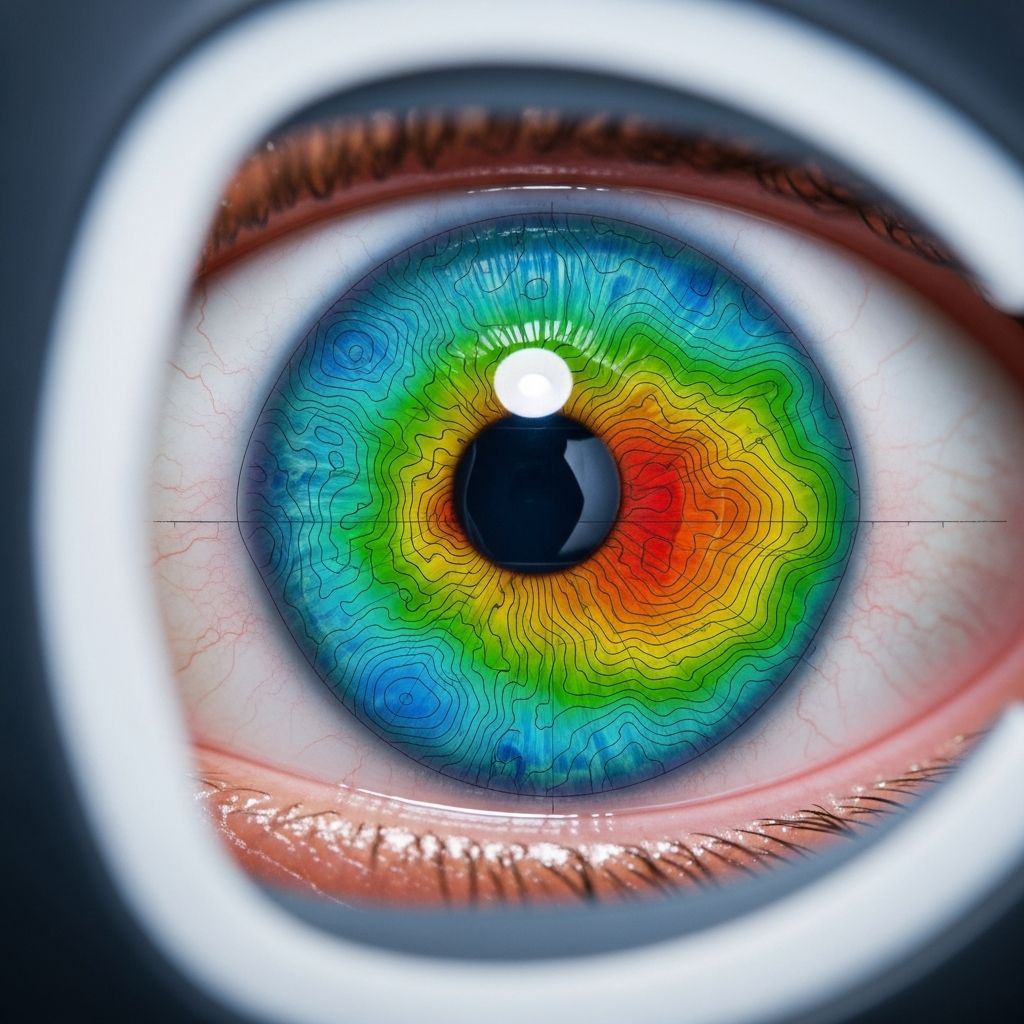
The examination process begins when the topographer projects a pattern of light rings, known as Placido discs or mires, onto the corneal surface. These rings reflect off the tear film covering the anterior cornea, and the system’s camera captures the reflected image. A sophisticated computer then analyzes the reflected pattern, measuring the position and height of several thousand individual points across the corneal surface. The resulting data is translated into color-coded topographic maps that allow clinicians to visualize corneal power, curvature irregularities, and surface abnormalities at a glance.
One of the key advantages of corneal topography is its speed and comfort. The entire procedure typically takes only seconds to complete and is entirely painless, making it suitable for patients of all ages and visual capabilities.
Technological Approaches to Corneal Assessment
The field of corneal imaging encompasses multiple technological methodologies, each offering distinct advantages depending on clinical objectives. Understanding the differences between these approaches helps practitioners select the most appropriate tool for specific diagnostic situations.
Placido Disc-Based Systems
Placido disc reflection technology represents the traditional and most widely utilized approach to corneal topography. These systems measure corneal curvature, surface irregularities, tear film characteristics, and identify foreign bodies or other corneal abnormalities. Placido-based topographers excel at providing detailed information about the anterior corneal surface and are particularly effective for screening candidates for refractive procedures like LASIK.
Advanced Imaging Technologies
Modern corneal imaging has evolved beyond traditional topography to include scanning slit and Scheimpflug imaging technologies. These advanced systems provide information about both the anterior and posterior corneal surfaces, offering a more complete three-dimensional representation. The ability to visualize both corneal surfaces proves especially valuable for detecting corneal swelling, which is particularly important for contact lens wearers who require careful monitoring of corneal hydration status. These systems can measure corneal thickness and generate elevation maps that reveal subtle topographic variations that might be missed by anterior-surface-only imaging.
Interpreting Topographic Maps: Understanding Visual Representations
Corneal topography generates multiple display formats, each conveying different types of information about corneal shape and power. Practitioners and informed patients benefit from understanding how to interpret these visual representations.
Related Stories



Axial or Sagittal Maps
The axial display map represents the most traditional and widely recognized format for presenting corneal topography data. This map shows the dioptric power and radius of curvature across the central, paracentral, and peripheral cornea, extending to approximately nine millimeters from the center. The visualization employs a color-coding system where warm colors like orange and red indicate steepening areas, while cooler colors such as blue and green represent flattening regions. In healthy corneas, the map typically appears predominantly green, reflecting gradual flattening from the center toward the periphery, which represents the normal corneal shape.
Elevation Maps
Elevation maps provide a different perspective by showing how the actual corneal surface deviates from a mathematically calculated reference shape, typically an eight-millimeter best-fit sphere or best-fit toric ellipsoid. Areas where the cornea rises above this reference shape appear in warm colors, while areas below the reference are displayed in cool colors. This format proves particularly useful for detecting subtle abnormalities that might not be apparent in traditional axial maps, especially in the early stages of corneal disease.
Clinical Applications and Diagnostic Value
The versatility of corneal topography extends across numerous clinical scenarios, from routine vision assessment to complex surgical planning. The technology has become indispensable in modern eye care.
Refractive Surgery Evaluation
Corneal topography plays a central role in assessing candidacy for refractive procedures such as LASIK and PRK. Before surgery, topography screening identifies patients with normal corneal shapes while detecting suspicious patterns or keratoconus-like presentations that might contraindicate surgery. Post-operatively, corneal topography helps assess the dioptric changes created by the procedure, verify proper ablation patterns, and detect complications such as decentered ablations or post-refractive ectasia.
Corneal Ectasia Detection and Monitoring
Corneal ectasias represent progressive thinning conditions where the cornea gradually weakens and bulges forward. Keratoconus, the most common corneal ectasia, is often barely visible during routine slit lamp examination and may elude detection through conventional keratometry, which assesses only the central three millimeters. Corneal topography has become the gold standard for screening patients at risk for keratoconus and other corneal ectasias because it evaluates the entire corneal surface. Once ectasia is diagnosed, regular topographic surveillance allows clinicians to identify warning signs of progression, including high central corneal power, significant differences between the two eyes, and large disparities between the apex and peripheral refractive power, enabling early intervention with treatments such as corneal collagen cross-linking.
Contact Lens Fitting Optimization
For practitioners specializing in complex contact lens fitting, corneal topography provides essential information about corneal shape that guides lens selection and design. The technology enables assessment of both anterior and posterior corneal surfaces, improving the accuracy of lens calculations and fitting predictions, particularly for patients with irregular corneas or post-surgical eyes.
Cataract Surgery Planning
When planning cataract surgery and intraocular lens implantation, corneal topography helps determine appropriate intraocular lens power calculations by providing precise measurements of corneal curvature. This information improves the accuracy of refractive predictions following cataract surgery, leading to better visual outcomes for patients.
Post-Surgical Assessment
Corneal topography assists in monitoring ocular health following refractive surgery and guides decisions regarding appropriate timing for suture removal after corneal transplant procedures. The technology identifies the steep axis necessary for planning post-keratoplasty astigmatism correction.
Detecting and Managing Corneal Conditions
Beyond refractive considerations, corneal topography serves as an important diagnostic tool for identifying various corneal pathologies. Conditions detected through topographic analysis include pterygium (tissue growth on the cornea), corneal scarring from injury or infection, Salzmann nodules (benign corneal growths), pellucid marginal degeneration, and infectious keratitis. The technology also enables evaluation of corneal nerve anatomy and assessment of the anterior chamber angle in glaucoma patients, supporting comprehensive anterior segment evaluation.
Advanced Diagnostic Parameters and Ectasia Detection
Modern topographic systems incorporate sophisticated analytical parameters designed to identify subtle indicators of corneal disease. The Belin-Ambrosio Enhanced Ectasia Display (BAD) represents an important advancement that combines multiple parameters including anterior and posterior elevation, pachymetric progression, relational thickness, and the location of the thinnest corneal point. These integrated parameters provide clinicians with sensitive indicators of ectasia risk that might not be apparent when examining individual measurements in isolation.
The Procedure and Patient Experience
Corneal topography requires minimal patient preparation and causes no discomfort. Patients typically sit in front of the topography device and look at a target light while the system captures the corneal image. Some practitioners may instill lubricating drops to optimize tear film quality and ensure accurate measurements, though this is optional in many cases. The examination takes only seconds, and patients can return immediately to their normal activities with no restrictions. The non-invasive nature and rapid completion time make corneal topography an ideal screening and monitoring tool even for anxious or medically complex patients.
Comparing Topography with Tomography: Understanding the Distinction
While corneal topography and corneal tomography are often discussed together, important differences distinguish these technologies. Topography measures only the anterior corneal surface, while tomography captures three-dimensional images of both the anterior and posterior surfaces along with corneal thickness at various locations. Tomography provides more comprehensive anatomic information and represents an advancement in corneal imaging capability, particularly valuable in complex cases where posterior corneal information is clinically relevant.
Modern Evolution and Clinical Impact
Advances in digital photography and computer processing have dramatically expanded the clinical utility of corneal topography. Originally designed to characterize only the anterior corneal surface, modern devices can now visualize and analyze both anterior and posterior surfaces simultaneously, creating comprehensive three-dimensional maps that were previously impossible to obtain. These technological improvements have enhanced diagnostic accuracy and expanded the range of conditions that can be detected and monitored.
Key Clinical Benefits Summary
- Rapid, painless examination requiring only seconds to complete
- Non-invasive assessment with no discomfort or recovery period
- Detailed visualization of entire corneal surface with thousands of measurement points
- Early detection of corneal abnormalities before they become visually apparent
- Objective documentation enabling precise disease progression monitoring
- Improved surgical planning and outcomes for refractive and cataract procedures
- Enhanced contact lens fitting accuracy through detailed corneal shape assessment
- Risk stratification for corneal ectasia development enabling preventive intervention
When Your Eye Care Provider Recommends Corneal Topography
If your eye care provider recommends corneal topography testing, you can proceed with confidence knowing that the examination is well-established, medically necessary, and entirely safe. The test provides valuable information that directly impacts treatment decisions and visual outcomes. Whether the recommendation stems from refractive surgery evaluation, contact lens fitting, disease monitoring, or diagnostic workup for visual symptoms, corneal topography delivers clinically relevant information that guides optimal eye care.
References
- What Is Corneal Topography? — American Optometric Association. https://www.optometrists.org/general-practice-optometry/guide-to-eye-exams/eye-exams/what-is-corneal-topography/
- Corneal Topography — Wikipedia. https://en.wikipedia.org/wiki/Corneal_topography
- Corneal Topography: An Introduction — University of Iowa Department of Ophthalmology. https://webeye.ophth.uiowa.edu/eyeforum/tutorials/Corneal-Imaging/Index.htm
- Corneal Imaging: An Introduction — University of Iowa Carver College of Medicine. https://webeye.ophth.uiowa.edu/eyeforum/tutorials/Corneal-Imaging/Index.htm
- Corneal Topography — National Center for Biotechnology Information (NCBI). https://www.ncbi.nlm.nih.gov/books/NBK585055/
- Corneal Topography — EyeWiki, American Academy of Ophthalmology. https://eyewiki.org/Corneal_Topography
Similar Articles








Read full bio of Sneha Tete