Creatine HCl Vs Monohydrate: In-Depth Guide
Discover the key differences between creatine HCl and monohydrate to choose the best supplement for your fitness goals and digestion needs.
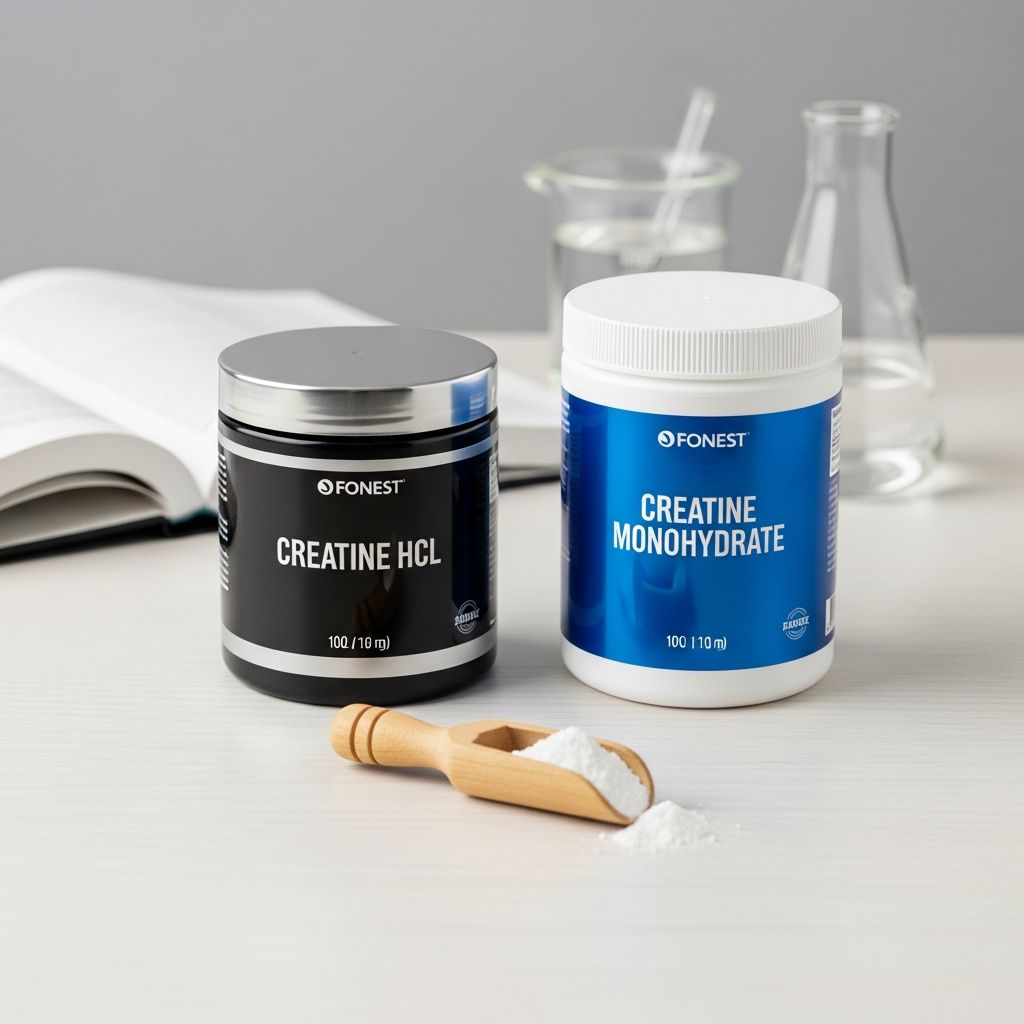
Creatine is one of the most researched and effective supplements for enhancing athletic performance, muscle growth, and strength. Two popular forms—creatine monohydrate and creatine hydrochloride (HCl)—dominate the market, each with unique properties. Creatine monohydrate, the traditional gold standard, offers about 90% creatine by mass and decades of supporting evidence. Creatine HCl, bonded with hydrochloric acid, provides roughly 78% creatine by mass but boasts superior water solubility—up to 41 times higher—potentially allowing smaller doses with fewer side effects.
This article breaks down their differences in solubility, absorption, dosage, side effects, cost, and research to help you decide which suits your needs, whether you’re a beginner athlete or someone prone to digestive issues.
What Is Creatine Monohydrate?
Creatine monohydrate is the most studied form of creatine, consisting of a creatine molecule bound to a water molecule. It increases phosphocreatine stores in muscles, aiding ATP regeneration for high-intensity exercise. Decades of research confirm its benefits: improved strength, power output, muscle mass, and recovery.
Typically, users take 3-5 grams daily after an optional loading phase of 20 grams per day for 5-7 days. Its low solubility requires more liquid for mixing, and some experience mild bloating from water retention during loading.
- Pros: Extensive evidence base, cost-effective, high creatine purity (~90%).
- Cons: Lower solubility, potential GI discomfort in sensitive individuals.
What Is Creatine HCl?
Creatine HCl pairs creatine with hydrochloric acid, enhancing solubility and acidity for better dissolution in less water. Manufacturers claim 60% better intestinal absorption, enabling doses as low as 1-2 grams without loading. It’s marketed for minimal bloating and GI issues due to higher bioavailability.
The form supports the same muscle energy benefits but in a more concentrated, user-friendly package. Its pH-lowering effect may improve uptake in the intestines.
- Pros: High solubility (41x monohydrate), lower doses, reduced side effects.
- Cons: Less creatine by mass (~78%), higher cost, limited long-term studies.
Creatine HCl vs. Monohydrate: Key Differences
While both deliver creatine to boost performance, their formulations lead to distinct profiles. Creatine HCl’s solubility advantage shines in mixing and potential absorption, but monohydrate’s research depth makes it reliable.
| Property | Creatine Monohydrate | Creatine HCl |
|---|---|---|
| Creatine Content | ~90% by mass | ~78% by mass |
| Solubility | Low (needs ~1L water for 14g) | High (41x better) |
| Effective Dose | 3-5g daily | 1-2g daily |
| Absorption | Moderate | Potentially faster |
| GI Side Effects | Mild bloating (loading phase) | Minimal |
| Research | Extensive | Limited but promising |
| Cost | Lower | Higher |
This table highlights HCl’s edge in convenience and tolerability, while monohydrate excels in affordability and proven efficacy.
Solubility and Mixability
Monohydrate’s poor solubility at neutral pH means it often clumps in water, requiring warm liquid or micronized versions for better results. HCl dissolves effortlessly, even in small volumes, making it ideal for on-the-go use without shakers.
Greater solubility reduces undissolved particles that might irritate the stomach, contributing to HCl’s digestive friendliness.
Absorption and Bioavailability
HCl’s acidity may enhance intestinal permeability, leading to claims of 60% better absorption. However, no robust studies confirm superior muscle saturation compared to monohydrate at equivalent doses. Both forms increase creatine levels effectively, but monohydrate’s data is more comprehensive.
Related Stories



A study showed similar performance gains across creatine forms, with no significant differences.
Dosage Requirements
Monohydrate often uses a loading phase for quick saturation, then maintenance. HCl skips loading, starting at 1-2g due to purported efficiency—saving time and reducing intake volume.
For budget-conscious users, monohydrate’s higher purity means more creatine per gram, offsetting dose similarities.
Side Effects and Safety
Monohydrate can cause temporary water retention and bloating, especially during loading, due to osmolality shifts. HCl minimizes this, appealing to those with sensitive stomachs.
Both are safe long-term; no evidence links either to kidney issues in healthy users. Stay hydrated and consult a doctor if concerned.
Which Is More Effective?
Monohydrate remains the gold standard with strongest evidence for strength, hypertrophy, and endurance. One study suggested HCl improved body composition more at equal doses, but replication is needed.
HCl matches benefits with fewer drawbacks for some, but lacks monohydrate’s volume of trials.
Cost Comparison
Monohydrate costs 80-90% less per effective dose. HCl’s premium pricing doesn’t always justify unless digestion is an issue.
Best Creatine for Your Goals
- Beginners/Budget: Monohydrate—proven, cheap.
- Digestion-Sensitive: HCl—less bloating.
- Performance-Focused: Either; prioritize purity-tested products.
How to Take Creatine HCl vs. Monohydrate
Monohydrate: Load 20g/day (4x5g) for 5-7 days, then 3-5g daily. Mix with carbs for uptake.
HCl: 1-2g daily, no loading. Take anytime, with or without food.
Cycle off every 8-12 weeks if desired, though not required.
Frequently Asked Questions (FAQs)
Is creatine HCl better than monohydrate?
No definitive proof; monohydrate has more research, but HCl offers better solubility and less bloating.
Can I switch between creatine HCl and monohydrate?
Yes, both saturate muscles similarly. Transition seamlessly.
Does creatine HCl cause less water retention?
Yes, due to no water molecule and higher solubility.
Is a loading phase needed for HCl?
No, smaller doses suffice.
Which is cheaper long-term?
Monohydrate, by a wide margin.
References
- Creatine HCl vs. Monohydrate: Is There a New Gold Standard? — Transparent Labs. 2023. https://www.transparentlabs.com/blogs/all/creatine-hcl-vs-monohydrate
- Creatine HCL vs. Monohydrate: Cutting Through the Hype — Levels Protein. 2023. https://levelsprotein.com/blogs/supplements/creatine-hcl-vs-monohydrate
- Understanding the Differences Between Creatine HCL and Monohydrate — ProSupps. 2023. https://prosupps.com/blogs/articles/understanding-the-differences-between-creatine-hcl-and-monohydrate
- Creatine Monohydrate vs HCL – What’s the Difference? — Naked Nutrition. 2023. https://nakednutrition.com/blogs/supplements/creatine-monohydrate-vs-hcl
- Supplementing With Which Form of Creatine (Hydrochloride or Monohydrate) Is More Effective? — NIH/PMC. 2024-10-29. https://pmc.ncbi.nlm.nih.gov/articles/PMC11629957/
Similar Articles








Read full bio of medha deb