Crouzon Syndrome: Guide to Causes, Symptoms & Treatment
Comprehensive guide to Crouzon syndrome: genetic craniosynostosis affecting skull and facial development, symptoms, diagnosis, and multidisciplinary management.
Revised: January 2026
Crouzon syndrome, also known as craniofacial dysostosis, represents the most common craniosynostosis syndrome, occurring in approximately 16 per million newborns. This autosomal dominant genetic disorder arises primarily from mutations in the FGFR2 gene on chromosome 10q26, leading to premature fusion of cranial sutures and characteristic craniofacial abnormalities. Unlike related conditions such as Apert syndrome, Crouzon syndrome spares the limbs, focusing malformations on the skull and midface.
Clinical severity varies widely, even within families, influenced by the specific mutation. Approximately one-third of cases result from de novo mutations, while inherited cases show nearly 100% penetrance but variable expressivity. Early diagnosis and multidisciplinary intervention are crucial to mitigate complications like elevated intracranial pressure, vision impairment, and airway obstruction.
What is the cause of Crouzon syndrome?
Crouzon syndrome stems from gain-of-function mutations in the fibroblast growth factor receptor 2 (FGFR2) gene, which encodes a tyrosine kinase receptor critical for bone and cartilage development. Over 80 distinct mutations have been identified, with the most common being C342Y in the linker region between Ig-like domains II and III. These mutations cause constitutive activation of FGFR2 signaling, accelerating osteoblast differentiation and premature suture fusion, particularly the coronal sutures.
Inherited cases follow an autosomal dominant pattern, meaning a single mutated allele from one parent suffices for disease manifestation. De novo mutations account for 30–50% of cases, often arising during paternal gametogenesis. A rare variant, Crouzon syndrome with acanthosis nigricans, results from the Ala391Glu mutation in the extracellular domain, additionally causing hyperpigmented skin thickening in flexural areas. Environmental factors do not contribute significantly; the condition is purely genetic.
Who gets Crouzon syndrome (epidemiology)?
Crouzon syndrome affects males and females equally, with an incidence of 1 in 60,000–65,000 live births, making it the most prevalent syndromic craniosynostosis. No ethnic or geographic predilections exist. Familial recurrence risk approaches 50% for offspring of affected individuals due to autosomal dominant inheritance.
- Population frequency: ~16 per 1,000,000 newborns
- Inheritance: Autosomal dominant; 50% de novo
- Penetrance: Complete, but variable expressivity
Diagnosis often occurs prenatally via ultrasound or postnatally through clinical examination and genetic testing. Long-term follow-up reveals normal intelligence in most patients, distinguishing it from more severe craniosynostoses.
What are the clinical features of Crouzon syndrome?
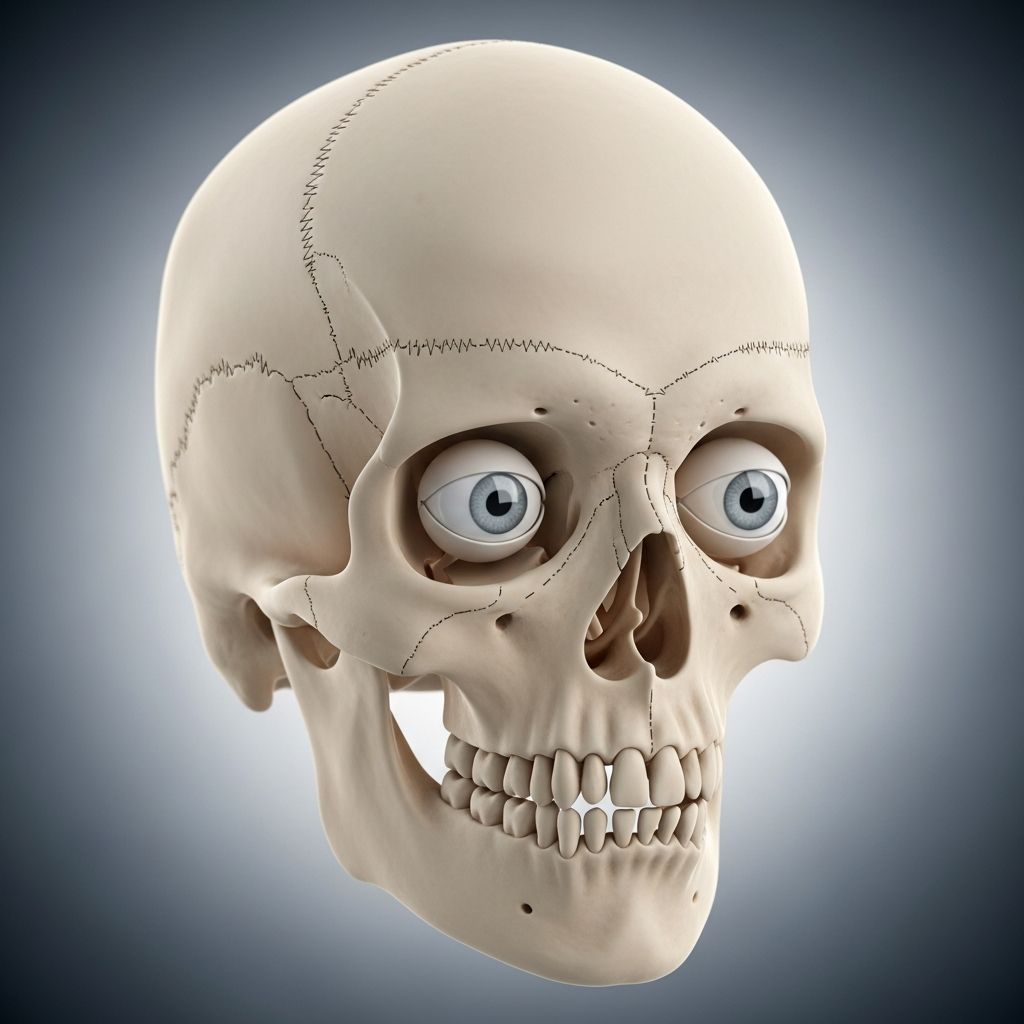
Crouzon syndrome manifests through progressive craniosynostosis, typically involving the coronal sutures bilaterally, resulting in a tower-shaped skull (turribrachycephaly). Facial features include midface hypoplasia, relative mandibular prognathism, and shallow orbits causing proptosis.
Cranial and facial characteristics
- Skull shape: Brachycephaly (short, broad head) or scaphocephaly (long, narrow); rare cloverleaf deformity (Kleeblattschädel)
- Forehead: Prominent bossing with pseudohydrocephalus appearance
- Eyes: Exophthalmos, hypertelorism, strabismus, exposure keratitis; shallow orbits
- Nose: Beaked appearance due to midface retrusion
- Midface: Hypoplastic maxilla, short philtrum, high-arched palate
- Jaws: Class III malocclusion with anterior open bite
Associated complications
Approximately 30% develop hydrocephalus from impaired CSF flow, presenting with bulging fontanelle, irritability, or rapid head growth. Chiari malformation, hearing loss (conductive or sensorineural), and cervical spine instability occur frequently. Airway obstruction from midface hypoplasia affects 20–50% of cases, sometimes necessitating tracheostomy.
| Feature | Frequency | Potential Complications |
|---|---|---|
| Hydrocephalus | 10–30% | Increased ICP, neurodevelopmental delay |
| Hearing loss | Common | Narrow ear canals, otitis media |
| Proptosis | Near universal | Corneal exposure, optic neuropathy |
| Airway issues | 20–50% | Sleep apnea, respiratory failure |
Related Stories



In Crouzon syndrome with acanthosis nigricans, velvety hyperpigmentation appears post-puberty in intertriginous areas, alongside chiari malformation and choanal atresia.
Diagnosis
Diagnosis combines clinical evaluation, imaging, and genetic confirmation. Prenatal ultrasound may detect craniosynostosis after 20 weeks gestation. Postnatally, skull radiographs reveal suture fusion, while CT provides 3D reconstruction for surgical planning. MRI assesses hydrocephalus, Chiari, and brainstem compression.
- Genetic testing: FGFR2 sequencing confirms >90% of cases
- Clinical criteria: Premature craniosynostosis + characteristic facies
Differential includes Apert, Pfeiffer, and Saethre-Chotzen syndromes; genetic testing distinguishes them. Ophthalmologic, audiologic, and neurosurgical evaluations are mandatory.
Treatment of Crouzon syndrome
Management requires a craniofacial team including neurosurgeons, plastic surgeons, ENT specialists, ophthalmologists, and orthodontists. Timing prioritizes brain protection, ocular safety, and airway patency.
Surgical interventions
- Infancy (3–12 months): Fronto-orbital advancement (FOA) or cranial vault remodeling to expand intracranial volume
- Early childhood (2–5 years): Midface distraction (Le Fort III) for proptosis and airway
- Adolescence: Orthognathic surgery for malocclusion; mandibular advancement
- Other: Tracheostomy, VP shunt for hydrocephalus, eyelid surgery
Monobloc advancement combines fronto-orbital and midface procedures for severe cases. Distraction osteogenesis gradually advances bones, minimizing relapse.
Non-surgical management
- ICP monitoring: Serial fundoscopy, headaches assessment
- Vision/hearing: Corrective lenses, myringotomy tubes
- Orthodontics: Palatal expansion, braces
- Genetic counseling: 50% recurrence risk
What is the outcome for Crouzon syndrome?
With timely intervention, most achieve normal lifespan and intelligence, though multiple surgeries (3–7 lifetime) are typical. Lifelong monitoring addresses psychosocial issues, fertility, and secondary complications. Untreated, risks include blindness, cognitive impairment, and respiratory failure.
Multidisciplinary clinics like those at Children’s Hospital Colorado optimize outcomes through coordinated care.
Related topics
- Apert syndrome
- Pfeiffer syndrome
- Craniosynostosis
- FGFR2-related craniosynostosis syndromes
Frequently Asked Questions
What is Crouzon syndrome?
A genetic craniosynostosis causing skull and facial abnormalities without limb involvement.
Is Crouzon syndrome inherited?
Autosomal dominant; 50% chance per child of affected parent.
Does Crouzon syndrome affect intelligence?
Typically normal intelligence preserved.
What surgeries are needed?
Cranial remodeling, midface advancement, orthognathic procedures.
Can Crouzon syndrome be detected prenatally?
Yes, via ultrasound and amniocentesis for FGFR2 testing.
References
- Crouzon Syndrome — Children’s Hospital Colorado. 2024. https://www.childrenscolorado.org/conditions-and-advice/conditions-and-symptoms/conditions/crouzon-syndrome/
- Crouzon Syndrome — Dayton Children’s Hospital. 2024. https://childrensdayton.org/conditions/crouzon/
- Crouzon Syndrome — Seattle Children’s Hospital. 2024. https://www.seattlechildrens.org/conditions/crouzon-syndrome/
- Crouzon Syndrome — National Organization for Rare Disorders (NORD). 2023-10-17. https://rarediseases.org/rare-diseases/crouzon-syndrome/
- Crouzon Syndrome: Symptoms, Causes & Treatment — Cleveland Clinic. 2024. https://my.clevelandclinic.org/health/diseases/22197-crouzon-syndrome
- Crouzon syndrome — MedlinePlus Genetics (U.S. National Library of Medicine). 2023. https://medlineplus.gov/genetics/condition/crouzon-syndrome/
- Crouzon Syndrome — StatPearls [Internet]. NCBI Bookshelf (National Center for Biotechnology Information). 2023-07-17. https://www.ncbi.nlm.nih.gov/books/NBK518998/
Similar Articles








Read full bio of Sneha Tete