Cryptococcosis Pathology: Essential Guide For Diagnosis
Comprehensive pathological examination of cryptococcosis, detailing histopathology, microbiology, and diagnostic features of this fungal infection.
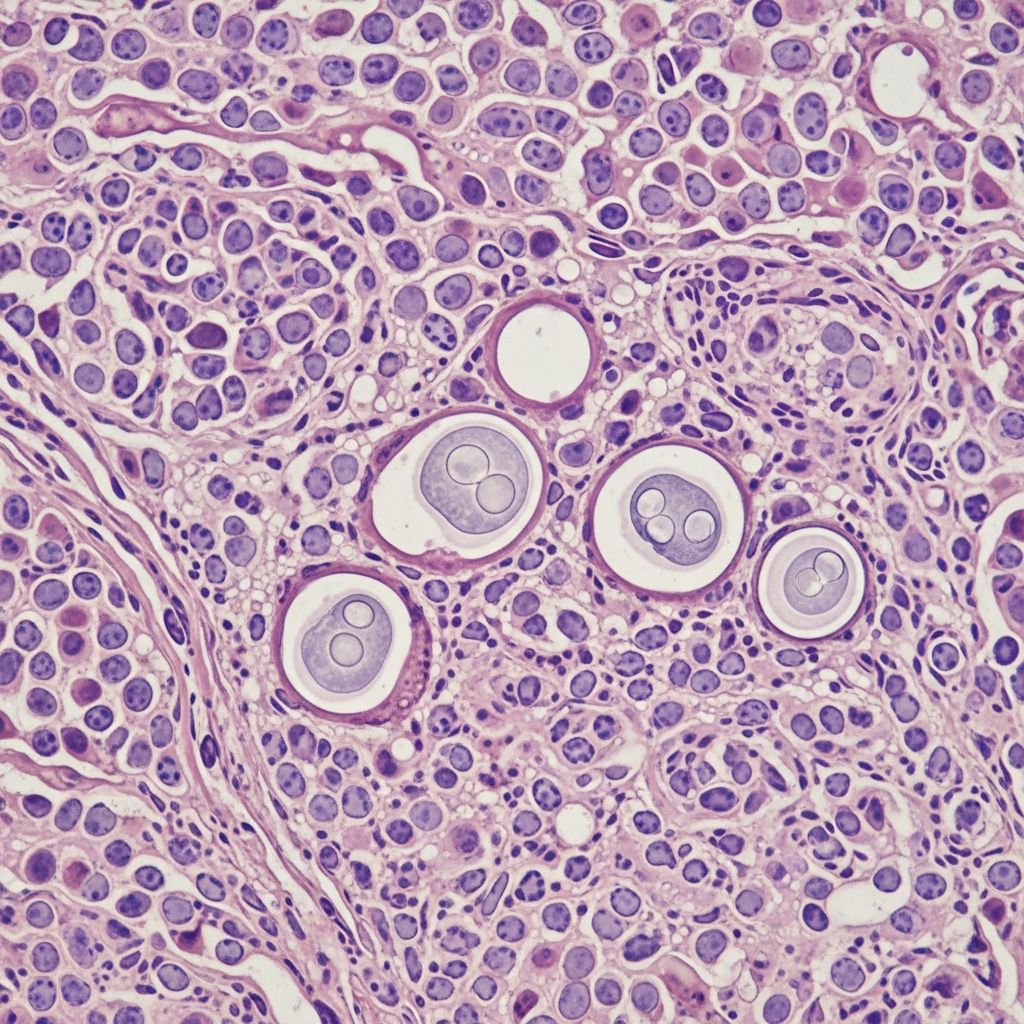
Cryptococcosis is a systemic fungal infection primarily caused by Cryptococcus neoformans and Cryptococcus gattii, with distinctive pathological features observed across various tissues, particularly in immunocompromised hosts.
Histopathology
The histopathological hallmark of cryptococcosis is the presence of encapsulated yeast forms within tissues, often eliciting varied inflammatory responses depending on the host’s immune status. In immunocompetent individuals, a brisk granulomatous reaction predominates, while in immunocompromised patients, such as those with AIDS, there is minimal inflammation with numerous organisms.
Yeast Forms
Cryptococcal yeasts appear as round to oval structures measuring 5-15 μm in diameter, featuring a thick mucoid capsule that stains prominently with specific histochemical stains. These yeasts reproduce by narrow-based budding, a key morphological feature distinguishing them from other fungi.
- Size: Typically 5-15 μm, occasionally larger variably sized forms up to 100 μm in C. gattii infections.
- Budding: Narrow-based budding with the bud often smaller than the mother cell.
- Capsule: Thick, clear halo surrounding the yeast cell, compressing adjacent structures.
Capsule Staining
The cryptococcal capsule is best demonstrated using mucicarmine, which imparts a bright red stain to the mucopolysaccharide capsule, providing high specificity for diagnosis. Alcian blue stains the capsule blue, while the India ink preparation reveals the capsule as a clear halo against a dark background in fresh specimens.
- Mucicarmine: Red capsule staining, gold standard for confirmation.
- Alcian blue (pH 2.5): Blue capsule staining, accentuates capsule thickness.
- India ink: Negative staining showing unstained capsule halo (microscopy).
Cytoplasm Staining
Yeast cytoplasm stains with hematoxylin and eosin (H&E) appearing pale with eccentric nuclei, or more vividly with periodic acid-Schiff (PAS) and Gomori methenamine silver (GMS) stains. GMS highlights yeast walls black against a green background, excellent for detecting sparse organisms.
| Stain | Yeast Features | Background | Diagnostic Utility |
|---|---|---|---|
| H&E | Pale cytoplasm, eccentric nuclei | Tissue detail | Screening |
| PAS | Magenta cytoplasm and walls | Pink | Good sensitivity |
| GMS (Grocott) | Black walls | Green | High sensitivity, sparse organisms |
| Mucicarmine | Red capsule | Green | Specificity for Cryptococcus |
Inflammatory Response
The inflammatory pattern varies markedly by immune status. Immunocompetent hosts show well-formed granulomas with multinucleated giant cells containing yeasts, epithelioid histiocytes, and lymphocytes. In AIDS patients, there is scant inflammation with gelatinous pools of extracellular yeasts and minimal lymphocytic infiltrate.
- Granulomatous: Epithelioid granulomas, Langhans giant cells, caseation rare.
- Suppurative: Neutrophils predominate in early or overwhelming infection.
- Paucicellular: AIDS – numerous yeasts, few inflammatory cells (“swiss cheese” appearance).
Cutaneous Pathology
Cutaneous cryptococcosis manifests as secondary dissemination in 10-15% of systemic cases, presenting diverse morphologies including umbilicated papules resembling molluscum contagiosum, nodules, ulcers, and cellulitis. Primary cutaneous infection is rare, typically from direct inoculation.
Histologically, dermis shows dermal nodules with numerous yeasts, pseudoepitheliomatous hyperplasia, and variable inflammation. In AIDS, lesions show lakes of mucoid material packed with organisms. Common sites: face, extremities; 90% have concurrent systemic disease.
- Nodular: Dermal granulomas with yeasts.
- Ulcerative: Necrosis, pseudoepitheliomatous hyperplasia.
- Cellulitis-like: Dermal edema, sparse yeasts.
Related Stories



Pulmonary Pathology
Pulmonary cryptococcosis presents as nodules, masses, or interstitial infiltrates. Histology reveals yeast-filled granulomas or paucicellular yeast accumulations. Necrotizing granulomas mimic tuberculosis; organisms vary from sparse to numerous.
Central Nervous System Pathology
Meningoencephalitis shows subarachnoid yeast accumulations with minimal inflammation in immunocompromised patients. Parenchymal cryptococcomas form mass lesions with granulomatous reaction. Ventricular yeasts cause hydrocephalus.
Microbiology
Cryptococcus neoformans grows as creamy colonies at 25-37°C. Urease positive, phenol oxidase positive (melanin production), capsule production enhanced on Niger seed agar.
- India ink: 80-90% sensitive in meningitis.
- Antigen test: Serum/CSF CrAg highly sensitive/specific.
- Culture: Gold standard, Sabouraud agar.
Special Stains Comparison
| Feature | Mucicarmine | Alcian Blue | PAS | GMS |
|---|---|---|---|---|
| Capsule | Red++ | Blue++ | – | – |
| Cytoplasm | – | – | Magenta++ | Black walls |
| Sensitivity | High (capsule) | High (capsule) | Moderate | Very high |
| Specificity | Cryptococcus | Cryptococcus | Fungi | Fungi |
Frequently Asked Questions
What is the most specific stain for cryptococcal capsule?
Mucicarmine stain produces bright red capsule staining, providing the highest specificity for Cryptococcus spp.
Describe the yeast budding pattern in cryptococcosis.
Narrow-based budding where the bud is attached by a narrow isthmus, often smaller than the mother cell.
What is the typical immune response in AIDS patients with cryptococcosis?
Paucicellular with numerous extracellular yeasts and minimal lymphocytic or granulomatous response.
Which patient population shows granulomatous inflammation?
Immunocompetent hosts develop well-formed granulomas with giant cells containing yeasts.
Is primary cutaneous cryptococcosis common?
Rare; most skin lesions represent hematogenous dissemination from pulmonary or CNS infection.
Diagnostic Challenges
Cryptococci may be overlooked on routine H&E due to pale staining. Special stains essential. Mimics include histoplasmosis (smaller yeasts), blastomycosis (broad-based budding), and molluscum (clinical). Correlation with clinical findings and antigen testing crucial.
In summary, cryptococcosis pathology centers on encapsulated budding yeasts identifiable by characteristic staining patterns and variable host responses. Early recognition through biopsy and special stains enables prompt antifungal therapy.
References
- Cutaneous Cryptococcus — MD Searchlight. 2023. https://mdsearchlight.com/infectious-disease/cutaneous-cryptococcus/
- Cutaneous Cryptococcosis — JAMA Dermatology. 1977-10-01. https://jamanetwork.com/journals/jamadermatology/fullarticle/532259
- Cryptococcosis — DermNet NZ. 2024. https://dermnetnz.org/topics/cryptococcosis
- Fungus – Cryptococcosis — Perri Dermatology. 2023. https://perridermatology.com/dr-perris-blog/fungus-cryptococcosis/
- Primary cutaneous cryptococcosis – History, concepts, clinical — Anais de Dermatologia. 2024. https://www.anaisdedermatologia.org.br/en-primary-cutaneous-cryptococcosis-history-articulo-S0365059624002228
- Cutaneous Cryptococcosis — PubMed. 2019-11-30. https://pubmed.ncbi.nlm.nih.gov/31787730/
Similar Articles








Read full bio of Sneha Tete