Curled Toenails: Symptoms, Causes, and Treatments
Understand curled toenails: symptoms from pain to discoloration, causes like aging and trauma, and effective treatments for relief.
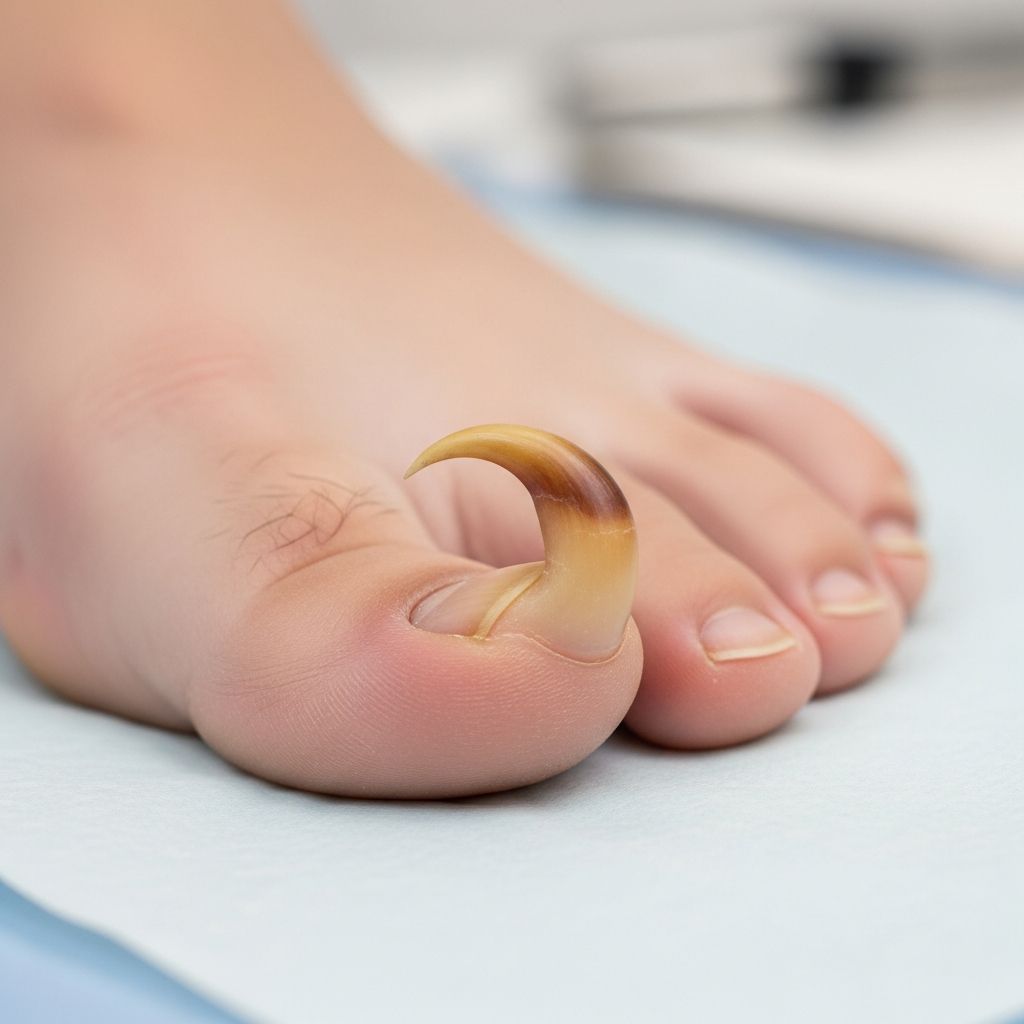
Curled toenails, medically known as
onychogryphosis
or ram’s horn nails, involve abnormally thickened, overgrown, and curved toenails, most often affecting the big toe. This condition causes discomfort, pain, and mobility issues if untreated, but various treatments restore nail health and alleviate symptoms.What Are Curled Toenails?
Curled toenails develop when nails grow excessively thick and curve dramatically, resembling a ram’s horn. Primarily impacting the great toe, it can affect other toes too. The nail hardens, discolors, and deforms the nail bed, leading to pain during walking or wearing shoes.
Aging reduces blood flow and slows nail growth, promoting thickening. Neglected hygiene exacerbates overgrowth. Unlike pincer nails, which pinch inward transversely, onychogryphosis curves longitudinally outward.
Symptoms of Curled Toenails
Symptoms progress gradually, starting with minor thickening and escalating to severe deformity. Key signs include:
- **Thickened, curved nails**: Nails become excessively dense and claw-like, often yellow-brown or gray.
- **Pain and tenderness**: Pressure from shoes causes soreness; advanced cases hinder walking.
- **Discoloration**: Shift to yellow, brown, or black from debris or infection.
- **Trimming difficulty**: Hardened nails resist standard clippers, risking injury.
- **Infection risk**: Trapped bacteria lead to paronychia or cellulitis.
In pincer nail deformity (PND), a related condition, nails curve inward at sides, causing inflammation and infections. Spoon nails curve outward softly, often from iron deficiency.
Causes of Curled Toenails
Onychogryphosis arises from multiple factors, often combined. Primary causes:
- **Aging**: Nails thicken naturally; reduced circulation promotes overgrowth.
- **Trauma**: Ill-fitting shoes, stubbing, or sports injuries damage the nail matrix repeatedly.
- **Poor circulation**: Peripheral artery disease or diabetes impairs nutrient delivery.
- **Fungal infections**: Onychomycosis weakens structure, encouraging irregular growth.
- **Genetics**: Hereditary predisposition leads to curved, thick nails.
- **Medical conditions**: Psoriasis, ichthyosis, or yellow nail syndrome contribute.
Other curvatures have distinct etiologies: spoon nails link to iron deficiency anemia; clubbed nails (tip curving) to lung issues or heredity; ingrown nails from tight shoes. PND ties to microcirculation changes, trauma, or osteophytes.
Curled Toenails vs. Other Nail Conditions
| Condition | Description | Key Causes | Symptoms |
|---|---|---|---|
| Onychogryphosis (Ram’s Horn) | Thick, longitudinally curved outward | Aging, trauma, poor circulation | Pain, discoloration, hard to trim |
| Pincer Nails | Inward transverse curvature | Genetics, trauma, AVF | Severe pain, inflammation |
| Spoon Nails (Koilonychia) | Soft, concave upward | Iron deficiency, hypothyroidism | Holds water droplet, brittle |
| Clubbed Nails | Tip curves over rounded fingertip | Lung disease, heart issues | Soft nail bed, increased angle |
| Ingrown Nails | Sides curve into skin | Tight shoes, improper cutting | Redness, swelling, infection |
When to See a Doctor for Curled Toenails
Seek podiatric care if nails thicken suddenly, cause persistent pain, show pus/drainage, or accompany systemic symptoms like fatigue or swelling. Diabetics or those with circulation issues warrant prompt evaluation to avert complications.
Diagnosis involves visual exam, history review, and tests like fungal cultures, X-rays for bone spurs, or bloodwork for anemia. Early intervention prevents progression.
Diagnosis of Curled Toenails
Podiatrists assess via:
- Clinical exam: Nail shape, thickness, surrounding skin.
- Patient history: Trauma, shoes, family traits, comorbidities.
- KOH prep or culture: Rule out fungus.
- X-rays: Detect subungual exostosis.
- Biopsy: Rare, for tumors or psoriasis.
Related Stories



PND classification uses Baran types: omega (type 1), plicated (type 2), tile-shaped (type 3).
Treatment Options for Curled Toenails
Treatments range conservative to surgical, based on severity.
Conservative Treatments
- **Professional trimming**: Podiatrist uses specialized tools for safe debridement.
- **Topical antifungals**: For onychomycosis, e.g., ciclopirox.
- **Padding/orthotics**: Reduce pressure; wider shoes help.
- **Urea cream**: Softens nails for easier filing.
Surgical Treatments
- **Partial avulsion**: Removes deformed portion; nail may regrow normally.
- **Matrixectomy**: Phenol/alcohol ablation prevents regrowth.
- **Nail bed reconstruction**: For severe cases.
PND management mirrors: conservative filing or surgery like nail plate removal with matrix ablation.
Prevention Tips for Curled Toenails
- Trim straight across, not rounded; avoid cuticles.
- Wear well-fitting shoes with toe room.
- Maintain foot hygiene; dry between toes.
- Manage comorbidities: Control diabetes, treat fungus promptly.
- Regular podiatry visits for at-risk individuals.
Balanced diet with iron, biotin supports nail health.
Frequently Asked Questions (FAQs)
What causes toenails to curl?
Curled toenails stem from aging, trauma, poor circulation, fungal infections, or genetics. Repeated pressure deforms the nail matrix.
Are curled toenails painful?
Yes, they cause pain from shoe pressure and infection risk. Severity varies with growth stage.
Can curled toenails be fixed?
Yes, via trimming, antifungals, or surgery like matrixectomy. Early treatment yields best outcomes.
Do curled toenails indicate serious disease?
Often not, but linked to diabetes, psoriasis, or anemia. Consult a doctor for associated symptoms.
How to straighten curled toenails at home?
Avoid home fixes on thick nails; risk injury. Soak, file gently, use urea ointment, but see a professional.
Is onychogryphosis contagious?
No, unless fungal; treat underlying infection.
References
- Onychogryphosis – Causes, Symptoms, and Treatment Options — University Foot and Ankle Institute / Balance Health. 2024. https://balancehealth.com/services/onychogryphosis-causes-symptoms-and-treatment-options/university-foot-and-ankle-institute/
- Curved nails: Causes of spoon nails and curved tips and sides — Medical News Today. 2023-05-30. https://www.medicalnewstoday.com/articles/curved-nails
- Pincer Nail Deformity: Clinical Characteristics, Causes, Managements — National Library of Medicine (PMC). 2020-04-22. https://pmc.ncbi.nlm.nih.gov/articles/PMC7180426/
Similar Articles








Read full bio of Sneha Tete