Cutaneous Adverse Reactions to Antibiotics
Exploring skin reactions from antibiotics: from common rashes to life-threatening conditions like SJS/TEN.
Cutaneous adverse drug reactions (ADRs) to antibiotics represent a significant clinical challenge, accounting for 10–30% of all ADRs, with antibiotics being the leading cause. These reactions range from mild morbilliform rashes to severe, potentially fatal conditions like Stevens-Johnson syndrome/toxic epidermal necrolysis (SJS/TEN), affecting 2–3% of hospitalized patients, some fatally.
What are adverse drug reactions?
Adverse drug reactions (ADRs) are unintended, harmful responses to medications occurring at normal doses. In hospitals, 2–3% of inpatients experience ADRs, with one in 20 potentially fatal. Cutaneous manifestations comprise 10–30% of these, predominantly from antibiotics, varying from mild-to-moderate (most cases) to severe in 0.1–2%.
Who gets cutaneous ADRs from antibiotics?
Anyone can develop these reactions, but risk factors include immunodeficiency (e.g., HIV), extremes of age, polypharmacy, and prior drug exposure. Immunocompromised patients, such as those with HIV using co-trimoxazole for Pneumocystis jirovecii pneumonia, face up to 27% incidence. Children under 5 and those aged 6–19 show high rates, with 18.2% experiencing moderate-to-severe allergies.
Classification of ADRs
ADRs divide into non-immunological (80%) and immunological (20%) types. Non-immunological include dose-related toxicity, side effects, drug interactions, and intolerance. Immunological reactions follow four Gell and Coombs types:
- Type I (IgE-mediated): Immediate hypersensitivity like urticaria, angioedema, anaphylaxis, within minutes to hours.
- Type II (cytotoxic): Antibody-mediated cell destruction, e.g., haemolytic anaemia, thrombocytopenia.
- Type III (immune complex): Serum sickness-like reactions with fever, rash, arthralgia.
- Type IV (delayed, T-cell mediated): Most common for antibiotics, including morbilliform eruptions (7–10 days onset), maculopapular rashes, SJS/TEN, DRESS, AGEP.
Severe reactions like SJS/TEN involve complex mechanisms, often T-cell mediated.
Clinical features of cutaneous ADRs to antibiotics
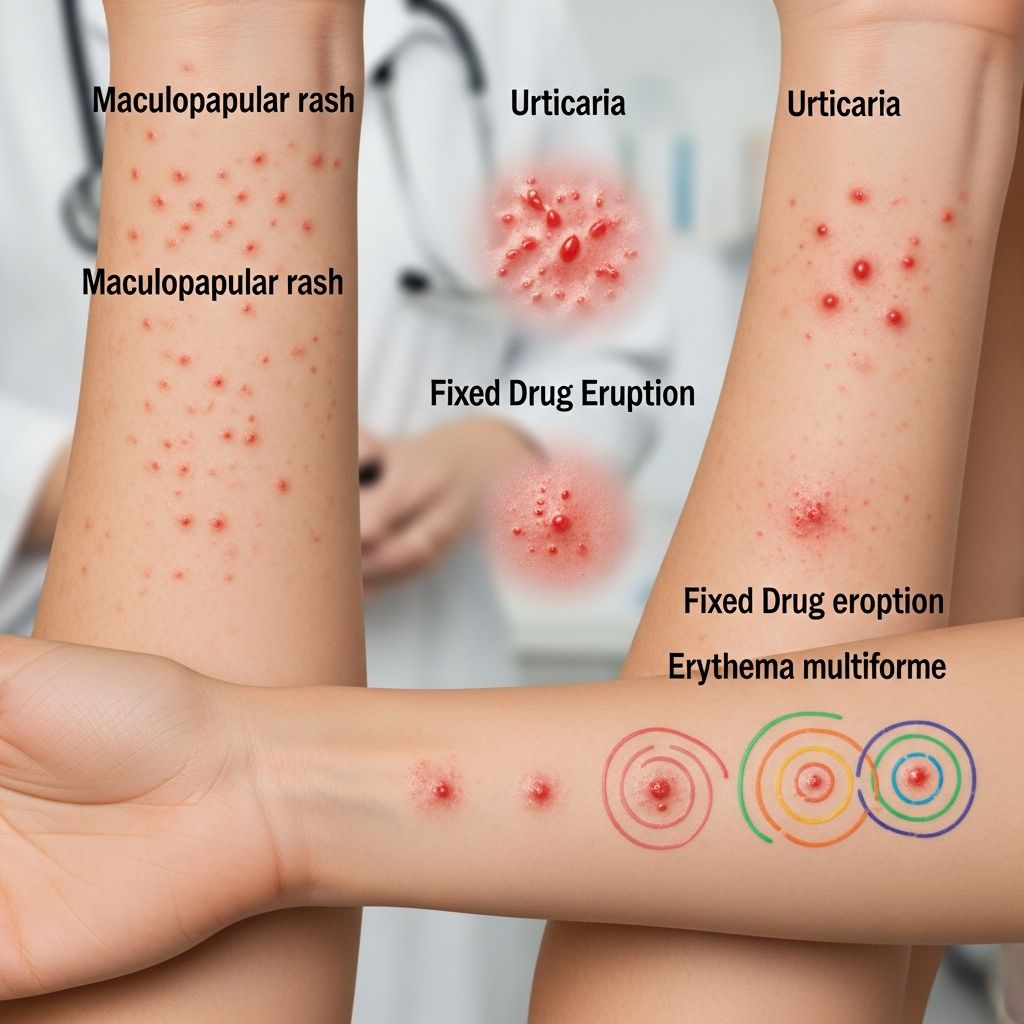
Rashes are typically morbilliform (measles-like) or urticarial. Onset is usually 7–10 days post-exposure; rapid onset suggests non-immunological or prior sensitization. Common patterns:
- Morbilliform exanthema: Symmetrical trunk-to-extremities red macules/papules.
- Urticaria: Transient wheals, itchy.
- Fixed drug eruptions: Recurrent oval erythematous patches.
- SJS/TEN: Mucosal erosions, skin detachment (>10% body surface in TEN).
- AGEP: Widespread sterile pustules on edematous erythema.
- DRESS: Rash, eosinophilia, organ involvement.[10]
Diagnosis
Diagnosis relies on history, timing, and exclusion of mimics. Re-challenge is avoided due to risk. Tools include:
- Skin biopsy: Confirms patterns like interface dermatitis in SJS.
- Patch/intradermal testing: 6.6–100% sensitivity for antibiotics, higher for DRESS.
- Lymphocyte transformation test: Identifies culprit in 46–56% cases.
Differentials: Viral exanthems (e.g., measles), bacterial infections, autoimmune diseases.
Differential diagnosis
Key mimics include:
- Infectious rashes (EBV, CMV, HIV seroconversion).
- Other drug eruptions (e.g., anticonvulsants).
- Autoimmune: Erythema multiforme, vasculitis.
- Malignancy: Lymphoma.
Which antibiotics cause cutaneous reactions?
Numerous antibiotics implicated; beta-lactams most common due to structure triggering IgG/IgE.
Beta-lactam antibiotics
Penicillins, cephalosporins, carbapenems, monobactams. Cause 50% of cases. Reactions: anaphylaxis, morbilliform (90%), urticaria, SJS/TEN, serum sickness. Cross-reactivity penicillin-cephalosporin ~10%; avoid cephalosporins post-penicillin anaphylaxis. Carbapenems safe post-penicillin reaction per testing.
Related Stories



| Drug Class | Common Reactions |
|---|---|
| Penicillins (e.g., amoxicillin) | Morbilliform, urticaria, anaphylaxis, SJS/TEN |
| Cephalosporins | Similar to penicillins, cross-reactivity |
| Carbapenems | Generally safe if penicillin allergy non-severe |
Fluoroquinolones
Current ones: tendinopathy, QT prolongation; cutaneous: morbilliform, photosensitivity, SJS/TEN.
Sulfonamides (e.g., co-trimoxazole)
Highest incidence (3–8%); morbilliform/urticaria common, SJS/TEN severe. HIV risk 27%. Avoid trimethoprim/sulfamethoxazole separately if reacted.
Other antibiotics
- Macrolides (e.g., erythromycin): Cholestatic jaundice, rare SJS.
- Tetracyclines: Photosensitivity, pigmentation (minocycline), FDE.
- Clindamycin: SDRIFE, maculopapular.
- Vancomycin: Red man syndrome, DRESS, linear IgA bullous dermatosis.
- Metronidazole: FDE, SDRIFE.
Management
Immediate withdrawal of suspect antibiotic is key. Symptomatic: antihistamines/steroids for mild; IVIG, cyclosporine for SJS/TEN. Limit antibiotics; alternatives like isotretinoin for acne. Educate on avoidance and cross-reactivity.
Prevention
History-taking crucial; label allergies accurately (many penicillin ‘allergies’ unfounded). Use narrow-spectrum when possible, test for allergies. High-risk patients: desensitization or alternatives (e.g., carbapenems post-penicillin).
Investigations
- Bloods: Eosinophilia (DRESS), liver/renal function.
- Patch testing: Post-resolution, 4–6 weeks.
- Biopsy: Essential for severe cases.
Outlook
Mild reactions resolve in days-weeks post-withdrawal; severe (SJS/TEN) mortality 10–50%, sequelae like scarring. Recurrence risks high on re-exposure.
Table: Common Cutaneous ADRs by Antibiotic Class
| Antibiotic Class | Frequency | Key Reactions |
|---|---|---|
| Beta-lactams | Most common | Morbilliform (90%), urticaria, SJS/TEN |
| Sulfonamides | 3–8% | Morbilliform, SJS/TEN (high in HIV) |
| Fluoroquinolones | Moderate | Photosensitivity, tendinopathy |
| Tetracyclines | Variable | Pigmentation, FDE |
Frequently Asked Questions (FAQs)
What is the most common skin reaction to antibiotics?
Morbilliform (maculopapular) eruption, resembling measles, typically 7–10 days after starting.
Can I take cephalosporins if allergic to penicillin?
Avoid if history of anaphylaxis; low cross-reactivity (~2%) otherwise. Consult allergist.
How serious can antibiotic rashes get?
Most mild, but severe like SJS/TEN can be fatal (0.1–2% cases).
Is sulfa allergy the same as sulfate allergy?
No; sulfonamide antibiotics distinct from sulfates/sulfites.
What to do if I get a rash on antibiotics?
Stop drug, seek medical advice immediately; do not rechallenge.
References
- Cutaneous adverse reactions to antibiotics — DermNet NZ. 2023. https://dermnetnz.org/topics/cutaneous-adverse-reactions-to-antibiotics
- Sulfonamides (Sulfa Drugs) And The Skin — DermNet NZ. 2023. https://dermnetnz.org/topics/sulfa-drugs-and-the-skin
- The assessment of severe cutaneous adverse drug reactions — PMC (NIH). 2022-05-01. https://pmc.ncbi.nlm.nih.gov/articles/PMC9081939/
- Cutaneous Adverse Drug Reactions to Antibiotics — Juniper Publishers. 2019. https://juniperpublishers.com/jojdc/pdf/JOJDC.MS.ID.555666.pdf
- Drug eruptions — DermNet NZ. 2023. https://dermnetnz.org/topics/drug-eruptions
Similar Articles








Read full bio of medha deb