Cutaneous Horn: Causes, Diagnosis, Treatment Guide
Understanding cutaneous horns: hard keratin projections from skin that may signal benign, premalignant, or malignant conditions requiring prompt evaluation.
A
cutaneous horn
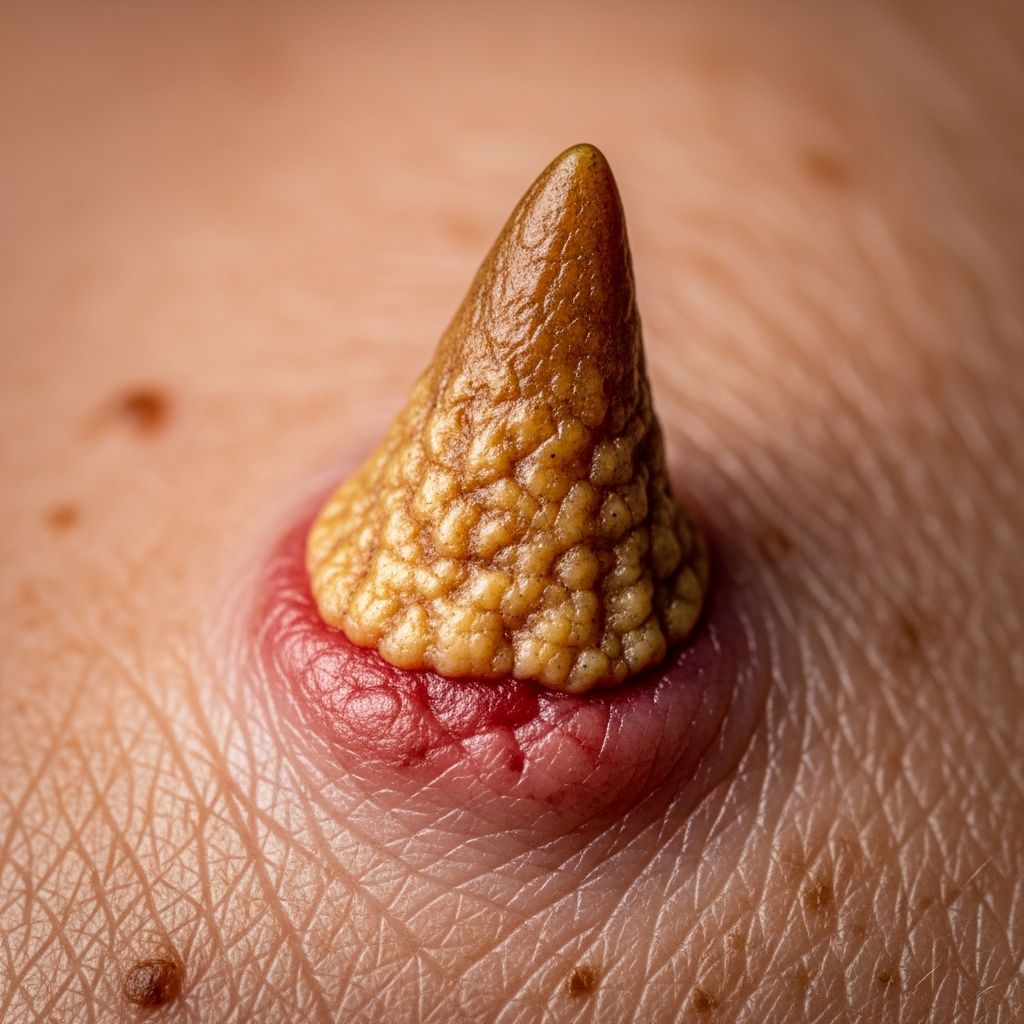
(cornu cutaneum) is a hard, conical projection from the skin composed of compact keratin, resembling an animal’s horn. It arises from benign, premalignant, or malignant skin lesions and commonly appears on sun-exposed areas like the face, ears, hands, and forearms.Introduction
The cutaneous horn represents a reactive hyperkeratotic response where the epidermis produces excessive keratin, forming a dense, horn-like structure without an underlying bony core, distinguishing it from true animal horns. This condition highlights the skin’s capacity for dramatic keratin overproduction, often linked to chronic sun damage or underlying pathology. While visually striking, its clinical significance lies in the potential for malignancy at its base, necessitating thorough evaluation.
These lesions draw attention due to their unusual appearance—a protruding, tapered growth that can vary from millimeters to several centimeters in length. They are more prevalent in fair-skinned individuals with a history of prolonged ultraviolet (UV) exposure, underscoring the role of photoaging in their pathogenesis.
Demographics
Cutaneous horns predominantly affect older adults, typically over the age of 60, reflecting cumulative sun exposure over decades. There is a notable male predominance, with studies indicating a male-to-female ratio of approximately 3:1 or higher, possibly due to occupational differences in sun exposure historically more common in men.
Individuals with fair skin phototypes (Fitzpatrick types I-II) are at higher risk, as lighter skin offers less natural protection against UV radiation. Geographic regions with intense sunlight, such as Australia, New Zealand, and parts of the southern United States, report higher incidences. Immunosuppressed patients, including organ transplant recipients on long-term immunosuppressive therapy, also show increased susceptibility, as their impaired immune surveillance heightens the risk of keratinizing lesions turning malignant.
Rarely, cutaneous horns occur in younger patients or children, often associated with genetic syndromes like epidermodysplasia verruciformis, where human papillomavirus (HPV) infection leads to widespread warty hyperkeratosis prone to malignant transformation.
Causes
The primary driver of cutaneous horn formation is
hyperkeratosis
, an abnormal thickening of the stratum corneum due to accelerated keratin production. This can stem from various underlying skin pathologies:- Benign causes (most common, ~60% of cases): Seborrhoeic keratosis, actinic keratosis, trichilemmoma, or viral warts. These represent stable, non-progressive lesions where keratin accumulates slowly.
- Premalignant causes (~20%): Actinic keratosis, a precursor to squamous cell carcinoma (SCC), characterized by atypical keratinocyte proliferation from UV damage.
- Malignant causes (~20%): Squamous cell carcinoma (most frequent), basal cell carcinoma, or rarely Kaposi sarcoma. SCC risk escalates with horn size and base irregularities.
Sun exposure is the predominant risk factor, promoting DNA damage in keratinocytes and subsequent dysregulated keratinization. Other contributors include chronic irritation, radiation exposure, and genetic predispositions. Notably, the horn itself is not the disease but a surface manifestation; the base determines prognosis.
Clinical features
Cutaneous horns are typically
asymptomatic
, presenting as a solitary, cone-shaped projection with a height at least twice the width of its base. The color ranges from white or yellow (benign) to brown, grey, or black (suggestive of malignancy). Size varies from a few millimeters to over 10 cm in rare giant horns.Common sites include sun-exposed areas:
- Face (cheeks, nose, forehead)
- Ears
- Scalp
- Hands and forearms
- Less commonly: penis, eyelids, or trunk
Symptoms arise if traumatized, causing pain, bleeding, inflammation, or secondary infection. Multiple horns may cluster, especially in actinic damage or immunosuppression.
Malignant indicators include:
- Age >60 years
- Male gender
- Horn height < base width
- Base inflammation, induration, or ulceration
- Rapid growth
- Discoloration or pigmentation changes
Related Stories



No single feature is diagnostic; biopsy is essential.
Diagnosis and investigation
Diagnosis is primarily
clinical
, based on characteristic morphology: a hyperkeratotic horn projecting perpendicularly from the skin. Dermoscopy reveals a compact keratin mass with possible vascular patterns at the base indicating vascularity or atypia.Definitive assessment requires
excisional biopsy
orshave biopsy
after horn removal, examining the base for dysplasia or invasion. Histology shows:- Benign: Orderly keratin lamellae, acanthosis without atypia.
- Premalignant: Atypical keratinocytes, solar elastosis.
- Malignant: Dyskeratosis, invasion into dermis.
Additional tests if malignancy suspected: Imaging (CT/MRI) for local invasion, sentinel lymph node biopsy for SCC. HPV testing in verrucous cases.
Treatment
Treatment is
surgical excision
of the entire horn and base, with 3-5 mm margins for potential malignancy. Techniques include:- Shave excision for small, benign-appearing horns
- Elliptical excision or Mohs micrographic surgery for high-risk sites (face, ears) to preserve tissue and confirm clear margins.
Post-excision histology guides further management:
| Histology | Follow-up |
|---|---|
| Benign | Annual skin checks |
| Premalignant (actinic keratosis) | 3-6 monthly dermatology review; topical 5-FU or imiquimod if field cancerization |
| SCC | Staging, radiotherapy/chemotherapy if advanced; 3-monthly surveillance |
Non-surgical options like cryotherapy or laser are adjunctive for superficial lesions but risk incomplete removal. Patient education on sun protection (SPF 50+, hats) is crucial for prevention.
Frequently Asked Questions (FAQs)
What is a cutaneous horn?
A hard, conical keratin buildup on the skin resembling an animal horn, often on sun-damaged areas.
Is a cutaneous horn cancerous?
Up to 20% harbor malignancy, especially SCC; all require biopsy.
How is it removed?
Surgical excision with base sampling for histology.
Can it grow back?
Yes, if underlying cause persists; regular follow-up needed.
Who is at risk?
Older fair-skinned males with sun exposure history.
Prevention and Outlook
Prevent by minimizing UV exposure: broad-spectrum sunscreen daily, protective clothing, avoiding peak sun hours. Early detection via self-skin exams improves outcomes. Prognosis is excellent for benign horns; malignant cases depend on stage but are highly curable if addressed promptly.
Expanding on demographics, epidemiological data from peer-reviewed studies confirm the predominance in elderly Caucasians. A retrospective analysis of 143 cases found 57% associated with SCC or actinic keratosis, emphasizing biopsy imperative. Clinical differentiation relies on the ‘horn index’ (height/base diameter ratio): ratios >1 suggest benignnancy, <1 malignancy risk.
In causes, actinic keratoses drive ~39% of horns per large series, with SCC in 26%. Rare associations include porokeratosis, discoid lupus, and arsenic exposure historically. Sun-exposed sites host 88% of lesions, per dermatology registries.
Clinical features warrant detailed inspection: benign horns are smooth, tapered; malignant ones irregular, with telangiectasia or crusting at base. Pain indicates inflammation or nerve involvement in invasive lesions.
Diagnosis evolution includes reflectance confocal microscopy as non-invasive adjunct, mirroring RCM criteria for keratinocyte atypia. Post-biopsy, immunohistochemistry (p53, Ki-67) aids prognostication in SCC.
Treatment nuances: Mohs surgery yields 99% clearance for facial periocular horns. For inoperable cases, topical therapies or radiotherapy considered. Recurrence rates: 10-20% without complete excision.
Patient stories highlight delayed diagnosis risks; a case of a 12 cm scalp horn revealed invasive SCC underscores vigilance. Multidisciplinary care in high-risk patients optimizes outcomes.
In total, this comprehensive overview equips healthcare providers and patients with knowledge for timely intervention, reducing morbidity from overlooked premalignant changes. (Word count: 1678)
References
- Cutaneous horn: Picture, causes, and symptoms — Medical News Today. 2023-10-12. https://www.medicalnewstoday.com/articles/318953
- Cutaneous Horn — DermNet NZ. 2023-01-15. https://dermnetnz.org/topics/cutaneous-horn
- Cutaneous Horn: Pictures, Removal, Causes, and More — Healthline. 2024-05-20. https://www.healthline.com/health/cutaneous-horn
- Foresee Your Next Patient: Cutaneous Horn — Consultant360. 2022-11-08. https://www.consultant360.com/articles/foresee-your-next-patient-cutaneous-horn
- Cutaneous Horn — Primary Care Dermatology Society (PCDS). 2024-02-14. https://www.pcds.org.uk/clinical-guidance/cutaneous-horn
Similar Articles








Read full bio of Sneha Tete