Cutaneous Markers of Internal Malignancy
Skin signs that signal hidden cancers: Early detection through dermatological clues and paraneoplastic syndromes.
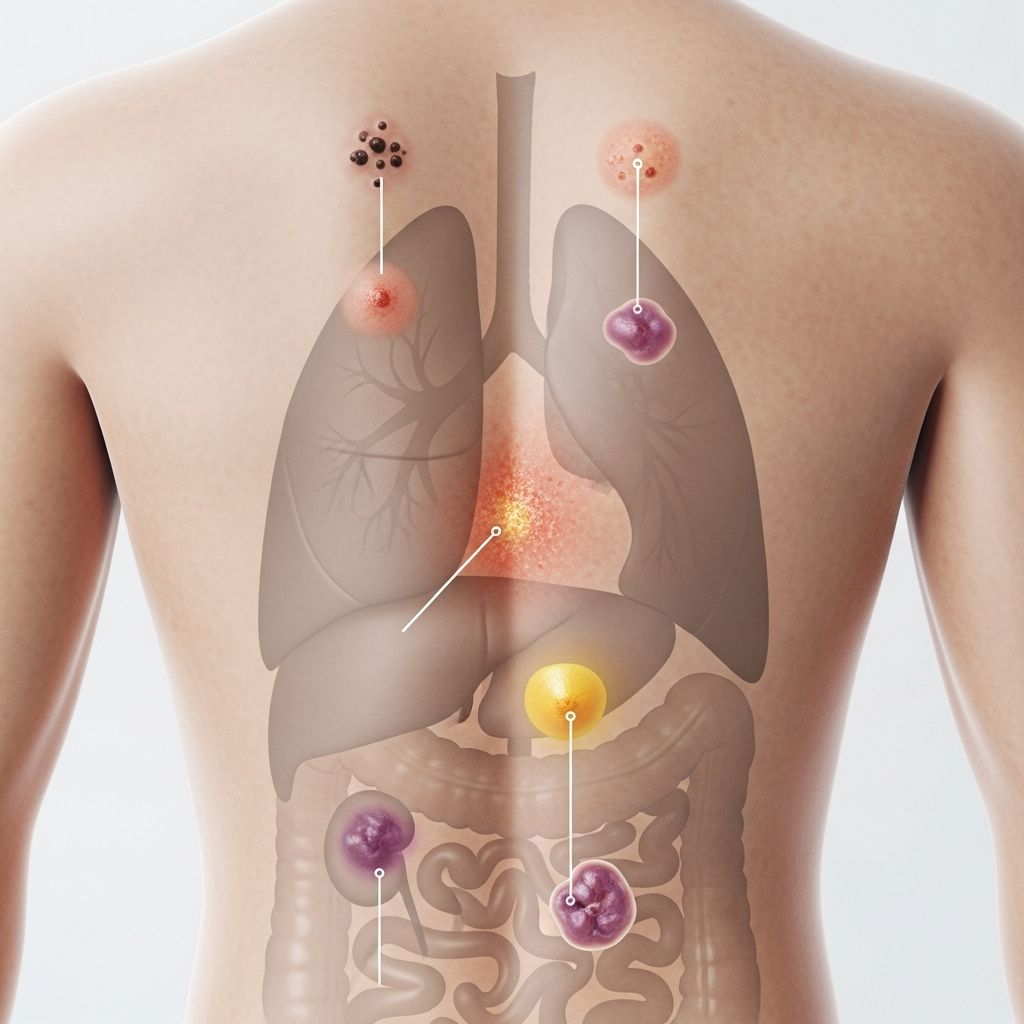
Skin changes may be the first sign of an internal problem including a visceral malignancy. Signs of skin disease may precede, occur with, or follow the detection of associated cancer. These skin diseases can be a feature of undiagnosed cancer and may prompt a thorough examination in patients. In a patient whose cancer is in remission, these skin diseases may be the initial sign of cancer recurring.
What are Cutaneous Markers of Internal Malignancy?
Cutaneous markers of internal malignancy refer to skin alterations directly or indirectly linked to underlying cancers. These manifestations arise from tumor cells invading the skin, direct extension, metastases, or remote effects via paraneoplastic mechanisms where no tumor cells are present in the skin. Up to 20% of cancer patients experience paraneoplastic syndromes, often unrecognized, and these findings may aid early malignancy identification.
Cutaneous markers can be classified into two major types: direct (non-paraneoplastic) and indirect (paraneoplastic).
Direct (Non-paraneoplastic) Markers
These involve the presence of tumor cells within the skin, including direct tumor extension or metastases. Cutaneous metastasis refers to cancer cells growing in the skin from internal primaries, often developing late but sometimes preceding diagnosis. Firm, round nodules, rubbery or hard, skin-colored, red, blue, or black, may appear near the primary tumor site and ulcerate.
- Common primaries: Breast (30% skin metastases, chest/abdomen), lung (20% in males >40), melanoma (45% chance).
- Sites: Near primary (e.g., chest for breast), but can be distant.
- Patterns: Nodules, carcinoma erysipeloides (breast-like cellulitis), zosteriform, telangiectatic.
In males under 40, melanoma, colorectal, lung predominate; over 40, lung, colorectal. Females under 40: breast, colorectal, ovarian; over 40: breast, colorectal, lung.
Indirect (Paraneoplastic) Markers
No tumor cells in skin; visceral tumors secrete inflammatory, proliferative, or metabolic factors causing changes. These rare syndromes strongly correlate with specific cancers.
Specific Cutaneous Paraneoplastic Syndromes
Cutaneous paraneoplastic syndromes are categorized by lesion type: papulosquamous, erythematous, bullous, ichthyosiform, acanthotic, sclerotic, among others.
Papulosquamous Syndromes
- Tripe Palms (Acanthosis Palmaris): Velvety, ridged palms resembling cow stomach lining. 90% associated with malignancy, often gastric/bronchogenic; coexists with acanthosis nigricans.
- Sign of Leser-Trélat: Sudden multiple seborrhoeic keratoses eruption. Controversial but valid in young patients; linked to gastric/colon adenocarcinoma, lymphoproliferative disorders.
Erythematous Syndromes
- Erythema Gyratum Repens: Wood-grain annular erythema, rapid migration. Strongly malignancy-associated (lung, breast).
- Acrokeratosis Paraneoplastica (Bazex Syndrome): Psoriasis-like acral/nail changes (hyperkeratosis, nail dystrophy). Upper aerodigestive carcinomas.
- Dermatomyositis: Heliotrope rash, Gottron papules, shawl sign, holster sign. 18-25% adult cases malignancy-linked (ovary, lung, GI); 5-7x increased risk.
Bullous Disorders
- Paraneoplastic Pemphigus: Severe mucocutaneous blisters, erosions. 84% hematologic (NHL, CLL); autoantibodies cross-react.
- Necrolytic Migratory Erythema: Glucagonoma-related; erythematous, crusted, circinate patches on lower abdomen, thighs, perineum.
Acanthotic Disorders
- Acanthosis Nigricans (Malignant): Velvety hyperpigmentation (axillae, neck). Distinguish from benign: older, non-obese, sudden, extensive. Gastric adenocarcinoma (90%).
Other Notable Syndromes
- Acquired Hypertrichosis Lanuginosa: Fine lanugo-like hair on face/trunk. Lung/colon cancers.
- Necrobiotic Xanthogranuloma: Indurated yellow plaques, ulceration, periorbital. Multiple myeloma.
- Sweet Syndrome (Malignancy-Associated): 20% cases; tender plaques, fever, neutrophilia. AML, GU solids.
- Migratory Thrombophlebitis (Trousseau): Superficial veins, unusual sites (chest). Pancreatic/lung adenocarcinomas (50%).
Bowen’s Disease (Intraepidermal Carcinoma): Scaly red plaque. 75% primary skin; 25% visceral (GI/GU extension).
Related Stories



Genetic Diseases with Increased Malignancy Risk
Certain genodermatoses predispose to internal cancers:
| Condition | Skin Features | Associated Cancers |
|---|---|---|
| Xeroderma Pigmentosum | Photosensitivity, freckling | Skin, internal (lung, GI) |
| Bastex Syndrome | Palmoplantar keratoderma | Squamous cell carcinomas |
| Tuberous Sclerosis | Adenoma sebaceum | Renal, brain |
| Neurofibromatosis | Café-au-lait, neurofibromas | Pheochromocytoma, sarcoma |
| Gardner Syndrome | Cysts, lipomas | Colon carcinoma |
These syndromes feature skin signs as part of multi-system involvement.
Clinical Approach and When to Suspect Malignancy
Sudden onset, therapy-resistant dermatoses in older adults warrant investigation. Key red flags:
- Sudden, extensive acanthosis nigricans in non-obese/cachectic patient.
- Multiple eruptive seborrhoeic keratoses in young.
- Acral psoriasiform changes (Bazex).
- Wood-grain erythema (EGR).
- Neutrophilic dermatoses with hematologic workup.
Workup: Age-appropriate cancer screening, tumor markers, imaging. Treat underlying malignancy; syndromes often resolve.
Frequently Asked Questions (FAQs)
What percentage of cancer patients develop paraneoplastic skin syndromes?
Up to 20%, though often unrecognized.
Can skin signs precede cancer diagnosis?
Yes, in rare cases like metastases or paraneoplastic syndromes, prompting investigation.
What is the most common source of skin metastases?
Breast cancer (30%), followed by lung and melanoma.
How to differentiate malignant acanthosis nigricans?
Older, non-obese, sudden onset, extensive, cachectic patient.
Is Leser-Trélat sign reliable?
Controversial in elderly, but significant in young with GI/lymphoma links.
What cancers link to dermatomyositis?
Ovary, lung, stomach; screen adults over 40.
References
- Cutaneous Manifestations of Internal Malignancy — Kittridge, POMA Conference Handout. 2018. https://poma.memberclicks.net/assets/docs/Conferences/D8-Handouts/POMA%20D8%2018-Kittridge-CutaneousManifestations.pdf
- Cutaneous Markers of Internal Malignancy — DermNet NZ. 2023 (updated). https://dermnetnz.org/topics/cutaneous-markers-of-internal-malignancy
- Cutaneous Metastasis from Internal Malignancies — PMC/NIH. 2023-09-22. https://pmc.ncbi.nlm.nih.gov/articles/PMC10486998/
- Skin Metastasis — DermNet NZ. 2023 (updated). https://dermnetnz.org/topics/skin-metastasis
- Tripe Palms — DermNet NZ. 2023 (updated). https://dermnetnz.org/topics/tripe-palms
Similar Articles








Read full bio of medha deb