Cutaneous Mosaicism: Genetic Patterns in Skin
Understanding cutaneous mosaicism: genetic mutations creating diverse skin patterns and birthmarks.
Understanding Cutaneous Mosaicism
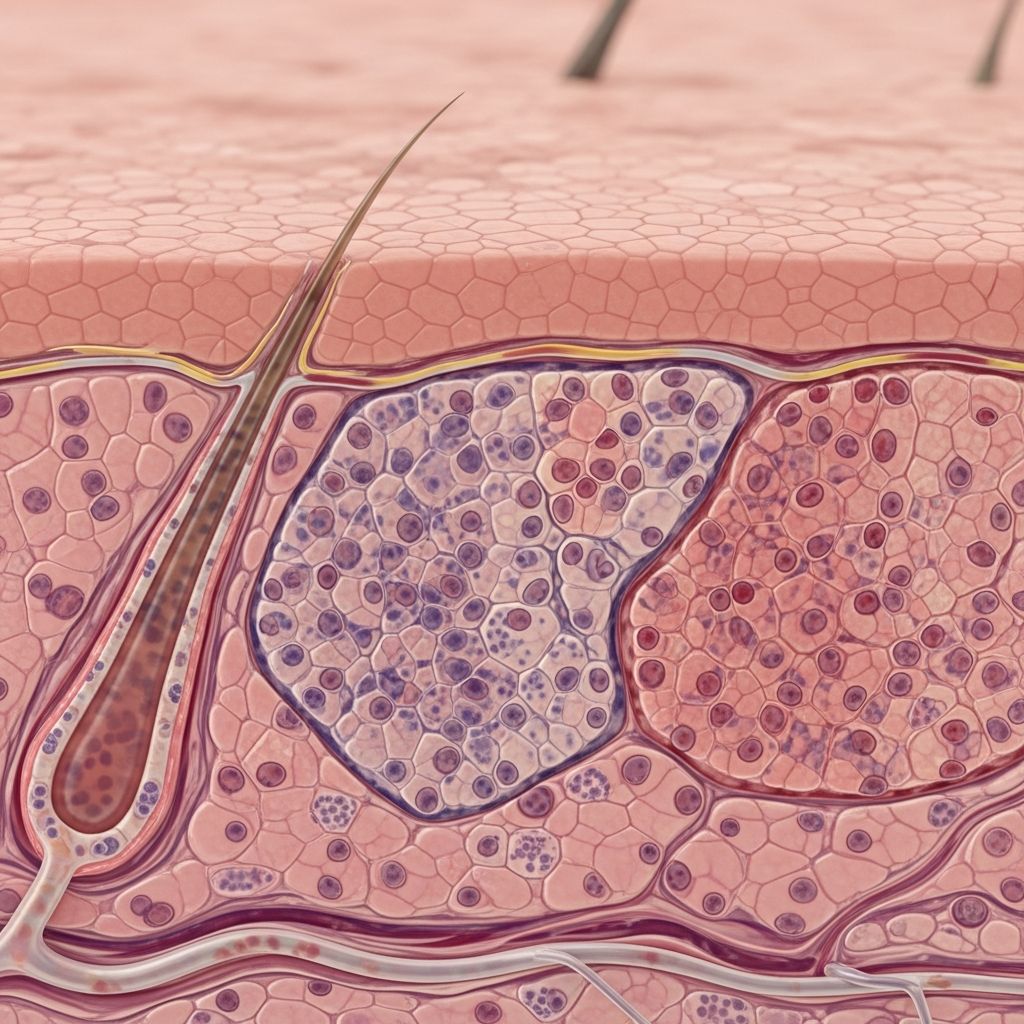
Cutaneous mosaicism describes an individual composed of two or more genetically different populations of cells existing side by side within the skin. These distinct cell lines develop very early in the life of the embryo, arising from a single genetically uniform fertilized egg (zygote) that undergoes genetic changes in specific cells during early development. This fascinating phenomenon creates a patchwork of genetically distinct tissues, leading to visible and sometimes clinically significant variations in skin appearance and function.
Many genetic skin disorders reflect cutaneous mosaicism as their underlying mechanism. Rather than affecting the entire body uniformly, mosaic conditions create localized or segmental patterns of disease. Understanding mosaicism is essential for dermatologists, geneticists, and other healthcare professionals involved in diagnosing and managing these complex conditions.
Major Genetic Categories of Cutaneous Mosaicism
Cutaneous mosaicism is classified into distinct genetic categories based on the distribution pattern and severity of affected tissue. These categories help clinicians identify the underlying mechanism and predict potential complications, including the risk of germline involvement.
| Type | Pattern Description | Clinical Example |
|---|---|---|
| Type 1 | Linear patterns along Blaschko lines with normal surrounding skin | Epidermal nevi |
| Type 2 | Affected area with milder manifestation in surrounding skin | Actinic porokeratosis |
| Type 3 | Phylloid (leaf-like) pattern of distribution | Various segmental disorders |
| Type 4 | Large patches without midline separation | Segmental conditions |
| Type 5 | Lateralisation with unilateral involvement | CHILD syndrome |
Blaschko Lines and Cutaneous Manifestations
Blaschko lines represent the primary anatomical pattern for many mosaic skin conditions. First described more than a century ago by German dermatologist Alfred Blaschko, these lines trace the pathways of ectodermal cell development during embryogenesis. The characteristic pattern includes linear lesions on the extremities, S-shaped configurations on the anterior trunk, and V-shaped patterns on the back.
Cutaneous lesions following Blaschko lines are a manifestation of cutaneous mosaicism, representing the lines of division between the two cell lines within embryonic skin tissue. However, cutaneous mosaicism does not always follow Blaschko lines, which may relate to the timing of when the mosaicism arises during embryonic development. Early mutations may follow Blaschko lines more consistently, while later mutations may create different patterns entirely.
Pattern Variations in Mosaic Skin Lesions
- Linear streaks and swirls along Blaschko lines
- Wavy or S-shaped configurations on the trunk
- V-shaped patterns on the back
- Round or oval patches in segmental distribution
- Checkerboard-like patterns in some conditions
Epidermal Nevi and Mosaicism
Epidermal nevi are classic examples of cutaneous mosaicism in which localized thickening of the epidermis is patterned along the lines of Blaschko. These common benign lesions result from a postzygotic mutation confined to affected ectodermal tissue, creating type 1 mosaicism. The molecular basis for these conditions was first established in 1994 with the discovery of keratin 10 mutations in lesional skin of patients with epidermolytic hyperkeratotic epidermal nevi, but notably absent in clinically normal skin.
Related Stories



Various forms of epidermal nevi exist, including verrucous forms showing keratinocytic changes and epidermolytic hyperkeratotic types demonstrating epidermal lysis and marked stratum corneum thickening. These histological features mirror the characteristics of epidermolytic hyperkeratosis, a generalized genetic condition caused by keratin 10 mutations, but in epidermal nevi, the mutations are restricted to affected tissue.
Clinical Presentations and Unique Birthmarks
Patients with mosaic disorders may present with unique ‘birthmarks’ due to mutations of known or unknown genes. These birthmarks represent areas of skin with different genetic programming from surrounding normal tissue. Most birthmarks have a genetic basis, arising from postzygotic mutations that occur during early fetal development.
Pigmentary mosaicism exemplifies this phenomenon, where the skin contains two or more genetically different types of cells producing different amounts of pigment. This results in areas of skin with distinctly different colors. Melanocytes produce melanin responsible for brown skin color, while other specialized cells produce the pigments responsible for red or yellowish birthmarks. The pattern and distribution of color help establish diagnosis, with variations appearing as wavy streaks, swirls, round patches, or checkerboard patterns.
Proteus Syndrome: A Notable Example of Mosaicism
Proteus syndrome exemplifies mosaicism in which the abnormal AKT1 gene in some cells produces a growth-activating protein. This condition demonstrates how a single genetic mutation in select cells can produce widespread clinical consequences. Affected individuals develop various forms of overgrowth and naevi that may progress throughout life, sometimes dramatically changing body proportions and appearance.
The progressive nature of Proteus syndrome highlights an important characteristic of many mosaic disorders: they are not static conditions but may evolve as affected cells accumulate and multiply over time. This contrasts with germline mutations, which remain constant throughout life.
Molecular Basis and Genetic Testing
Understanding the molecular mechanisms of cutaneous mosaicism has advanced significantly with modern genetic technologies. The molecular basis for somatic mosaicism in several epidermal disorders following Blaschko lines has been established, providing evidence that these lines represent pathways of ectodermal embryonic development. Studies have shown mutations in genes such as keratin 10, with these mutations confined to affected tissue rather than present throughout the body.
Mosaicism has also been shown to reverse clinical phenotypes, particularly in patients with forms of epidermolysis bullosa, the group of generalized blistering disorders. This reversal phenomenon suggests that second-site mutations in affected tissue can compensate for or suppress the original pathogenic variant, offering potential therapeutic insights.
Diagnostic Approach and Genetic Investigation
Patients with mosaic disorders may be referred to a geneticist for evaluation and diagnosis. The affected tissue can be tested to detect somatic mutations explaining the cause of the skin disease. This usually involves whole-exome sequencing, a comprehensive approach that examines all protein-coding genes for mutations. Importantly, normal-appearing skin samples will typically show different genetic findings than affected tissue, reflecting the mosaic nature of the condition.
One continuing area of investigation is the relationship between the extent of cutaneous manifestation of mosaicism and the risk of germline involvement, which could lead to a widespread skin disorder in offspring. Keratinocyte mutations with earlier onset during the postzygotic period are theorized to be associated with lower germline mutation risk, while more extensive skin involvement is thought to be associated with higher risk.
Mesoderm Versus Ectoderm Development
Important distinctions exist between mutations affecting ectodermal tissues (from which skin epidermis develops) and mesodermal tissues (from which fibroblasts and deeper skin structures develop). Several studies have clearly demonstrated that the genotypes of keratinocytes and underlying fibroblasts do not correlate in mosaic skin conditions, confirming the different developmental patterns of ectoderm and mesoderm. This explains why some mosaic conditions affect only the epidermis while deeper skin structures remain genetically normal.
Type 2 Mosaicism and Complex Phenotypes
Rarely, an individual shows skin lesions following type 1 mosaicism pattern, but the rest of the skin shows a milder form of the disorder, termed type 2 mosaicism. This form has been observed in patients with superficial actinic porokeratosis with streaks of thick linear porokeratosis, and in those with tumor syndromes in which large numbers of cutaneous tumors are confined to segmental areas.
A notable example involves a patient who developed widely distributed, severely erythematous, and crusted plaques along Blaschko lines on the left side of her body. In contrast to typical disease onset in late childhood or young adulthood confined to intertriginous areas, these extensive plaques were first noted at only three months of age, suggesting an unusually early postzygotic mutation event.
Other Mosaic Versions of Germline Diseases
Several well-known genetic syndromes can present in mosaic form, where a mutation arises in one cell during development rather than being inherited from a parent. These conditions include:
- Mosaic neurofibromatosis type 1
- Mosaic CM-AVM syndrome
- Mosaic tuberous sclerosis
- Mosaic Darier disease
- Mosaic Gorlin syndrome
When these conditions appear in mosaic form, they typically present with segmental or limited distribution rather than the widespread manifestations seen in germline versions. Accurate diagnosis distinguishes mosaic presentations from germline forms, which has important implications for genetic counseling and recurrence risk.
Management of Pigmentary Mosaicism
Pigmentary mosaicism represents a permanent color change in the skin. The underlying genetic material cannot be changed to make skin color uniform, so management focuses on strategies to minimize visibility. Key recommendations include:
- Protection of affected areas from sun exposure
- Regular use of broad-spectrum sunscreen
- Protective clothing when feasible
- Sun avoidance during peak UV hours
- Monitoring for color changes over time
Many areas of pigmentary mosaicism covered by clothing may not be noticed until those areas receive sun exposure, as UV radiation can accentuate the color difference between affected and normal skin.
Segmental Vitiligo and Variable Mosaic Patterns
Some conditions may occur in various mosaic patterns, exemplified by segmental vitiligo. Rather than the symmetric pattern typical of generalized vitiligo, segmental vitiligo appears in localized patches, often following Blaschko lines or other segmental distributions. Understanding that segmental vitiligo represents a mosaic manifestation of the underlying genetic susceptibility helps explain its distinct clinical presentation and different prognosis compared to generalized vitiligo.
Frequently Asked Questions
Q: Is cutaneous mosaicism inherited from parents?
A: No, cutaneous mosaicism arises from a postzygotic (after fertilization) genetic mutation in a single cell during embryonic development. This event can happen to any child and is not inherited from either parent. However, if the mutation affects germline cells, there may be risk of transmission to offspring.
Q: Can cutaneous mosaicism affect internal organs?
A: While cutaneous mosaicism primarily manifests in skin, some mosaic syndromes can affect multiple body systems. For example, Proteus syndrome affects not only skin and soft tissues but can also involve skeletal and vascular systems. A geneticist should evaluate mosaic disorders for potential systemic involvement.
Q: How is cutaneous mosaicism diagnosed?
A: Diagnosis typically involves clinical examination, assessment of skin lesion patterns (particularly their relationship to Blaschko lines), and genetic testing of affected tissue. Whole-exome sequencing can identify somatic mutations confined to affected skin, distinguishing mosaic conditions from germline genetic disorders.
Q: Will pigmentary mosaicism worsen over time?
A: Pigmentary mosaicism typically remains stable throughout life, though sun exposure may make the color difference more apparent. Some progressive mosaic conditions like Proteus syndrome may evolve over time, but pure pigmentary mosaicism is generally permanent and non-progressive.
Q: What is the significance of Blaschko lines in mosaicism?
A: Blaschko lines represent the pathways of ectodermal cell development during embryogenesis. Many mosaic skin lesions follow these lines because they correspond to the developmental boundaries between different cell populations. However, not all mosaic lesions follow Blaschko lines, depending on when during development the mutation occurred.
References
- Cutaneous Mosaicism — DermNet NZ. 2024. https://dermnetnz.org/topics/cutaneous-mosaicism
- Piecing together the puzzle of cutaneous mosaicism — Journal of Clinical Investigation. 2009. https://www.jci.org/articles/view/23580
- Cutaneous Mosaicism Service — Great Ormond Street Hospital NHS Trust. 2024. https://www.gosh.nhs.uk/wards-and-departments/departments/clinical-specialties/dermatology-information-parents-and-visitors/clinics-and-wards-used-dermatology-department/cutaneous-mosaicism-service/
- What is pigmentary mosaicism? — Society for Pediatric Dermatology. 2024. https://pedsderm.net/site/assets/files/1028/spd_pigmentary_mosaicism_color_web.pdf
- Cutaneous Mosaicism — Journal of the European Academy of Dermatology and Venereology Clinical Practice. Torrelo A. 2025. https://onlinelibrary.wiley.com/doi/10.1002/jvc2.70111
- Mosaic abnormalities of the skin: review and guidelines — British Journal of Dermatology. 2025. https://academic.oup.com/bjd/article-abstract/182/3/552/6731465
Similar Articles








Read full bio of medha deb