Cutaneous Tumors: Key Histopathology Insights
Comprehensive guide to the pathology of common epithelial, melanocytic, and other skin tumours for dermatologists and pathologists.
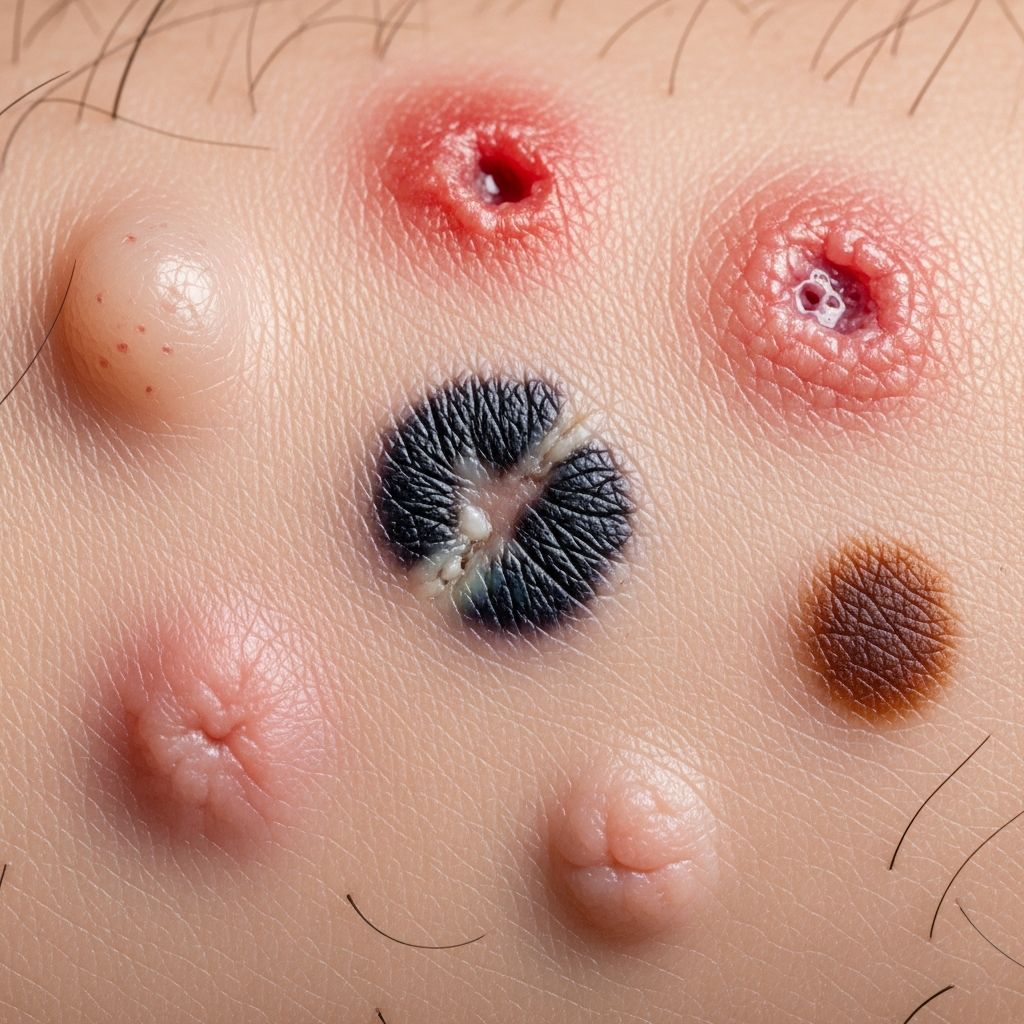
Cutaneous tumours encompass a wide spectrum of benign and malignant proliferations arising from the skin’s diverse cell types. This article outlines the pathology of key epithelial tumours, melanocytic lesions, and other significant skin neoplasms, focusing on routine haematoxylin and eosin (H&E) stained sections. Understanding these histopathological features is crucial for accurate diagnosis, management, and prognosis in dermatopathology.
Useful Terms in Dermatopathology
Before delving into specific tumours, familiarity with common dermatopathological terminology is essential. These terms describe cellular and architectural patterns observed in skin biopsies.
| Term | Description |
|---|---|
| Foam cells | Cells with bubbly cytoplasm, usually macrophages. |
| Spindle cells | Long thin cells of many cell types. |
| Squamous eddies, horn pearls, horn cysts | Concentric whorled arrangement of keratinocytes, more keratinised in the middle (marked keratinisation forms horn pearls or cysts). |
| Epidermotropism | Migration of malignant cells into the epidermis (usually lymphocytes). |
| Pagetoid spread | Individual cell spread of malignant cells in the epidermis in a ‘buckshot’ pattern. |
| Pautrier microabscesses | Clusters of atypical lymphocytes in the epidermis with little spongiosis. |
Epithelial Tumours
Seborrhoeic Keratosis
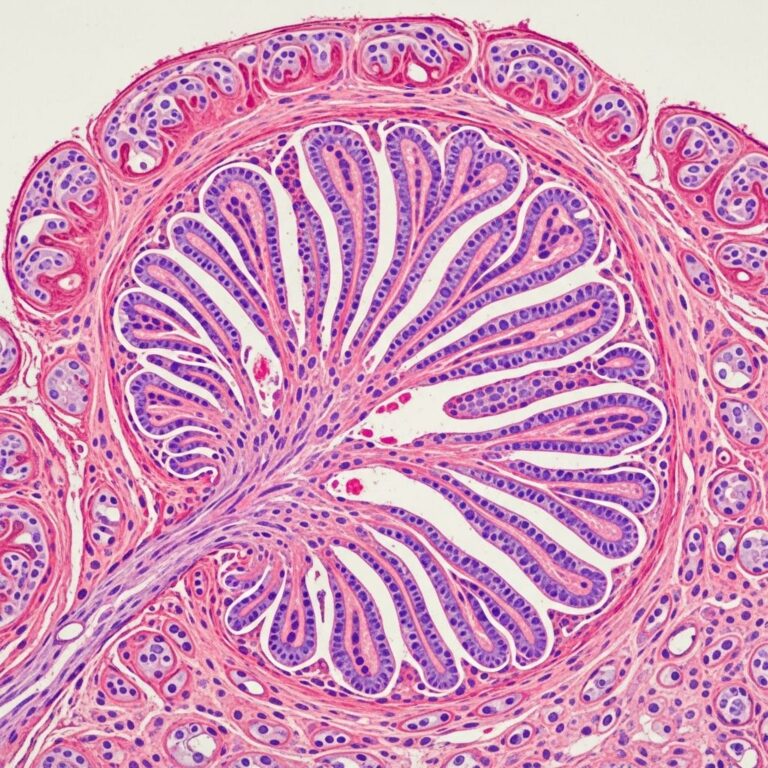
Seborrhoeic keratosis is a common benign epithelial tumour presenting as waxy, stuck-on lesions, often on sun-exposed areas in older adults. Histologically, it features a proliferation of basaloid cells attached to the epidermis with a hyperkeratotic surface. Key features include horn cysts—well-defined keratin-filled invaginations—and pseudohorn cysts containing laminated keratin or loose basophilic material. The tumour may show acanthosis, hyperkeratosis, and papillomatosis. Cells are monomorphic with small nuclei and scant cytoplasm, arranged in nests or sheets. No significant atypia or mitoses are present, distinguishing it from malignancy. Inflammatory infiltrates may occur if irritated.
Basal Cell Carcinoma
Basal cell carcinoma (BCC) is the most common skin cancer, arising from basal keratinocytes, typically in sun-damaged skin. It rarely metastasises but is locally invasive. Histological subtypes correlate with clinical behaviour and recurrence risk.
| Subtype | Histological Features |
|---|---|
| Nodular BCC | Well-demarcated tumour nodules without significant surrounding infiltration. |
| Superficial BCC | Poorly demarcated; small isolated islands attached to epidermal base, connections not visible in 2D sections, complicating margin assessment. |
| Infiltrative BCC | Small islands diffusely infiltrating dermis/subcutis; ill-defined margins, often incompletely excised, higher recurrence. |
| Micronodular BCC | Small scattered islands in dermis; prone to recurrence, perineural invasion possible but less aggressive than infiltrative. |
Common features across BCC subtypes include basaloid cells with high nuclear:cytoplasmic ratio, peripheral palisading, retraction artefact from stroma, and mucinous stroma. Mitotic figures and apoptosis are frequent. Perineural invasion indicates aggressive behaviour.
Actinic Keratosis
Actinic (solar) keratosis represents the most common precancerous skin lesion, appearing as small scaly spots on sun-exposed skin. It is superficial and non-invasive. Histology shows atypical keratinocytes confined to the lower epidermis, with nuclear hyperchromasia, pleomorphism, and disordered maturation. Parakeratosis, hyperkeratosis, and basal budding may occur. Solar elastosis in the dermis confirms UV damage. Though intraepidermal, it carries risk of progression to squamous cell carcinoma.
In-situ Squamous Cell Carcinoma
Related Stories



Also known as Bowen disease, this presents as a slowly enlarging red scaly plaque, in sun-exposed or non-exposed skin. Full-thickness epidermal atypia characterises it: keratinocytes show marked pleomorphism, hyperchromatic nuclei, numerous mitoses (including atypical forms), and dyskeratosis. Unlike actinic keratosis, atypia extends suprabasally with extensive parakeratosis and spongiosis. No dermal invasion occurs, but pagetoid spread may mimic melanoma. Overlap with actinic keratosis exists, but fuller epidermal involvement defines in-situ SCC.
Invasive Squamous Cell Carcinoma
Invasive SCC penetrates the dermis, posing metastasis risk (higher in poorly differentiated or immunosuppressed patients). It proliferates as irregular nests of atypical squamous cells from the epidermis into dermis. Differentiation grades (well, moderate, poor) assess similarity to normal keratinocytes: greater keratinisation indicates better differentiation and prognosis.
Variants include:
- Spindle cell SCC: Pleomorphic spindle-shaped cells; diagnostically challenging.
- Acantholytic (adenoid/pseudoglandular) SCC: Gland-like spaces from acantholysis; worse prognosis.
- Verrucous carcinoma: Exophytic with minimal atypia, mimicking benign; locally aggressive but rarely metastasises; diagnosis often delayed.
Desmoplastic stroma, perineural invasion, and lymphovascular invasion predict poor outcome. Grading and depth guide management.
Melanocytic Naevi
Melanocytic naevi (moles) are benign proliferations of melanocytes. Histology varies by type:
- Junctional naevi: Nests of melanocytes at dermoepidermal junction.
- Compound naevi: Junctional and dermal components; maturation with descent (type C cells deeper).
- Intradermal naevi: Purely dermal melanocytes, often ballooned or neurotised.
Features include symmetry, uniform pigmentation, lack of atypia/mitoses, and maturation. Lentiginous hyperplasia may occur. Trauma can cause pseudomelanomatous changes.
Malignant Melanoma
Malignant melanoma has high metastatic potential. Clinical types: superficial spreading, lentigo maligna, nodular, acrolentiginous, amelanotic. Histological classification focuses on the in-situ component.
- Superficial spreading melanoma: Pagetoid spread of atypical melanocytes upward in epidermis; radial growth phase before vertical invasion.
- Lentigo maligna melanoma: Atypical melanocytes along basilar epidermis in atrophic skin; prolonged radial phase.
- Nodular melanoma: Predominantly vertical growth; minimal radial phase; lacks pagetoid spread above tumour.
Melanoma cells show epithelioid or spindled morphology, cytological atypia, mitoses, necrosis, and ulceration. Breslow thickness, Clark level, ulceration, and mitoses predict prognosis. Regression (dermal fibrosis, pigment incontinence) complicates assessment.
Other Cutaneous Tumours
Beyond epithelial and melanocytic lesions, other tumours warrant mention:
- Keratoacanthoma: Rapidly growing dome-shaped nodule with central keratin plug; well-differentiated SCC-like histology but regresses spontaneously. Debate persists on benign vs low-grade malignancy.
- Pyogenic granuloma: Vascular lobules in inflamed stroma; lobular capillary haemangioma post-trauma.
- Sebaceous cysts/epidermoid cysts: Keratin-filled epidermal-lined sacs; rupture causes inflammation.
Frequently Asked Questions (FAQs)
Q: What is the most common skin cancer?
A: Basal cell carcinoma (BCC) is the most prevalent, accounting for ~80% of non-melanoma skin cancers, primarily due to UV exposure.
References
- Cutaneous tumours – Dermatopathology — DermNet NZ. 2023. https://dermnetnz.org/cme/dermatopathology/cutaneous-tumours
- Skin cancer — DermNet NZ. 2024. https://dermnetnz.org/topics/skin-cancer
- Cutaneous malignancies — Roswell Park Comprehensive Cancer Center. 2016-04-12. https://www.roswellpark.org/sites/default/files/paragh_4_12_2016.pdf
- Cutaneous Metastasis from Internal Malignancies — National Library of Medicine (PMC). 2023. https://pmc.ncbi.nlm.nih.gov/articles/PMC10486998/
- Benign Skin Tumours — Patient.info. 2024.


Read full bio of Sneha Tete