Cutis Laxa: Causes, Symptoms, and Treatment
Understanding cutis laxa: A rare connective tissue disorder affecting skin elasticity and internal organs.
What Is Cutis Laxa?
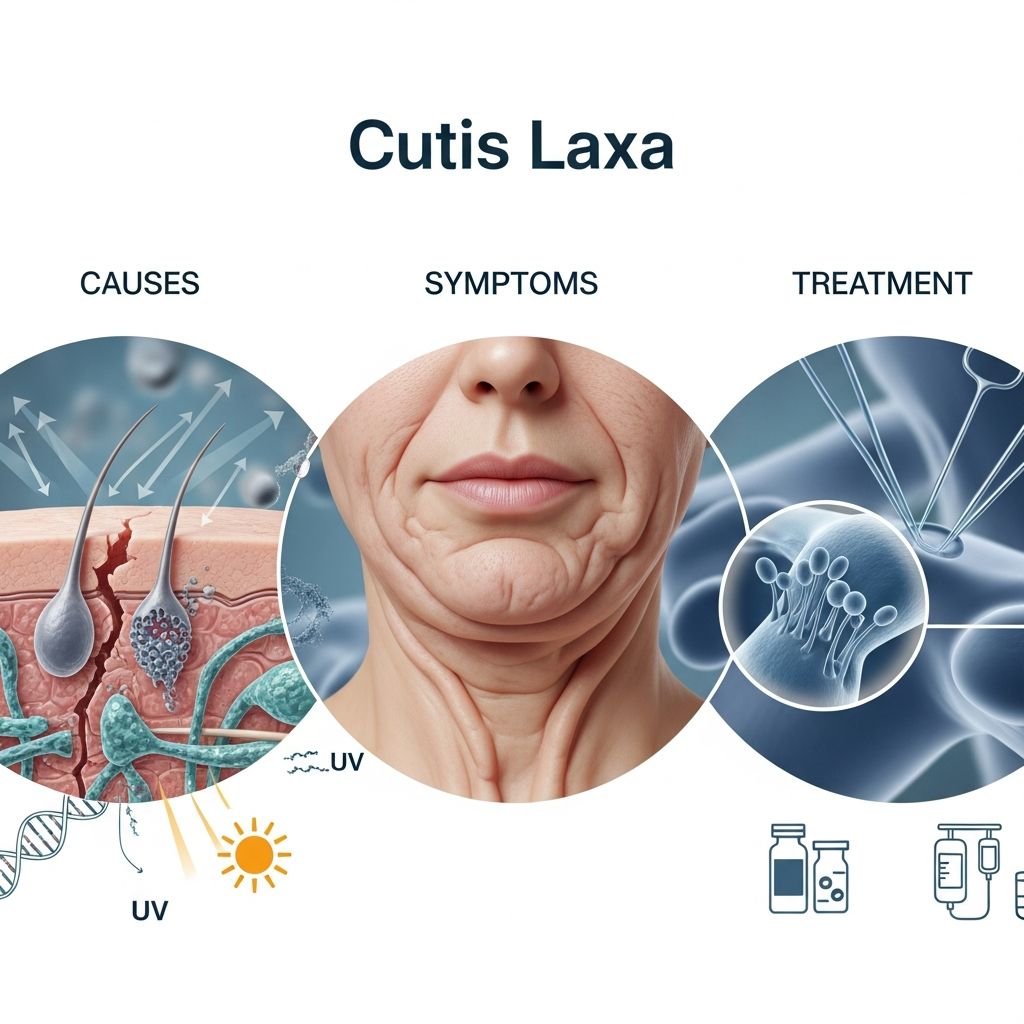
Cutis laxa is a rare group of connective tissue disorders characterized by skin that is loose, lax, wrinkled, sagging, and lacking elasticity. The term cutis laxa is Latin for “lax skin,” meaning loose skin. The condition affects connective tissue found throughout the body in muscles, joints, skin, and other organs. When the skin of individuals with cutis laxa is stretched, it returns to place abnormally slowly, and affected individuals may develop excess droopy skin, particularly on the face, arms, legs, and trunk. Cutis laxa is considered a very rare condition, affecting only about 400 families worldwide, or approximately 1 in every 2,000,000 babies.
The hallmark feature of cutis laxa disorders is the loss of skin elasticity due to abnormalities in elastic fiber formation and structure. The pathological manifestations include absence or significant reduction of elastic fibers in the dermis layer of the skin, along with residual fragments of elastic fibers after elastin staining. In some cases, perivascular inflammatory infiltration dominated by lymphocytes may be present, along with microthromboses or phagocytosis of elastic fibers by macrophages.
Types of Cutis Laxa
Cutis laxa manifests in multiple forms, classified primarily by age of onset and inheritance pattern. Understanding the different types is essential for proper diagnosis and management.
Congenital Forms
Congenital cutis laxa (CCL) is often symptomatic at birth or during infancy and shows a high degree of inheritance heterogeneity. The congenital forms include several subtypes:
- Autosomal Recessive Cutis Laxa Type 1A (ARCL1A): This form is associated with FBLN4-related mutations and is known as FBLN4-related cutis laxa or autosomal recessive cutis laxa type 1B (ARCL1B). It is a highly variable disorder that ranges from severe, life-threatening complications early in life, such as heart or lung (cardiopulmonary) failure, to cases limited to vascular disease and craniofacial abnormalities.
- Urban-Rifkin-Davis Syndrome (ARCL1C): In addition to characteristic skin symptoms, affected individuals develop joint laxity, diminished muscle tone, growth delays, and severe complications affecting the pulmonary, gastrointestinal, and urinary systems. Cardiovascular involvement is relatively mild in this type.
- Autosomal Recessive Cutis Laxa Type 3 (ARCL3): Affected individuals develop characteristic skin symptoms along with growth deficiencies, moderate to severe intellectual disability, loose joints, cataracts, and corneal abnormalities. Additional symptoms may eventually develop, including dystonia, a group of movement disorders.
- Autosomal Dominant Forms: In autosomal dominant cutis laxa, affected individuals may develop only characteristic skin symptoms, although the affected skin may worsen with age. Less often, individuals develop more serious complications including cardiovascular and pulmonary abnormalities such as aortic aneurysms, pulmonary artery disease, or emphysema.
- X-Linked Forms: Cutis laxa is mild with redundant skin on the face being the most common manifestation. Additional symptoms include joint laxity, moderate to severe scoliosis, and characteristic facial features including abnormal enlargement of the gums (gingival hyperplasia), a lower lip that is turned outward (everted), a receded jaw (retrognathia), puffy eyelids, and abnormal positioning of the teeth.
Acquired Forms
Acquired cutis laxa usually occurs in early adulthood and shows different degrees of pathological changes in the structure and quantity of elastic fibers due to the application of certain pathogenic factors to the skin. Acquired cutis laxa is sometimes broken down into type 1 and type 2. Type 1 may be associated with cutis laxa that is widespread through the body or localized to a specific area and can occur at any age, although most cases begin in adulthood. Localized forms frequently affect the face or the hands and feet, and systemic involvement may occur in some cases. Type 2 usually develops following acute inflammatory skin lesions, in which the areas affected by the skin lesions develop cutis laxa skin symptoms.
Symptoms and Clinical Manifestations
Cutis laxa symptoms vary widely and can be different even between family members, as the condition is highly heterogeneous. Generally, cutis laxa causes problems in forming elastin and connective tissue, which affects the skin but can also impact internal organs like the heart and lungs.
Skin Manifestations
The primary skin manifestations include:
- Loose, sagging, wrinkled skin that is inelastic
- Redundant and droopy skin, particularly on the face, arms, legs, and trunk
- Skin that returns abnormally slowly when stretched
- Premature aging appearance
- Characteristic facial features such as underdevelopment of the cheeks (malar hypoplasia) and a protruding jaw (prognathism)
Related Stories



Systemic Manifestations
Depending on the type and severity, cutis laxa can cause complications affecting various body systems:
- Cardiovascular: Arterial tortuosity, aortic aneurysms, cardiac hypertrophy, bradycardia, and potential heart failure
- Pulmonary: Severe breathing difficulties, cystic changes in the lungs, atelectasis, tracheomalacia, emphysema, and potential respiratory failure
- Gastrointestinal: Pouches in the intestines called diverticula
- Skeletal: Joint laxity, osteoporosis, fragile bones prone to fracture, frequent hip dislocations, and growth deficiency
- Neurological: Intellectual disability, dystonia, seizures, and brain malformations in severe forms
- Ocular: Cataracts and corneal abnormalities
Causes and Genetic Basis
Cutis laxa results from genetic mutations affecting the production or structure of elastic fibers and connective tissue proteins. The pathogenic mutations vary depending on the type of cutis laxa. For example, pathogenic mutations in the LMNA gene on chromosome 1q cause certain degenerative disorders associated with cutis laxa. The LMNA gene encodes prelamin A, which converts into lamin A, and lamin A plays a crucial role in stabilizing the nuclear membrane as a nuclear lamina structural protein.
For acquired cutis laxa, several health conditions and reactions can increase the risk of developing the condition, though the specific triggers vary by type and individual circumstances.
Diagnosis
Diagnosis of cutis laxa typically involves clinical evaluation combined with confirmatory testing. Healthcare providers assess the characteristic skin changes and conduct laboratory and imaging examinations to evaluate systemic involvement. Pathological examination of affected skin tissue reveals the hallmark finding of reduced and broken elastic fibers. Elastic fiber staining demonstrates the absence or significant reduction of elastic fibers in the dermis layer. Additional investigations may include ultrasound examination and biochemical analysis to evaluate organ involvement and rule out other connective tissue disorders.
Treatment and Management
Management of cutis laxa is primarily supportive and symptomatic, as there is no cure for the underlying connective tissue defect. Plastic surgery might be the most effective treatment for addressing the skin manifestations of the disorder. A healthcare provider can help manage symptoms and explore treatment options to protect health and improve comfort.
Treatment approaches vary depending on the type and severity of cutis laxa:
- Skin Care: Management of loose and sagging skin, which may include cosmetic procedures or surgical interventions to improve appearance and function
- Cardiovascular Monitoring: Regular evaluation and monitoring of the heart and blood vessels, particularly in forms with vascular involvement
- Pulmonary Support: Respiratory management for individuals with lung involvement, including monitoring for emphysema and other pulmonary complications
- Orthopedic Management: Treatment of joint laxity, osteoporosis, and skeletal abnormalities through physical therapy, bracing, or surgery as needed
- Multidisciplinary Care: Coordination among dermatologists, cardiologists, pulmonologists, and other specialists based on systemic involvement
Complications
Complications can vary based on the type, with milder presentations in autosomal dominant forms and more serious complications in autosomal recessive forms. Affected individuals may suffer from not only the aging skin appearance but also progressive developing diseases, including atherosclerosis, lipoatrophy, skeletal dysplasia, alopecia, and other systemic conditions. Heart and lung problems usually appear in early childhood in severe forms, and some complications can be serious or even life-threatening, which is why regular check-ups and adherence to the provider’s care plan are important.
Differential Diagnosis
Cutis laxa must be distinguished from other conditions causing premature aging or loose skin. For example, patients with Hutchinson-Gilford progeria syndrome present with characteristic facial appearance including micrognathia, prominent eyes, circumoral cyanosis, alopecia, and prominent scalp veins, along with sclerotic skin changes and reduced joint range of motion, which can distinguish this condition from cutis laxa in clinical appearance.
Prognosis and Quality of Life
The prognosis for cutis laxa depends on the specific type and severity of systemic involvement. Individuals with cutis laxa affecting primarily the skin may have a relatively normal lifespan, although the skin manifestations may worsen with age. However, those with severe systemic involvement, particularly cardiovascular and pulmonary complications, face significant health challenges and may experience reduced life expectancy if complications are not appropriately managed.
Frequently Asked Questions
Q: Is cutis laxa life-threatening?
A: Cutis laxa can be life-threatening depending on the type and severity of systemic involvement. Forms with significant cardiovascular or pulmonary complications may pose serious health risks, particularly in early childhood. However, milder forms affecting primarily the skin may not be directly life-threatening.
Q: Can acquired cutis laxa be prevented?
A: While congenital forms cannot be prevented as they result from genetic mutations, acquired cutis laxa may be prevented by avoiding conditions and triggers associated with its development. Consultation with healthcare providers can help identify and manage risk factors.
Q: Is there a cure for cutis laxa?
A: Currently, there is no cure for cutis laxa as the underlying connective tissue defect cannot be reversed. Treatment focuses on managing symptoms, preventing complications, and improving quality of life through supportive care and surgical interventions when appropriate.
Q: How is cutis laxa inherited?
A: Congenital cutis laxa can be inherited in autosomal dominant, autosomal recessive, or X-linked patterns, depending on the specific genetic mutation responsible for the condition. Genetic counseling is recommended for affected families.
Q: What specialists should treat cutis laxa?
A: Cutis laxa requires multidisciplinary care involving dermatologists, cardiologists, pulmonologists, orthopedic surgeons, and genetic counselors, depending on the extent of systemic involvement and individual patient needs.
References
- Congenital Cutis Laxa: A Case Report and Literature Review — National Center for Biotechnology Information (NCBI). 2022. https://pmc.ncbi.nlm.nih.gov/articles/PMC8966123/
- Cutis Laxa – Symptoms, Causes, Treatment — National Organization for Rare Disorders (NORD). https://rarediseases.org/rare-diseases/cutis-laxa/
- FAQs – Cutis Laxa — University of Pittsburgh. https://cutislaxa.pitt.edu/faq.php
- Cutis Laxa: What It Is, Types, Causes & Treatment — Cleveland Clinic. https://my.clevelandclinic.org/health/diseases/cutis-laxa
- Cutis Laxa – StatPearls — National Center for Biotechnology Information (NCBI) Bookshelf. https://www.ncbi.nlm.nih.gov/books/NBK532944/
- Cutis Laxa: Types, Symptoms, and Treatments — WebMD. https://www.webmd.com/skin-problems-and-treatments/what-is-cutis-laxa
Similar Articles








Read full bio of Sneha Tete