Cutis Marmorata Telangiectatica Congenita
Rare congenital vascular malformation with persistent reticulated skin mottling, atrophy, and potential limb involvement.
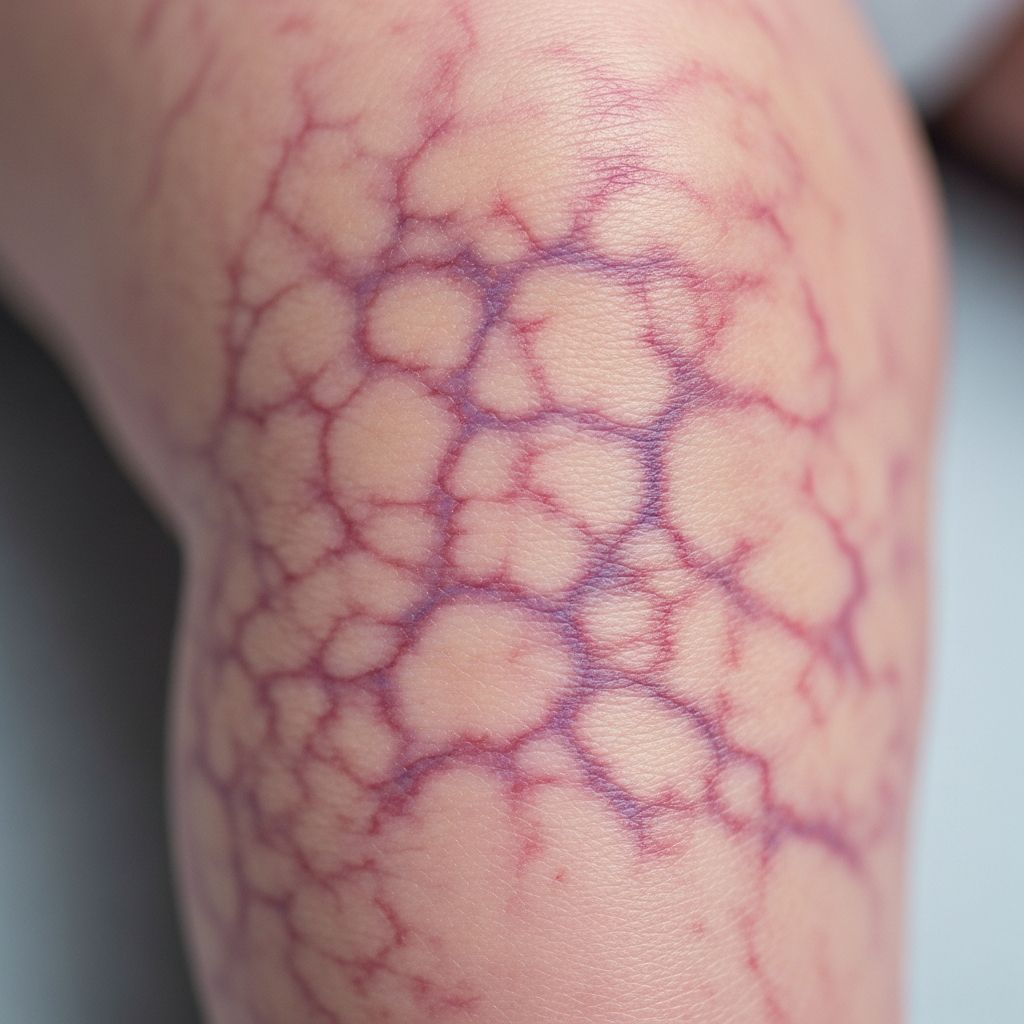
Cutis marmorata telangiectatica congenita (CMTC) is a rare congenital capillary vascular malformation presenting as fixed, reticulated purple patches on the skin, distinct from physiological cutis marmorata that resolves with warming.
Introduction
Cutis marmorata telangiectatica congenita, often abbreviated as CMTC, represents an uncommon vascular birthmark characterized by persistent mottling of the skin in a net-like pattern. Unlike the benign, transient cutis marmorata seen in infants exposed to cold, CMTC lesions do not fade upon rewarming and may involve additional skin changes such as atrophy, telangiectasias, and rarely ulceration. This condition is primarily cutaneous but can associate with extracutaneous anomalies, including limb asymmetry, making early recognition crucial for comprehensive care.
The term ‘cutis marmorata’ refers to the marbled appearance, ‘telangiectatica’ to dilated small vessels, and ‘congenita’ indicates its presence at birth. CMTC typically manifests unilaterally on the lower limbs but can affect arms, trunk, or face. It is considered a type of vascular malformation arising from developmental abnormalities in capillary networks.
Demographics
CMTC is a rare disorder with an estimated incidence lower than 1 in 100,000 births, though exact prevalence is unknown due to underreporting and variable presentation. It affects males and females equally and is usually sporadic, with no familial pattern in most cases. Rare familial occurrences have been documented, suggesting possible genetic factors in select instances.
The condition is diagnosed across all ethnic groups, with no racial predilection noted. It is identified at birth or shortly thereafter, often prompting early pediatric dermatology consultation.
Causes
The precise etiology of CMTC remains unknown, but it is classified as a congenital vascular malformation resulting from abnormal development of dermal capillaries and venules. Recent genetic research implicates postzygotic somatic mutations, particularly in the GNA11 gene (c.547C>T; p.Arg183Cys), identified in lesional tissue or saliva of affected individuals. These mosaic mutations support the ‘lethal mutation surviving by mosaicism’ hypothesis, explaining the localized and sporadic nature.
Earlier studies suggested a potential role for variations in the ARL6IP6 gene, though this requires further validation. Environmental factors, medications, or maternal exposures have not been causally linked. CMTC is not inherited in a Mendelian fashion but arises de novo during embryogenesis.
Clinical Features
CMTC is evident at birth, featuring fixed patches of reticulated, blue-to-purple livedo reticularis that persist regardless of temperature. Lesions exhibit a coarse, net-like pattern of dilated capillaries and venules, often with telangiectasias and phlebectasia (dilated veins). Skin atrophy, appearing as indentations or thinning, affects up to 80% of cases, particularly in localized forms on limbs.
Common sites: Lower extremities (most frequent, often unilateral), upper limbs, trunk (midline predilection), face (rare).
- Legs: Branching red-purple markings, limb hypotrophy (smaller/shorter ipsilateral limb) in 20-50%.
- Trunk: Midline patches.
- Generalized: Rare, higher risk of systemic involvement.
Additional skin findings include ulceration (especially in atrophic areas), scarring, hyperkeratosis, or coexisting naevi like café-au-lait macules, Mongolian spots, or port-wine stains. Lesions may intensify with crying, activity, or cold exposure.
Related Stories



Associated anomalies:
- Limb involvement: Hypoplasia (undergrowth), rarely hyperplasia; syndactyly, brachydactyly.
- Neurological: Macrocephaly (in macrocephaly-capillary malformation overlap), developmental delay (rare).
- Ocular: Glaucoma, choroidal malformations.
- Syndromic: Adams-Oliver syndrome (aplasia cutis, limb defects); phakomatosis pigmentovascularis (pigmented and vascular lesions).
Less common associations include cleft palate, cardiac anomalies, and persistent cutis marmorata in chromosomal disorders like Down syndrome or trisomy 18.
Diagnosis
Diagnosis is clinical, based on characteristic persistent reticulated erythema with atrophy, excluding physiological cutis marmorata, port-wine stains, or infantile hemangiomas. Differential diagnoses include:
| Condition | Key Distinguishing Features |
|---|---|
| Physiological cutis marmorata | Transient, fades with warming; no atrophy. |
| Port-wine stain | Blush pink-red, homogenously flat; no reticulation. |
| Infantile hemangioma | Grows postnatally, proliferates then involutes. |
| Livedo reticularis (acquired) | Secondary to cold, coagulopathy; not congenital. |
Wood lamp may highlight telangiectasias; ultrasound or MRI assesses deeper vessels or limb involvement. Genetic testing for GNA11 mutations confirms in select mosaic cases. Biopsy (rarely needed) shows dilated capillaries in superficial dermis with endothelial proliferation.
Management
No curative treatment exists; management is supportive and multidisciplinary. Focus includes:
- Skin care: Emollients for atrophy; wound care for ulcerations (antiseptics, dressings).
- Laser therapy: Pulsed dye laser (PDL) for telangiectasias/port-wine components; variable efficacy, not routinely recommended.
- Physical therapy: For limb hypotrophy/disparity.
- Screening: Ophthalmology for glaucoma; neurology if macrocephaly; skeletal imaging.
Avoid unproven therapies like aspirin (no evidence). Compression garments may aid atrophy but lack robust data.
Outcome
Prognosis is excellent; most lesions fade significantly within 1-2 years, though residual atrophy, telangiectasias, or hypopigmentation may persist. Limb discrepancies rarely require orthopedic intervention. Malignant transformation is unreported; regular follow-up monitors complications.
In syndromic cases (e.g., Adams-Oliver), prognosis depends on associated anomalies.
Frequently Asked Questions (FAQs)
Is CMTC dangerous?
CMTC is benign and self-improving; risks are low except for rare ulceration or syndromic associations requiring screening.
Will my child’s skin pattern go away?
Yes, markings fade over years, often dramatically by age 2, though not always completely.
Can CMTC be treated with laser?
Pulsed dye laser may help telangiectasias but results vary; not standard.
Is CMTC hereditary?
Usually sporadic; rare familial cases exist. Mosaic GNA11 mutations implicated.
Does CMTC affect internal organs?
Rarely; localized cases are skin-limited. Generalized forms may involve eyes, skeleton.
References
- Cutis marmorata telangiectatica congenita — DermNet NZ. 2023. https://dermnetnz.org/topics/cutis-marmorata-telangiectatica-congenita
- Cutis marmorata telangiectatica congenita (CMTC) — Texas Children’s Hospital. 2024. https://www.texaschildrens.org/content/conditions/cutis-marmorata-telangiectatica-congenita-cmtc
- Cutis marmorata telangiectatica congenita being caused by mosaic GNA11 mutations — PubMed (Eur J Med Genet). 2022-04-01. https://pubmed.ncbi.nlm.nih.gov/35351629/
- Cutis Marmorta Telangiectatica Congentia (CMTC) — Nicklaus Children’s Hospital. 2024. https://www.nicklauschildrens.org/conditions/cutis-marmorta-telangiectatica-congentia
- Cutis Marmorata Telangiectatica Congenita — Seattle Children’s Hospital. 2024. https://www.seattlechildrens.org/conditions/cutis/
Similar Articles








Read full bio of Sneha Tete