Cutis Marmorata: Causes, Diagnosis, And Care For Babies
Understanding the common physiological mottling of infant skin and distinguishing it from rare congenital vascular conditions.
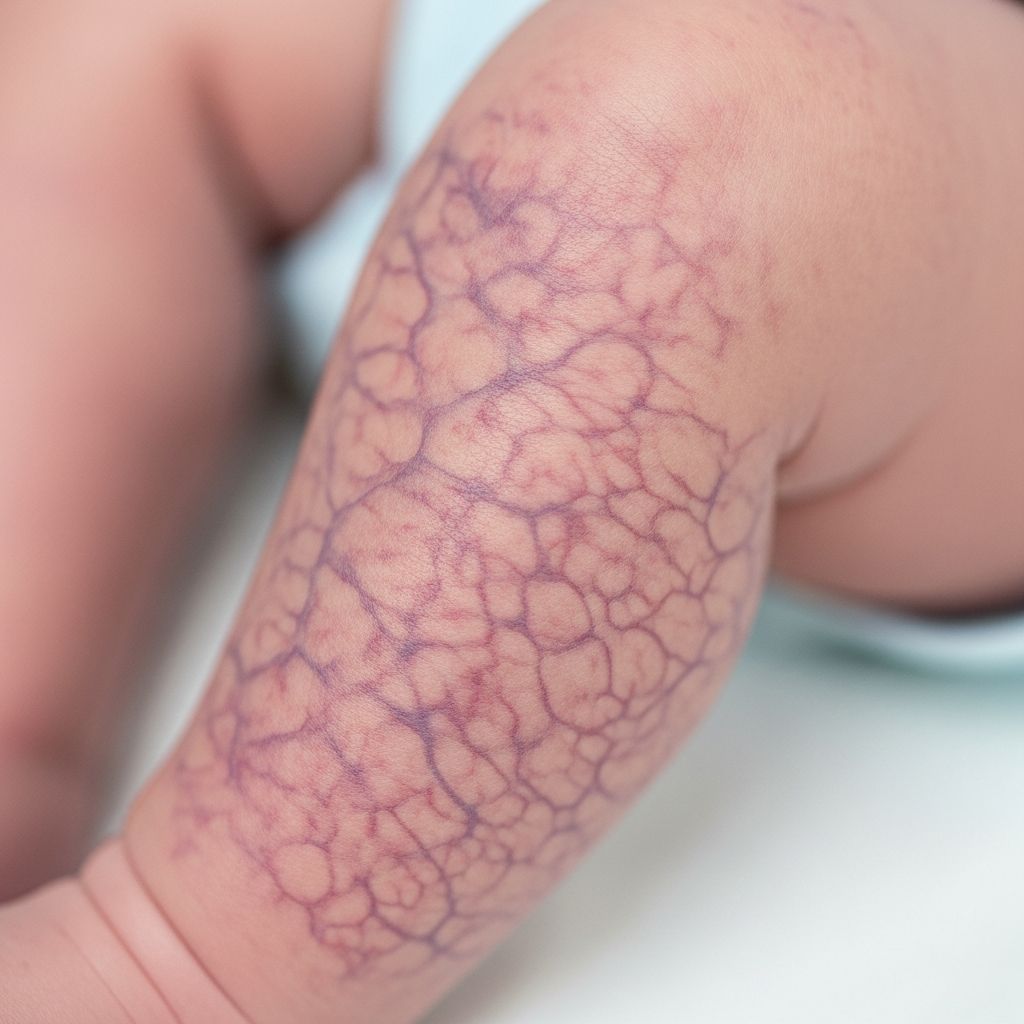
Cutis marmorata is a common, benign physiological response in infants where the skin develops a transient bluish-red marbled or lacy pattern upon exposure to cold temperatures. This mottling results from exaggerated vasomotor responses causing temporary dilation of capillaries and venules, fading quickly with warming. It must be distinguished from the rare congenital disorder cutis marmorata telangiectatica congenita (CMTC), characterized by persistent reticulated vascular patches present at birth.
What is cutis marmorata?
Cutis marmorata, also known as livedo reticularis in some contexts, appears as symmetrical, reticular red-purple mottling primarily on the extremities and trunk. It is most prevalent in newborns and young children due to immature thermoregulation and reduced subcutaneous fat, leading to vasospasm, hypoxia, and vasodilation in response to cold. The pattern resembles a fishnet or marble effect, with cyanotic reddish-blue areas surrounding pale centers from capillary dilation. Unlike pathological conditions, it is evanescent, resolving completely upon skin warming, and poses no long-term health risks.
In darker skin tones, the discoloration may manifest as marbled dark brown or purplish hues rather than pinkish-blue. It typically emerges periodically since birth, becoming more noticeable during well-baby visits or when the infant is cold, such as during baths or in cool environments. Prevalence is high in premature infants or those with low body fat, but it generally diminishes as the child ages and fat layers develop.
Who gets cutis marmorata?
This condition predominantly affects newborns, infants, and young children, with near-universal occurrence in healthy term babies under cold stress. It is physiological and self-limiting, often resolving within the first 6-12 months as thermoregulatory mechanisms mature. Adults rarely exhibit it unless associated with underlying issues like connective tissue disorders or cold agglutinin disease, though isolated cases can occur. No gender or ethnic predisposition is noted in physiological cutis marmorata.
What causes cutis marmorata?
- Primary physiological mechanism: Cold-induced vasospasm of arterioles leads to hypoxia in surrounding venules and capillaries, causing visible dilation and mottling.
- Immature vasculature: Infants have underdeveloped autonomic control of peripheral blood flow and thin subcutaneous fat, amplifying the response.
- Secondary associations: Rarely linked to decompression sickness in divers (with irregular patterns and possible itching), but this involves severe systemic symptoms.
Unlike pathological livedo, physiological cutis marmorata lacks inflammation, pain, or persistence.
Clinical features
The hallmark is a lacy, purplish-red network on the trunk, arms, and legs, intensifying with crying, movement, or cold exposure. It spares the face and is symmetric. No induration, ulceration, or atrophy occurs, distinguishing it from CMTC. Warming causes rapid blanching and disappearance. In severe cold, it may cover larger areas but remains asymptomatic.
Diagnosis
Diagnosis is clinical, based on history of cold provocation and prompt resolution with warming—no biopsies or imaging needed. Differential includes:
- Physiological cutis marmorata: Transient, symmetric, fades with heat.
- CMTC: Fixed, congenital, with telangiectasias and possible atrophy.
- Other: Livedo racemosa (pathological, irregular), erythema ab igne (heat-related).
Reassurance suffices for parents, emphasizing its benign nature.
Management
No treatment required; symptoms resolve spontaneously with age. Preventive measures include:
- Dressing infants in layers to maintain warmth.
- Avoiding cold baths; using lukewarm water.
- Monitoring in low-fat or premature babies.
Parental education prevents unnecessary concern.
Differential diagnosis: Cutis marmorata telangiectatica congenita (CMTC)
What is CMTC?
Related Stories



CMTC is a rare sporadic congenital capillary malformation (incidence ~1:40,000 births), featuring persistent blue-purple reticulated patches (livedo reticularis) due to dilated superficial vessels, unlike transient physiological cutis marmorata. Named for its marbled ‘cutis marmorata’ appearance with telangiectasias, it is fixed and does not blanch with warming.
Clinical features of CMTC
Present at birth, patches are irregular, net-like, purple-blue on limbs (80-90% cases), trunk (50%), rarely face. Additional features in 50-80%:
- Atrophy/hypoplasia: Dermal indentations, limb length discrepancy (ipsilateral hypotrophy).
- Ulcerations/aplasia cutis: Rare, especially legs; may link to Adams-Oliver syndrome.
- Vascular anomalies: Nevus flammeus, venous varicosities, glaucoma (2-5%), hemiatrophy.
| Feature | Physiological Cutis Marmorata | CMTC |
|---|---|---|
| Appearance | Transient pink-blue lacy on cold | Fixed purple marbled, telangiectasias |
| Blanching | Yes, with warming | No |
| Atrophy | Absent | Common (limbs) |
| Associations | None | Hyp trophy, ulcers, syndromes |
Associated conditions with CMTC
- Syndromic: Adams-Oliver (aplasia cutis, limb defects), Macrocephaly-Capillary Malformation (MCM, formerly Macrocephaly-CMTC), Klippel-Trenaunay (port-wine stains, hypertrophy).
- Chromosomal: Down syndrome, trisomy 18, Cornelia de Lange (persistent cutis marmorata).
- Other: Glaucoma, body asymmetry.
Pathophysiology of CMTC
Etiology unknown; theories include estrogen-related vascular reactivity, somatic mosaic mutations in skin vasculature. Histology shows dilated capillaries/venules in upper dermis, endothelial hyperplasia.
Diagnosis of CMTC
Clinical; refer to vascular specialists for atypical cases. Imaging (ultrasound for limbs, Doppler for veins) if hypotrophy or insufficiency suspected. Biopsy rarely needed.
Treatment of CMTC
Spontaneous improvement in 50-80% by puberty, though atrophy may persist. Symptomatic:
- Ulcers/bleeding: Dressings, pulsed dye laser.
- Venous issues: Compression, sclerotherapy if insufficiency develops.
- Limb discrepancy: Orthopedics monitoring/growth stimulation.
- Pain/glaucoma: Specialist referral.
Multidisciplinary care recommended. Prognosis excellent; mild anomalies in most.
Frequently Asked Questions (FAQs)
Q: Is cutis marmorata harmful to my baby?
A: No, physiological cutis marmorata is completely benign and resolves with warming and age.
Q: How do I differentiate cutis marmorata from CMTC?
A: Physiological fades with heat; CMTC is persistent, congenital, often with atrophy.
Q: When does cutis marmorata go away?
A: Typically within months to 2 years as the infant’s skin matures.
Q: Does CMTC require treatment?
A: Often not; most improve spontaneously, but monitor for complications like ulcers or leg growth issues.
Q: Can cutis marmorata occur in adults?
A: Rarely, and usually indicates an underlying condition needing evaluation.
Q: What if my baby’s mottling doesn’t fade?
A: Consult a pediatric dermatologist to rule out CMTC or other vascular anomalies.
References
- Cutis Marmorata Telangiectatica Congenita — National Organization for Rare Disorders (NORD). 2023. https://rarediseases.org/rare-diseases/cutis-marmorata-telangiectatica-congenita/
- Cutis marmorata telangiectatica congenita — DermNet NZ. 2024-01-15. https://dermnetnz.org/topics/cutis-marmorata-telangiectatica-congenita
- What Is Cutis Marmorata Telangiectatica Congenita? — WebMD. 2024. https://www.webmd.com/skin-problems-and-treatments/cutis-marmorata-telangiectatica-congenita
- Cutis Marmorata: Symptoms, Causes, Treatment, and Pictures — Healthline. 2023-11-20. https://www.healthline.com/health/cutis-marmorata
- Cutis Marmorata — Consultant360. 2022. https://www.consultant360.com/articles/cutis-marmorata
- Cutis Marmorata in a 6-Week-Old Boy — Contemporary Pediatrics. 2023. https://www.contemporarypediatrics.com/view/cutis-marmorata-6-week-old-boy
Similar Articles








Read full bio of Sneha Tete