Cylindroma Pathology: Key Insights For Accurate Diagnosis
Detailed histopathological analysis of cylindroma, an adnexal skin tumour with jigsaw-patterned islands and distinctive cellular features.
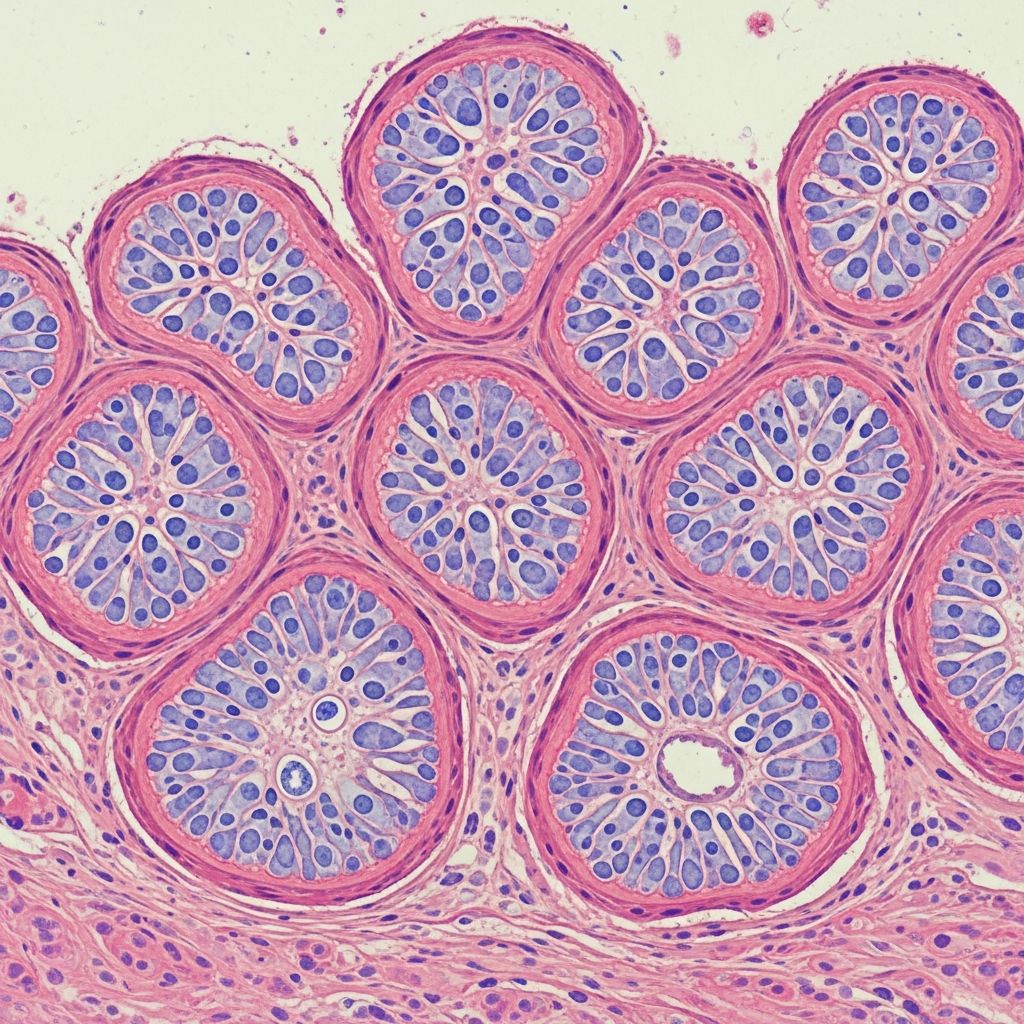
This distinctive tumour is an
adnexal tumour
argued to arise from the apocrine or eccrine secretory coil or coiled duct. Cylindromas are benign skin lesions primarily affecting the dermis, characterized by their unique histopathological appearance that aids in definitive diagnosis.Introduction
Cylindroma is a rare benign neoplasm of the skin’s adnexal structures, most commonly presenting on the scalp, face, or neck. It can occur sporadically as solitary lesions or multiply in the context of genetic syndromes. Histopathologically, it is recognized by its hallmark ‘jigsaw puzzle’ arrangement of tumour islands surrounded by thick hyaline material. Understanding its pathology is crucial for distinguishing it from malignant mimics and related adnexal tumours.
These tumours are typically asymptomatic but can cause cosmetic concerns or pain when numerous, as seen in ‘turban tumours’. While generally benign, rare malignant transformations to cylindrocarcinoma have been reported, particularly in larger lesions.
Clinical Features
Cylindromas often present as firm, pink to red nodules or dome-shaped papules, predominantly on the scalp. Solitary lesions are common in sporadic cases, measuring 0.5–2 cm in diameter. Multiple cylindromas form the ‘turban tumour’ appearance when they coalesce across the scalp.
In hereditary settings, such as Brooke-Spiegler syndrome or familial cylindromatosis, patients develop numerous tumours starting in adolescence or early adulthood. These syndromes are autosomal dominant, linked to mutations in the
CYLD
gene on chromosome 16q12, which acts as a tumour suppressor involved in NF-κB signaling regulation. Affected individuals may also develop spiradenomas and trichoepitheliomas, complicating clinical diagnosis without biopsy.Histopathology
Low Power View
At low magnification, cylindroma appears as a
non-encapsulated tumour nodule
arising from the dermis (Figure 1, not shown). It is composed of multiple irregular tumour islands arranged in a characteristic‘jigsaw’ pattern
(Figure 2). This pattern arises from the interlocking borders of the islands, mimicking a puzzle.Surrounding the tumour islands and interspersed as discrete droplets within the nodules is a thick
hyaline deposit
(Figure 3). These deposits create a lattice-like framework that is a diagnostic hallmark.Cellular Composition
Two distinct cell populations comprise the tumour nodules:
- Smaller peripheral cells**: Hyperchromatic nuclei, scant cytoplasm, arranged at the periphery of islands.
- Larger central cells**: Open vesicular nuclei, pale cytoplasm, predominant in the island centers.
This bimorphic pattern reflects differentiation towards ductal structures, with peripheral cells resembling basal/myoepithelial cells and central cells akin to secretory cells.
Stromal and Special Stains
The hyaline bands and deposits are
PAS-positive and diastase-resistant
, confirming their glycoprotein nature. Immunohistochemistry reveals type IV and VII collagen within these sheaths. Tumour cells express cytokeratins (e.g., CK5/6, CK7), p63 in peripheral cells, and S100-positive dendritic cells scattered throughout, distinguishing it from inflammatory infiltrates.Electron microscopy, though rarely needed, shows desmosomes and myoepithelial features supporting adnexal origin.
Cytology
Cytologically, aspirates show uniform small cells with hyperchromatic nuclei in clusters, embedded in hyaline material. However, biopsy is preferred for architecture assessment.
Pathogenesis
The exact cell of origin remains debated: apocrine vs. eccrine secretory coil or coiled duct. Evidence favors apocrine differentiation due to shared features with spiradenomas and CYLD mutations affecting Wnt/β-catenin and NF-κB pathways, promoting tumourigenesis.
In Brooke-Spiegler syndrome, germline CYLD mutations lead to biallelic inactivation in tumours, akin to the two-hit hypothesis. Over 51 mutations are reported across diverse ethnicities.
Associated Conditions
Brooke-Spiegler syndrome and multiple cylindromatosis (turban tumour syndrome): No histopathological differences from sporadic cylindromas. Overlap tumours with eccrine spiradenoma features (spiradenocylindroma) occur. CYLD cutaneous syndrome encompasses these, with onset in the 2nd–3rd decade.
Related Stories



Differential Diagnosis
Key mimics include:
| Tumour | Key Distinguishing Features |
|---|---|
| Eccrine spiradenoma | Diffuse basophilic proliferation without discrete islands; lymphocytic infiltrate prominent; lacks jigsaw pattern. S100 dendritic cells less vs. lymphocytes. |
| Spiradenocylindroma | Hybrid: combines cylindroma islands with spiradenoma’s dense basophilia and vascularity. |
| Trichoblastoma/Merkel cell carcinoma | Lacks hyaline sheaths; different immuno (CK20+ in Merkel). |
| Basal cell carcinoma | Peripheral palisading, retraction artifact, epidermal connection. |
| Cutaneous lymphadenoma | Lobular basaloid with dense lymphocytic infiltrate, no hyaline. |
Rarely, cylindrocarcinoma shows atypia, mitoses, necrosis.
Imaging and Further Tests
Dermoscopy shows arborizing vessels or white structures. MRI useful for extensive turban tumours planning excision. Genetic testing for CYLD confirms syndromes.
Management
Observation for small asymptomatic lesions. Surgical excision for solitary or symptomatic tumours. CO2 laser or electrosurgery for multiples. In syndromes, monitor for malignancy (rare <1%). No systemic therapy; genetic counseling recommended.
Frequently Asked Questions (FAQs)
Is cylindroma malignant?
Benign; rare malignant transformation to cylindrocarcinoma in large or syndromic cases.
What causes multiple cylindromas?
Often Brooke-Spiegler syndrome or familial cylindromatosis due to CYLD mutations.
How is cylindroma diagnosed?
Skin biopsy showing jigsaw islands with hyaline sheaths.
Can cylindromas be treated without surgery?
Laser ablation or electrosurgery for superficial lesions.
Are cylindromas painful?
Usually not; multiple scalp lesions may cause discomfort from size.
Prognosis
Excellent for benign cylindromas; recurrence rare post-excision. Syndromic patients require lifelong surveillance.
References
- Cylindroma pathology — DermNet NZ (Dr Ben Tallon). 2011 (last reviewed 2023). https://dermnetnz.org/topics/cylindroma-pathology
- Brooke-Spiegler syndrome — DermNet NZ. 2023. https://dermnetnz.org/topics/brooke-spiegler-syndrome
- Eccrine spiradenoma pathology — DermNet NZ (Dr Ben Tallon). 2011 (last reviewed 2023). https://dermnetnz.org/topics/eccrine-spiradenoma-pathology
- Sweat gland lesions — DermNet NZ. 2023. https://dermnetnz.org/topics/sweat-gland-lesions
- CYLD Cutaneous Syndrome — GeneReviews® (NCBI, NIH). 2022-11-03. https://www.ncbi.nlm.nih.gov/books/NBK555820/
Similar Articles








Read full bio of medha deb