Cystoid Macular Edema: A Comprehensive Guide For Patients
Understand cystoid macular edema: causes, symptoms, diagnosis, and effective treatments for preserving central vision.
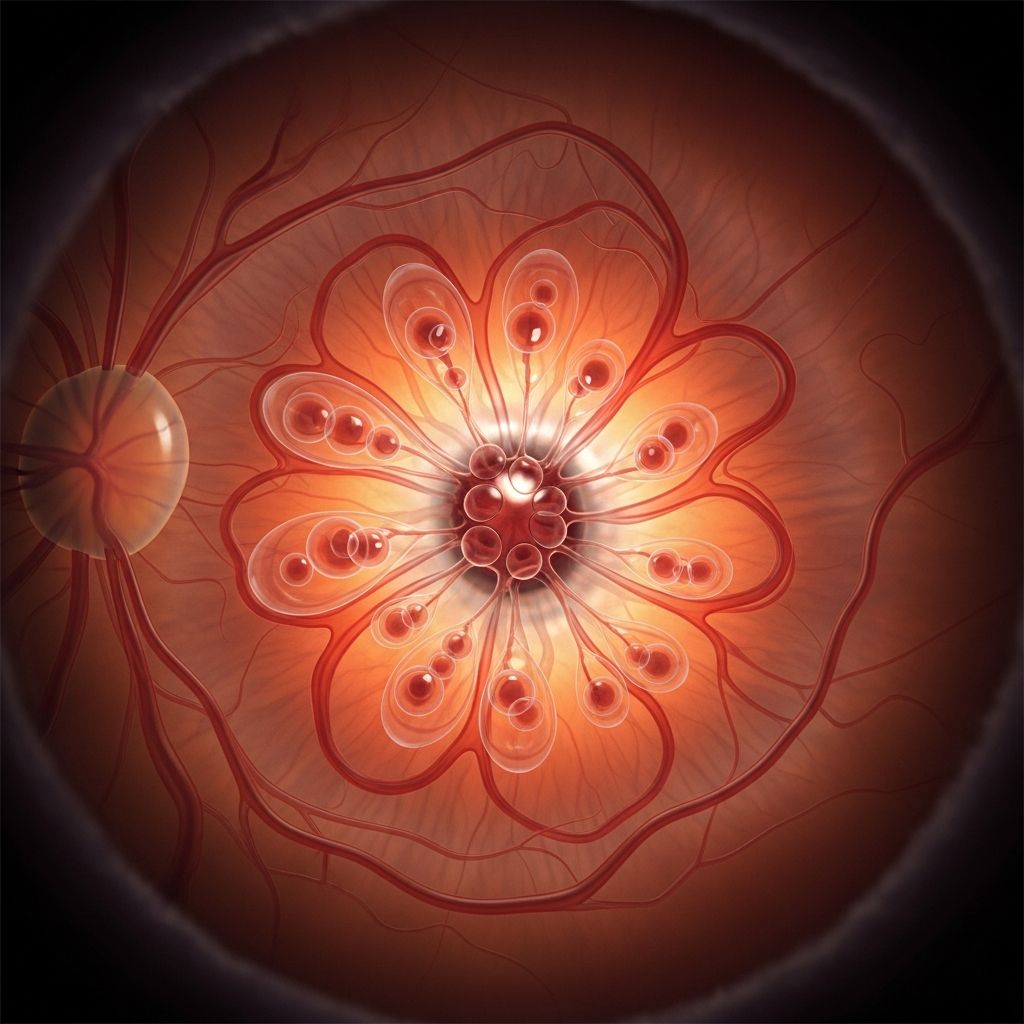
Cystoid macular edema (CME) represents a significant ophthalmic challenge, characterized by the accumulation of fluid in cyst-like formations within the macula, the retina’s central region vital for sharp vision. This condition disrupts normal retinal function, often resulting in diminished central acuity and visual distortion.
The Pathophysiology Behind Macular Fluid Buildup
At its core, CME arises from a breakdown in the blood-retinal barrier, permitting fluid leakage from perifoveal capillaries into retinal layers, particularly the outer plexiform layer. This creates cystoid spaces that thicken the retina and warp photoreceptor alignment, impairing light detection and image processing. The macula’s avascular foveal zone exacerbates vulnerability, as fluid pools in Henle’s fiber layer, forming a distinctive petaloid appearance on imaging.
Key mechanisms include inflammatory mediator release, such as vascular endothelial growth factor (VEGF) and basic fibroblast growth factor, triggered by vitreomacular traction or cellular stress on Müller cells. These factors compromise endothelial tight junctions, fostering leakage and edema. In watershed zones between retinal and choroidal circulations, fluid dynamics falter, amplifying cyst formation.
Primary Triggers and Risk Factors
CME manifests secondary to diverse etiologies, broadly categorized into surgical, inflammatory, vascular, and systemic origins.
- Postoperative Complications: Cataract extraction poses the foremost risk, affecting 1-3% of patients, typically emerging weeks post-procedure due to surgical inflammation.
- Retinal Vascular Disorders: Central or branch retinal vein occlusions provoke ischemia-driven leakage, responsive to targeted interventions.
- Inflammatory Conditions: Uveitis induces cytokine storms that erode vascular integrity, while retinitis pigmentosa may yield non-leaking edema.
- Diabetic and Metabolic Influences: Diabetic retinopathy fosters chronic leakage; medications like high-dose niacin (>1.5g/day) have been implicated.
- Traumatic and Structural Factors: Ocular injury or vitreomacular traction exerts mechanical stress, lysing Müller cells and promoting edema.
Individuals with one affected eye face heightened bilateral risk, underscoring vigilant monitoring.
Recognizing the Signs of CME
Symptoms predominantly impair central vision, evolving subtly or acutely based on severity.
| Symptom | Description | Frequency |
|---|---|---|
| Blurred Central Vision | Progressive dimming or haziness in straight-ahead sight | Most Common |
| Metamorphopsia | Straight lines warp or objects vary in size between eyes | Frequent |
| Photophobia | Increased glare sensitivity | Occasional |
| Color Desaturation | Faded or washed-out hues | Variable |
| Asymptomatic | No noticeable deficit, detected incidentally | Possible in Mild Cases |
Untreated progression risks central scotoma, profoundly hindering reading, driving, or facial recognition.
Diagnostic Approaches for Accurate Detection
Clinicians employ multimodal imaging to confirm CME and pinpoint etiology.
- Optical Coherence Tomography (OCT): Gold standard for visualizing cystoid spaces, retinal thickening, and subretinal fluid; quantifies central macular thickness.
- Fluorescein Angiography (FA): Highlights leakage patterns, petaloid hyperfluorescence, and barrier defects.
- Fundus Photography: Documents macular changes for longitudinal tracking.
- Clinical Exam: Slit-lamp biomicroscopy reveals subtle edema; visual acuity and Amsler grid assess distortion.
These tools differentiate CME from mimics like age-related macular degeneration or central serous retinopathy.
Treatment Strategies Tailored to Underlying Causes
Therapy hinges on etiology, aiming to quell inflammation, staunch leakage, and alleviate traction. Most cases resolve in 3-4 months with intervention, though chronic forms threaten photoreceptor atrophy.
Pharmacological Interventions
Related Stories



- Topical/Periocular Anti-Inflammatories: NSAIDs (e.g., nepafenac) or corticosteroids curb postoperative inflammation; dorzolamide aids retinitis pigmentosa-related CME.
- Intravitreal Injections: Anti-VEGF agents (bevacizumab, aflibercept, ranibizumab) excel in vascular occlusions; steroids like triamcinolone for uveitic cases.
- Systemic Agents: Acetazolamide promotes fluid resorption in select non-leaking edemas.
Surgical and Laser Options
- Pars Plana Vitrectomy: Relieves vitreomacular traction or epiretinal membranes; improves edema in 80-92% of diabetic cases.
- Laser Photocoagulation: Seals leaky vessels in diabetic or vein occlusion CME.
- Internal Limiting Membrane Peeling: Addresses tractional components.
Prognosis favors recovery with prompt, cause-specific management; recurrences necessitate ongoing surveillance.
Preventive Measures and Lifestyle Adjustments
While not fully preventable, risk mitigation includes:
- Preoperative NSAIDs for cataract patients.
- Tight glycemic control in diabetics.
- Medication review to avoid niacin excess.
- Regular retinal screening post-surgery or with vascular risks.
Patients should report vision changes promptly to avert permanence.
Patient Outcomes and Long-Term Management
Acute CME often regresses fully, restoring acuity. Chronic variants risk irreversible macular disruption, mandating multimodal therapy. Annual monitoring post-resolution prevents relapse, especially bilaterally.
Frequently Asked Questions (FAQs)
What triggers cystoid macular edema most frequently?
Cataract surgery is the leading cause, impacting 1-3% of cases due to inflammation.
Can CME resolve without treatment?
Some mild instances self-resolve, but intervention enhances outcomes and prevents chronicity.
Is surgery always required for CME?
No; medications suffice for many, with surgery reserved for tractional or refractory cases.
How does CME affect daily life?
It impairs central tasks like reading or driving via blur and distortion.
What is the typical recovery timeline?
Most improve within 3-4 months; full vision may take longer.
References
- Cystoid Macular Edema – EyeWiki — American Academy of Ophthalmology EyeWiki. 2023. https://eyewiki.org/Cystoid_Macular_Edema
- Cystoid Macular Edema | Retina Consultants of Texas — Retina Consultants of Texas. 2024. https://www.retinaconsultantstexas.com/treatment/retina-conditions/cystoid-macular-edema
- Cystoid Macular Edema: Causes, Symptoms, and Treatment Options — Louisiana Retina. 2023. https://louisianaretina.com/cystoid-macular-edema-causes-symptoms-and-treatment-options/
- What Is Cystoid Macular Edema? — WebMD. 2024-02-23. https://www.webmd.com/eye-health/what-is-cystoid-macular-edema
- Cystoid Macular Edema (CME) — University of Michigan Health. 2023. https://www.uofmhealth.org/our-care/specialties-services/cystoid-macular-edema-cme
Similar Articles








Read full bio of medha deb