Darier Disease Pathology: Cellular Changes
Understanding the cellular and histological basis of Darier disease and its pathological mechanisms.
Understanding Darier Disease Pathology
Darier disease, also known as keratosis follicularis or Darier-White disease, is a rare autosomal dominant genetic skin disorder characterized by distinctive pathological features at the cellular and tissue level. The disease results from mutations in the ATP2A2 gene, which encodes the SERCA2 enzyme (Sarcoplasmic/Endoplasmic Reticulum Calcium-ATPase), leading to disrupted calcium homeostasis within skin cells. Understanding the pathology of Darier disease is essential for comprehending how genetic mutations translate into clinical manifestations and for developing effective therapeutic strategies.
Histological Features of Darier Disease
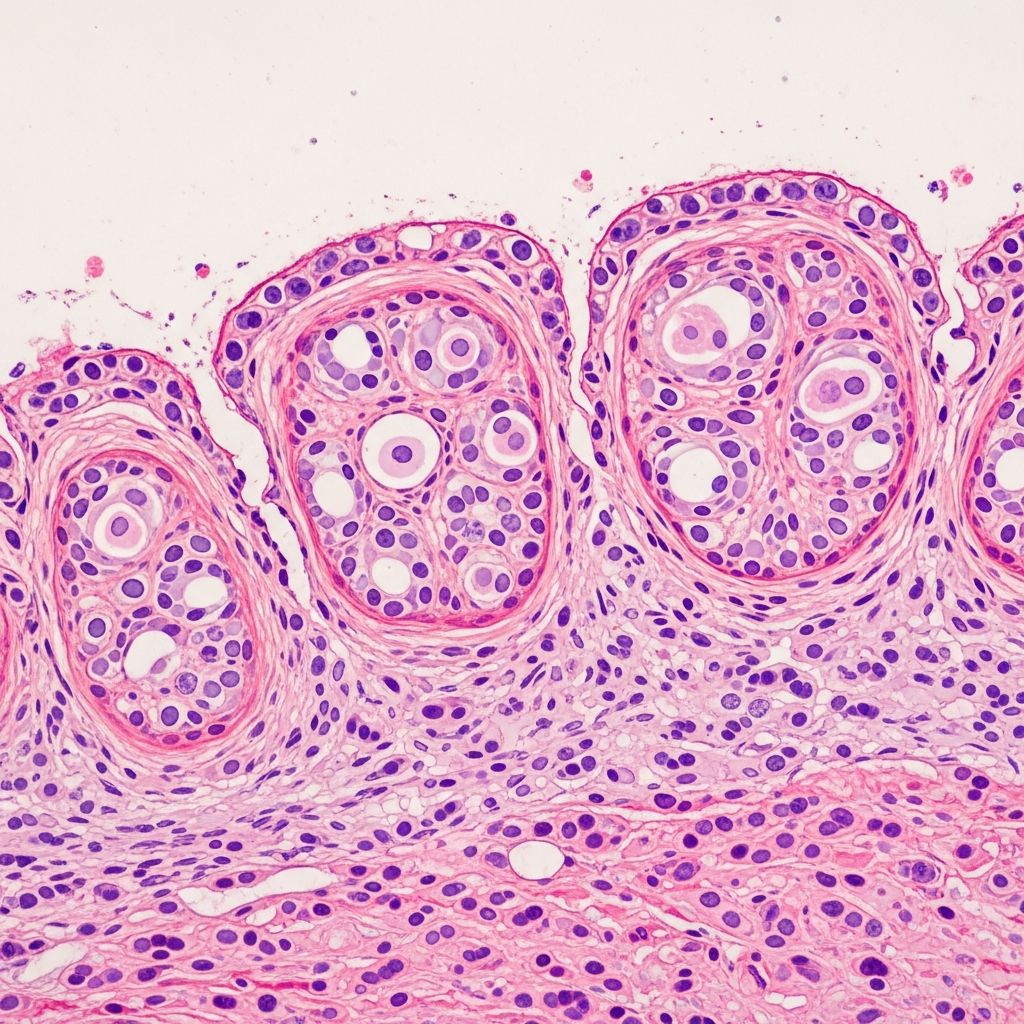
The histopathological examination of Darier disease reveals characteristic findings that distinguish it from other dermatological conditions. The most distinctive histological feature is focal acantholytic dyskeratosis, which describes the abnormal separation and death of keratinocytes (skin cells) within the epidermis. This finding is often accompanied by varying degrees of papillomatosis, referring to the formation of small, finger-like projections on the skin surface.
The acantholytic process in Darier disease involves the loss of cell-to-cell adhesion, resulting in the formation of intraepidermal clefts and lacunae. These microscopic cavities form as keratinocytes lose their ability to maintain tight connections with neighboring cells. The dyskeratotic changes involve abnormal keratinization and premature death of individual keratinocytes, leading to the presence of what are termed “corps ronds” and “grains” on histological examination. Corps ronds are rounded, eosinophilic (pink-staining) keratinocytes with a prominent, hyperchromatic nucleus surrounded by a clear halo, while grains appear as small, dark-staining, flattened keratinocytes in the stratum corneum.
Additional histological findings may include hyperkeratosis (thickening of the outer layer of skin), parakeratosis (abnormal keratinization with retained nuclei), and occasional inflammatory infiltrates consisting of lymphocytes and other immune cells in the dermis beneath the affected epidermis.
Cellular Mechanisms and Desmosomal Dysfunction
At the cellular level, Darier disease involves fundamental disruption of the structures responsible for holding skin cells together. Desmosomes are specialized adhesive junctions that function as the primary mechanism for cell-to-cell adhesion in the epidermis, analogous to mortar cementing bricks in a wall. These structures are composed of adhesion proteins, including desmogleins and desmocollins (transmembrane glycoproteins), which connect to the cytoskeleton through intermediate filaments via desmoplakin and other adaptor proteins.
The fundamental pathological problem in Darier disease stems from impaired calcium homeostasis. The SERCA2 protein normally functions as a calcium pump, actively transporting calcium from the cytoplasm into the sarcoplasmic and endoplasmic reticulum, thereby maintaining proper intracellular calcium levels. When SERCA2 function is compromised due to mutations in the ATP2A2 gene, cellular calcium levels become dysregulated. This dysregulation has several critical consequences:
- Insufficient calcium availability impairs the proper assembly and organization of desmosomal proteins, weakening the adhesive bonds between keratinocytes
- Abnormal calcium signaling activates cellular stress pathways that can impair protein structure and function
- Disrupted calcium homeostasis leads to alterations in the regulation of calcium-dependent enzymes and processes essential for normal skin barrier function
Related Stories



The desmosomal dysfunction results in loss of cell cohesion, allowing keratinocytes to separate abnormally and undergo premature apoptosis (programmed cell death). This explains the characteristic acantholytic features observed histologically and the clinical presentation of papules and plaques in affected patients.
Epidermal Barrier Dysfunction
The disruption of desmosomal integrity in Darier disease has profound consequences for skin barrier function. The epidermis serves as the critical interface between the body and the external environment, providing protection against water loss, ultraviolet radiation, pathogens, and mechanical injury. This barrier function depends upon the organized arrangement of keratinocytes and the integrity of the adhesive junctions connecting them.
In Darier disease, the weakened “cement” holding keratinocytes together compromises barrier integrity. This allows:
- Increased transepidermal water loss (TEWL), leading to skin dryness and irritation
- Enhanced penetration of irritants and allergens through the defective barrier
- Reduced protection against mechanical insults and friction
- Impaired defense against microbial invasion, predisposing to secondary bacterial infections
The barrier dysfunction explains why patients with Darier disease experience exacerbation of symptoms in response to environmental triggers such as heat, sweating, friction, and sun exposure. These factors further stress an already compromised barrier, leading to increased inflammation and clinical deterioration.
Inflammatory Pathways and Immune Dysregulation
Beyond the direct effects of desmosomal dysfunction, Darier disease involves significant alterations in immune and inflammatory responses. The impaired calcium homeostasis characteristic of the disease activates cellular stress pathways, including the unfolded protein response (UPR), which can trigger inflammatory signaling cascades. Additionally, keratinocytes with dysfunctional SERCA2 demonstrate altered production of inflammatory cytokines and chemokines.
Ultraviolet radiation, a known exacerbating factor in Darier disease, can further amplify these inflammatory processes. UV exposure stimulates keratinocytes to release inflammatory mediators, and the presence of inflammatory infiltrates in the dermis reflects recruitment of immune cells responding to keratinocyte-derived signals. Remarkably, chronic inflammation and associated inflammatory cell infiltration can paradoxically worsen SERCA2 insufficiency by reducing the expression of remaining functional SERCA2 protein, creating a vicious cycle of cellular stress and immune activation.
Comparison with Other Acantholytic Disorders
Darier disease belongs to a broader category of hereditary acantholytic dermatoses characterized by keratinocyte separation. Understanding how Darier disease differs from other conditions in this category provides insight into its unique pathological mechanisms.
| Condition | Inheritance Pattern | Primary Pathology | Key Distinguishing Features |
|---|---|---|---|
| Darier Disease | Autosomal dominant | SERCA2 dysfunction, desmosomal disruption | Focal acantholytic dyskeratosis, corps ronds and grains, seborrhoeic distribution |
| Grover Disease (Transient Acantholytic Dermatosis) | Acquired (not inherited) | Desmosomal failure | Acute onset, sun-exposed areas, typically resolves within 6-12 months |
| Familial Benign Pemphigus (Hailey-Hailey Disease) | Autosomal dominant | ATP2C2 gene mutation affecting calcium pump | Recurrent blistering in intertriginous areas, acantholysis, flaccid blisters |
While Darier disease and Grover disease both demonstrate acantholytic features histologically, Grover disease is an acquired condition that typically presents acutely in middle-aged to older individuals and often resolves spontaneously, whereas Darier disease is inherited, typically begins in adolescence, and persists chronically. Both conditions involve desmosomal dysfunction, but the underlying cause differs fundamentally.
Variations in Pathological Expression
The pathological manifestations of Darier disease can vary significantly between individuals and even within different skin sites on the same individual. Some patients demonstrate relatively subtle histological changes with minimal symptoms, while others exhibit extensive acantholytic areas with marked inflammation. This variability reflects differences in genetic background, environmental influences, and possibly variations in the specific mutations affecting the ATP2A2 gene.
In segmental or linear forms of Darier disease, where lesions are restricted to one side of the body, the pathological changes may be confined to the affected regions. These localized variants arise from somatic mutations in a subset of skin cells rather than germline mutations present in all cells, explaining their limited distribution and typically benign course.
Atypical presentations of Darier disease, such as acrokeratosis verruciformis (warty papules on the dorsal hands and feet) or acne conglobata (severe cystic acne), may demonstrate modifications of the typical histological pattern while maintaining the fundamental desmosomal dysfunction.
Nail and Mucosal Involvement
The pathology of Darier disease extends beyond the epidermis to affect specialized epithelial tissues including nails and mucous membranes. In the nails, the characteristic longitudinal red and white stripes result from alternating bands of normal and abnormal nail matrix cells, reflecting the same desmosomal dysfunction affecting the skin. The V-shaped notch at the free edge of the nail represents a focal area of impaired nail growth.
In the oral and other mucous membranes, patients may develop white cobblestone patterns representing focal areas of acantholysis and dyskeratosis. The mucosal involvement, while less common than skin involvement, demonstrates that the underlying pathological mechanism affects all epithelial tissues expressing the mutated ATP2A2 gene.
Frequently Asked Questions
Q: What is the fundamental cellular defect in Darier disease?
A: The fundamental defect involves mutations in the ATP2A2 gene, which encodes SERCA2, a calcium pump protein. This leads to impaired calcium homeostasis, resulting in defective desmosome assembly and weakened adhesion between keratinocytes. The resulting loss of cell-to-cell adhesion causes the characteristic acantholytic features observed histologically.
Q: How does Darier disease differ histologically from normal skin?
A: Normal skin shows regularly arranged keratinocytes connected by intact desmosomes. Darier disease demonstrates focal acantholytic dyskeratosis with intraepidermal clefts, corps ronds (rounded keratinocytes with prominent nuclei), grains (flattened keratinocytes), and varying degrees of papillomatosis. These abnormalities reflect keratinocyte separation and premature death due to desmosomal dysfunction.
Q: Why does Darier disease worsen with sun exposure and heat?
A: The compromised skin barrier and desmosomal dysfunction in Darier disease make the epidermis more susceptible to environmental stressors. UV radiation and heat activate inflammatory pathways and can further reduce SERCA2 expression, exacerbating the underlying cellular dysfunction. Additionally, heat increases sweating, which promotes skin maceration and irritation in areas with weakened barrier function.
Q: Can the pathological changes of Darier disease be reversed?
A: Currently, there are no treatments that reverse the fundamental genetic mutation or completely restore normal desmosomal function. However, symptomatic management through avoiding exacerbating factors, maintaining skin hydration with emollients, and treating secondary infections can significantly improve symptoms. Research into targeted therapies addressing calcium homeostasis or desmosomal assembly is ongoing.
Q: Why do patients with Darier disease have an increased risk of skin infections?
A: The defective skin barrier in Darier disease allows enhanced penetration of bacteria through the disrupted epidermis. Additionally, skin folds affected by Darier disease often become macerated (waterlogged) and weeping due to barrier dysfunction, creating an environment favorable for bacterial overgrowth. The inflammatory state of the skin further promotes infection.
References
- Darier disease — DermNet New Zealand. 2024. https://dermnetnz.org/topics/darier-disease
- Keratosis Follicularis (Darier Disease): Symptoms, Causes, Treatment — National Organization for Rare Disorders (NORD). 2024. https://rarediseases.org/rare-diseases/keratosis-follicularis/
- Darier’s Disease Research Overview — Feinberg School of Medicine, Northwestern University. 2024. https://labs.feinberg.northwestern.edu/green/research/dariers-disease.html
- Darier Disease Patient Information — Skin Health Info UK. 2020. https://www.skinhealthinfo.org.uk/
- Darier Disease — StatPearls, National Center for Biotechnology Information (NCBI). 2024. https://www.ncbi.nlm.nih.gov/books/NBK519557/
- Management of Darier Disease: A Review of the Literature and Update — Indian Journal of Dermatology, Venereology and Leprology. 2024. https://ijdvl.com/
- Darier Disease: Current Insights and Challenges in Pathogenesis — Journal of the European Academy of Dermatology and Venereology. 2024. https://onlinelibrary.wiley.com/journal/14683083
Similar Articles








Read full bio of Sneha Tete