Decoding LCDs: Technology and Applications
Explore the science behind liquid crystal displays, from molecular mechanics to modern innovations in screens and beyond.
Liquid crystal displays (LCDs) represent a cornerstone of modern visual technology, powering everything from smartphones to medical instruments. These devices manipulate light through unique molecular properties to create sharp, colorful images without emitting light themselves.
The Fundamental Science of Liquid Crystals
Liquid crystals occupy a fascinating intermediate state between liquids and solids, where molecules maintain long-range order while retaining fluidity. This dual nature allows them to respond to electric fields, twisting or aligning to control light passage. Discovered in the late 19th century, their practical application in displays began decades later, revolutionizing how we interact with visual information.
In an LCD, these crystals are sealed between glass substrates. Without voltage, they naturally twist light’s polarization by 90 degrees in a twisted nematic configuration, permitting light to pass through crossed polarizers. Applying voltage untwists them, blocking light and creating dark pixels. Varying voltages produce grayscale shades, forming the basis for images.
Core Components of LCD Systems
Every LCD comprises layered elements working in unison:
- Backlight: Provides illumination, typically LEDs along edges or directly behind the panel, diffused for uniformity.
- Polarizing Filters: Two orthogonal filters sandwich the liquid crystal layer, allowing only specific light orientations.
- Liquid Crystal Layer: Millions of tiny cells that twist or align under voltage to modulate light.
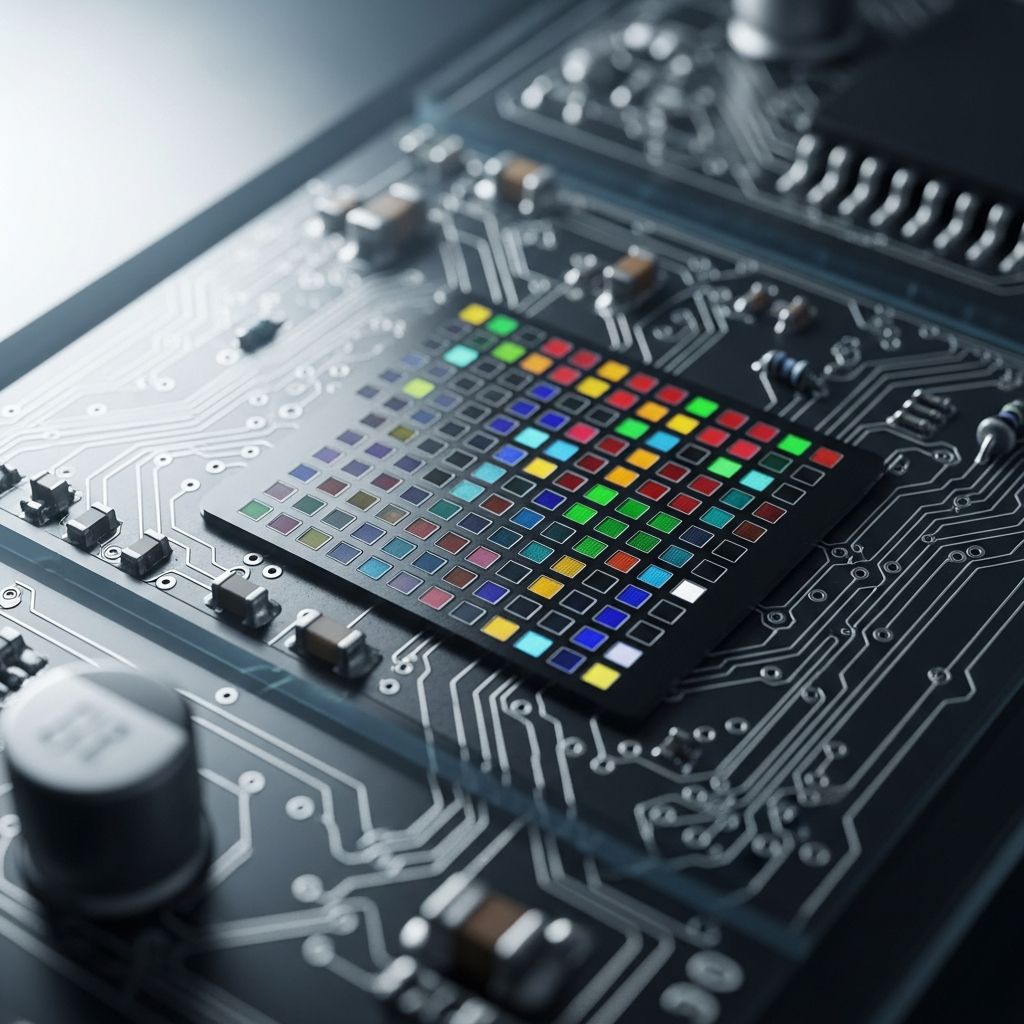
- Color Filters: Red, green, and blue subpixels per pixel combine to generate full-color spectra.
- Thin-Film Transistors (TFTs): Active matrix controls each pixel precisely for high-resolution displays.
Light from the backlight passes through the first polarizer, interacts with the crystals, hits color filters, and exits the second polarizer, yielding visible images.
Evolution of LCD Panel Technologies
LCDs have advanced through distinct panel types, each optimizing for speed, color, or viewing angles.
| Panel Type | Key Strengths | Limitations | Common Uses |
|---|---|---|---|
| Twisted Nematic (TN) | Fast response times, low cost | Narrow viewing angles, poor color accuracy | Gaming monitors |
| In-Plane Switching (IPS) | Wide viewing angles, accurate colors | Slower response, higher cost | Professional photo editing |
| Vertical Alignment (VA) | High contrast, deep blacks | Moderate viewing angles, slower than TN | TVs, home theater |
TN panels dominate budget applications due to quick pixel switching, ideal for motion-heavy content. IPS excels in color-critical tasks, while VA balances contrast for immersive viewing.
Backlight Innovations Driving Performance
Modern LCDs rely on edge-lit or direct LED backlights. Edge-lit uses light guide plates (often PMMA) to distribute light evenly, enabling slim profiles down to 5mm. Direct backlighting offers superior local dimming for better contrast, though at thicker dimensions.
Enhancements like dual brightness enhancement films and diffusers minimize light loss, boosting efficiency. These systems emit minimal heat and flicker, supporting high refresh rates up to 200Hz or more.
Advantages Powering LCD Dominance
LCDs outperform predecessors like CRTs in several ways:
- Low power use and heat generation.
- No geometric distortion or refresh flicker.
- Scalable sizes and resolutions, even stackable for ultra-high definition.
- Near-zero electromagnetic emissions.
Related Stories



These traits make LCDs ubiquitous in portable devices and large screens alike.
LCDs in Everyday Consumer Devices
From 1080p TVs with millions of TFT-controlled pixels to smartphone OLED hybrids, LCDs deliver vibrant visuals. Each pixel’s three subpixels (RGB) operate at 256 levels, blending 16.7 million colors. Native resolution operation ensures sharpness without artifacts.
Beyond Screens: LCDs in Specialized Fields
LCD principles extend to niche applications. In ophthalmology, liquid crystal devices simulate vision impairments or project precise patterns for diagnostic testing. These tools help clinicians assess visual fields or retinal function by dynamically altering light patterns. Custom LCD shutters control light exposure in phoropters during refraction exams, enhancing accuracy.
Emerging uses include adaptive optics in eyewear prototypes, where LCD layers adjust tint or focus in real-time based on environmental light or user gaze.
Challenges and Future Directions
Despite strengths, LCDs face competition from OLEDs, which offer perfect blacks via self-emission. LCD improvements like mini-LED backlights narrow this gap with thousands of dimming zones for HDR excellence. Quantum dot enhancements expand color gamuts, pushing boundaries further.
Sustainability efforts focus on recyclable materials and lower-energy LEDs, aligning with global eco-standards.
Practical Tips for Selecting LCD Displays
When choosing panels:
- Match refresh rates to use: 60Hz for office, 144Hz+ for gaming.
- Prioritize IPS for color work, VA for movies.
- Check backlight type for contrast needs.
Understanding these factors ensures optimal performance.
Frequently Asked Questions (FAQs)
What makes liquid crystals unique for displays?
Their ability to change orientation with voltage, modulating light without self-emission.
How do TFTs improve LCD performance?
They enable active matrix addressing, controlling each pixel independently for high resolution and speed.
Why do some LCDs have better viewing angles?
IPS panels align crystals parallel to the substrate, minimizing color shifts off-axis.
Can LCDs achieve infinite resolution?
Theoretically yes; stacking panels multiplies resolution without limits.
Are LCDs energy-efficient?
Yes, they consume little power, emit low heat, and support flicker-free operation.
Conclusion
LCD technology’s versatility stems from precise light control via liquid crystals, evolving into indispensable tools across industries. As innovations continue, LCDs remain pivotal in visual communication.
References
- Liquid-crystal display – Wikipedia — Wikipedia. 2023-10-01. https://en.wikipedia.org/wiki/Liquid-crystal_display
- Liquid Crystal Technology | Applied Sciences | Research Starters — EBSCO. 2022-05-15. https://www.ebsco.com/research-starters/applied-sciences/liquid-crystal-technology
- Demystifying LCD Screens: How They Work, Components, and Types — Riverdi. 2024-03-20. https://riverdi.com/blog/understanding-lcd-how-do-lcd-screens-work
- How The Technology of LCD Displays Works — Xenarc. 2023-08-10. https://www.xenarc.com/lcd-technology.html
- How Does An LCD Screen Work? Answering A Liquid … – YouTube — YouTube. 2021-11-12. https://www.youtube.com/watch?v=dN5HXyp2p9U
Similar Articles








Read full bio of medha deb