Decompression Sickness: Causes, Symptoms, and Treatment
Comprehensive guide to understanding decompression sickness: prevention, recognition, and emergency care.
Understanding Decompression Sickness
Decompression sickness, commonly known as “the bends” or caisson disease, is a serious medical condition that occurs when the body experiences a rapid transition from a high-pressure environment to one of lower pressure. This dangerous condition primarily affects underwater divers, aviators flying in inadequately pressurized aircraft, and caisson workers who work in pressurized environments. When pressure decreases too rapidly, dissolved gases in body tissues form bubbles, leading to a range of symptoms from mild discomfort to life-threatening complications.
What Causes Decompression Sickness?
The primary cause of decompression sickness is the formation of gas bubbles in body tissues when pressure drops too quickly. During underwater diving or work in pressurized environments, the body absorbs inert gases—primarily nitrogen—from the air being breathed. Unlike oxygen, which is metabolized by the body, and carbon dioxide, which is exhaled, nitrogen simply accumulates in body tissues until saturation occurs at the ambient pressure.
According to Henry’s Law, when the pressure of a gas in contact with a liquid decreases, the amount of that gas dissolved in the liquid will also decrease proportionately. If a diver ascends too quickly, the pressure surrounding the body decreases faster than the nitrogen can be safely eliminated through respiration and perfusion. This causes the dissolved nitrogen to come out of solution and form gas bubbles within tissues and the bloodstream.
Nitrogen is much more soluble in fatty tissue than in other body tissues, which means tissues with high lipid content absorb more nitrogen than other tissues. The nervous system is particularly vulnerable, as it is composed of approximately 60 percent lipids. This explains why the brain, spinal cord, and peripheral nerves are especially susceptible to bubble formation and the resulting neurological complications.
Risk Factors and Susceptibility
Certain activities and conditions increase the risk of developing decompression sickness:
- Underwater diving with rapid ascent from depth
- Flying in unpressurized aircraft
- Working in pressurized caisson or tunnel environments
- Rapid decompression without proper staging
- Inadequate diver training or experience
- Fatigue or dehydration before diving
- Presence of a patent foramen ovale (a heart defect that allows right-to-left shunting)
- Repeated diving or multiple dives in short periods
Recognizing Symptoms of Decompression Sickness
The symptoms of decompression sickness vary widely depending on the location and severity of bubble formation. Approximately 90 percent of patients develop symptoms within three hours of surfacing, though only a small percentage become symptomatic more than 24 hours after diving. Initial symptoms may be subtle but can progress to severe conditions.
Mild Symptoms
Early signs of decompression sickness may include fatigue, skin rash or itching (known as “diver’s itch”), and mild joint or muscle pain. Small nitrogen bubbles trapped under the skin cause a red rash and itching sensation that usually subsides within 10 to 20 minutes. This skin manifestation, while uncomfortable, is generally less serious than other forms of the condition.
Moderate to Severe Symptoms
More serious symptoms develop when bubbles form in critical areas of the body:
- Nervous system effects: Bubbles in the brain, spinal cord, or peripheral nerves cause paralysis (divers’ palsy), convulsions, muscle coordination difficulties, numbness, tingling, sensory abnormalities, nausea, speech defects, and personality changes.
- Joint pain: Bubbles accumulating in joints cause severe pain and restricted mobility. This symptom inspired the term “the bends,” as affected individuals cannot straighten their joints.
- Respiratory symptoms: Nitrogen bubbles in the respiratory system cause excessive coughing, difficulty breathing (the chokes), chest pain, burning sensation while breathing, and severe shock.
- Neurological symptoms: Dizziness, vertigo, ringing in the ears, confusion, memory loss, tremors, staggering, collapse, or unconsciousness.
- Other symptoms: Difficulty urinating, disorientation, weakness, shortness of breath, and areas of decreased sensation.
Related Stories



Types of Decompression Illness
Decompression sickness is one component of a broader condition called decompression illness (DCI), which also includes arterial gas embolism (AGE). While both conditions can occur together and share many symptoms, they have different causes and mechanisms:
| Condition | Cause | Key Symptoms | Timeline |
|---|---|---|---|
| Decompression Sickness (DCS) | Dissolved inert gas bubbles forming in tissues during decompression | Joint pain, skin rash, neurological symptoms, paralysis | Usually within 3 hours of surfacing |
| Arterial Gas Embolism (AGE) | Gas bubbles entering arterial circulation through lung overpressure injury | Bloody froth, convulsions, unconsciousness, chest pain, vision problems | Often within minutes of surfacing |
Long-Term Complications
When decompression sickness is not treated promptly or appropriately, serious long-term complications can develop from end organ damage caused by air embolisms. These include:
- Bone damage: Dysbaric osteonecrosis leads to pathological fractures and chronic arthritis, particularly in the proximal femur, humerus, and tibia.
- Neurological damage: Depending on the area and severity of damage to the brain and spinal cord, complications range from coma and sensorimotor weakness to incontinence and other neurological deficits.
- Pulmonary complications: The lungs may develop pulmonary fibrosis.
- Organ damage: The pancreas, kidneys, liver, and gastrointestinal tract are vulnerable to necrosis, which can cause strictures and obstruction.
Emergency Treatment and Management
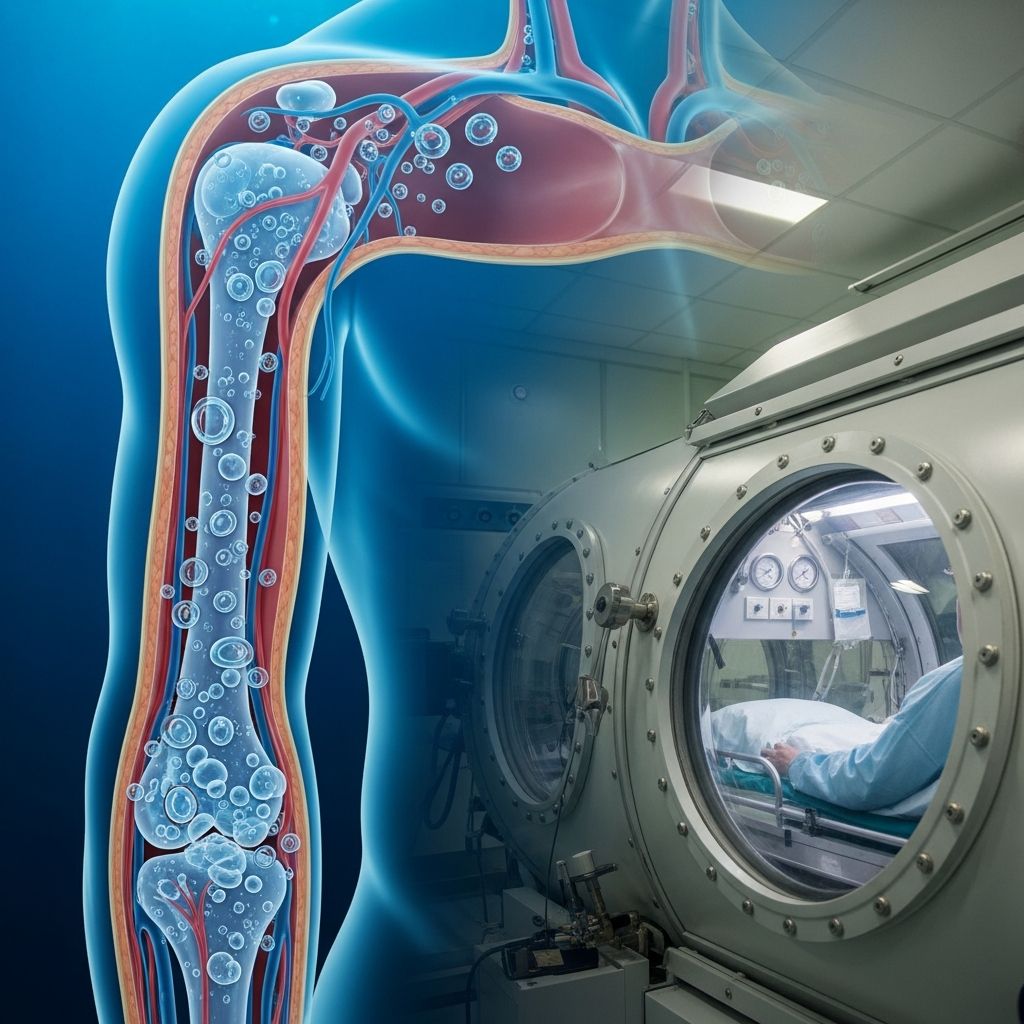
Immediate treatment is critical for the best outcomes in decompression sickness. Relief can usually be achieved only through recompression in a hyperbaric chamber followed by gradual decompression. However, this process is not always able to reverse tissue damage that has already occurred.
Hyperbaric Oxygen Therapy
The most effective treatment for decompression sickness is hyperbaric oxygen therapy, which involves placing the patient in a pressurized chamber filled with 100 percent oxygen. This treatment works by increasing the oxygen pressure in the blood, which helps reduce bubble size and accelerates the elimination of inert gases from the body.
Timing of Treatment
The timing of recompression is critical for treatment success. Research demonstrates that most cases recompressed within two hours have excellent outcomes. Recompression within six hours often produces improvement and sometimes full resolution. However, delays to recompression of more than 6 to 8 hours are often not very effective and are generally associated with poorer outcomes and delays in diagnosis and transfer to a hyperbaric chamber. A comprehensive study reported a 99.3 percent effectiveness rate when treating decompression illness with immediate recompression, and in 98.9 percent of cases, initial symptoms occurred within 6 hours after surfacing.
First Aid Measures
Before reaching a hyperbaric facility, initial first aid includes:
- Immediately stop diving activity
- Move the affected person to a safe location
- Administer high-flow oxygen if available
- Keep the person lying flat or in a position that prevents bubbles from traveling to vital organs
- Avoid further pressure changes
- Seek emergency medical attention immediately
- Stay hydrated and avoid alcohol and other medications that might interfere with treatment
Prevention Strategies
The most effective approach to decompression sickness is prevention through proper diving practices and awareness:
- Follow dive profiles: Adhere to established decompression schedules and ascent rates, typically not exceeding 30 feet per minute.
- Safety stops: Perform mandatory safety stops during ascent, especially after deep dives.
- Proper training: Obtain certification from recognized diving organizations.
- Equipment maintenance: Ensure all diving equipment functions properly.
- Physical fitness: Maintain good cardiovascular health and avoid diving when fatigued.
- Hydration: Stay well-hydrated before and after diving.
- Avoid alcohol: Do not consume alcohol before or after diving.
- Gradual progression: Build diving experience gradually before attempting deep or complex dives.
- Weather awareness: Monitor weather conditions and sea state before diving.
- Dive computer use: Utilize modern dive computers that track depth, time, and decompression requirements.
When to Seek Medical Attention
Seek immediate emergency medical care if you or someone else experiences symptoms of decompression sickness following diving, flying in an unpressurized aircraft, or work in a pressurized environment. Do not delay seeking treatment, as early intervention dramatically improves outcomes. Call emergency services or go to the nearest emergency room. If possible, alert medical personnel that decompression sickness is suspected so they can arrange transport to a facility with a hyperbaric chamber.
Frequently Asked Questions
Q: How quickly does decompression sickness develop?
A: Approximately 90 percent of patients develop symptoms within three hours of surfacing. However, a small percentage may not show symptoms until more than 24 hours after diving, which is why monitoring is important even after you leave the water.
Q: Can decompression sickness be prevented entirely?
A: While decompression sickness cannot be guaranteed to never occur, it can be greatly reduced through proper training, adherence to decompression schedules, appropriate ascent rates, and following all safety protocols established by recognized diving organizations.
Q: What is the difference between “the bends” and “the chokes”?
A: “The bends” refers to joint and muscle pain caused by bubbles in joints, while “the chokes” refers to respiratory symptoms including excessive coughing, difficulty breathing, and chest pain caused by bubbles in the respiratory system.
Q: Is hyperbaric oxygen therapy always successful?
A: Hyperbaric oxygen therapy is highly effective, especially when administered promptly. However, it may not be able to reverse tissue damage that has already occurred, particularly if treatment is delayed. Early treatment provides the best outcomes.
Q: Can recreational divers get decompression sickness?
A: Yes, recreational divers can develop decompression sickness if they ascend too quickly from depth or do not follow proper decompression procedures. This is why proper training and adherence to safe diving practices are essential for all divers.
Q: Are there long-term effects of decompression sickness even after treatment?
A: While hyperbaric treatment is effective, untreated or delayed treatment of decompression sickness can result in permanent complications including chronic joint pain, neurological deficits, bone damage, and organ dysfunction.
References
- Decompression illness — Wikipedia. Last updated 2025. https://en.wikipedia.org/wiki/Decompression_illness
- Decompression sickness: Description, Cause, Symptoms — Britannica. Updated September 9, 2025. https://www.britannica.com/science/decompression-sickness
- Deadly diving? Physiological and behavioural management of decompression stress in diving mammals — Royal Society Publishing. https://royalsocietypublishing.org/doi/10.1098/rspb.2011.2088
- A twelve-year longitudinal study of neuropsychological function in divers occupationally exposed to compressed air — National Center for Biotechnology Information (NCBI). https://pmc.ncbi.nlm.nih.gov/articles/PMC4508362/
- Decompression Sickness — Harvard Catalyst Profiles. https://connects.catalyst.harvard.edu/Profiles/profile/1205702
Similar Articles








Read full bio of medha deb