Deoxycholic Acid in Submental Fat Treatment
Discover how deoxycholic acid injections effectively reduce submental fat for a contoured chin profile without surgery.
What is deoxycholic acid?
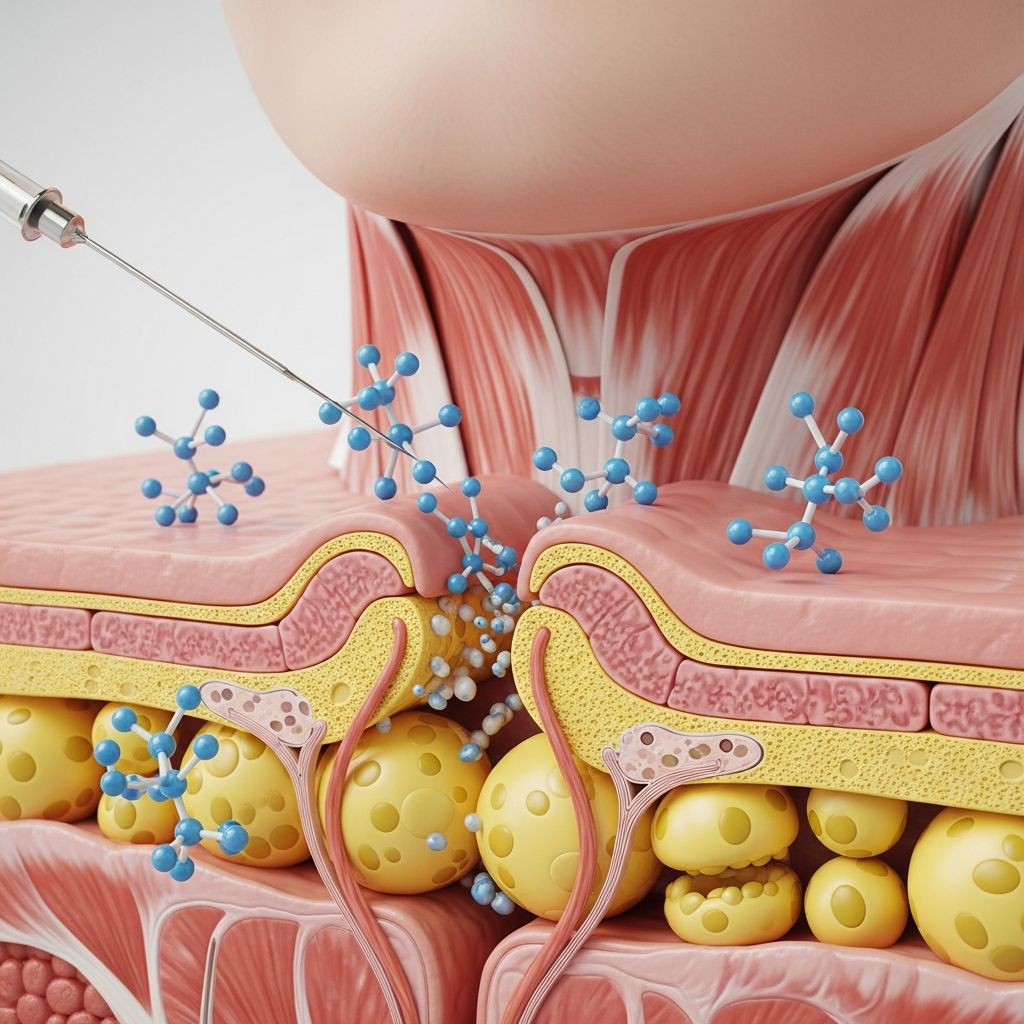
Deoxycholic acid is a secondary bile acid naturally produced by intestinal bacteria from primary bile acids secreted by the liver. Also known as deoxycholate or cholanoic acid, it plays a key role in fat emulsification and absorption in the digestive system. Synthetically formulated for medical use, deoxycholic acid acts as a cytolytic agent, disrupting adipocyte cell membranes upon injection, leading to permanent fat cell destruction. The body then metabolizes and eliminates the disrupted cells via the lymphatic system.
In dermatology and aesthetic medicine, deoxycholic acid is FDA-approved under the brand name Kybella for treating moderate to severe submental fullness. Its cytolytic properties make it uniquely suited for localized fat reduction without invasive surgery.
What is submental fat?
Submental fat refers to adipose tissue accumulation in the submental region, located beneath the chin and anterior to the neck (preplatysmal fat). This ‘double chin’ appearance arises from factors including aging, genetic predisposition, weight gain, and poor skin elasticity. Even individuals at ideal body weight may develop submental fullness due to hereditary traits, making it resistant to diet and exercise alone.
Clinically, submental fat impacts facial aesthetics, often leading to self-consciousness and psychological distress. Traditional management options include lifestyle modifications, liposuction, cryolipolysis, radiofrequency treatments, or surgical interventions like submental lipectomy. Deoxycholic acid offers a non-surgical alternative specifically targeting this stubborn fat compartment.
Who gets submental fat?
Submental fullness affects approximately 68% of individuals over age 19 across all ethnicities, genders, and body types. Prevalence increases with age due to skin laxity and fat redistribution. Genetic factors contribute significantly, as seen in familial patterns of double chins despite normal BMI. Obesity exacerbates accumulation, but even non-obese patients seek treatment for cosmetic improvement.
Assessment of submental fat
Objective evaluation uses the Clinician-Reported Submental Fat Rating Scale (CR-SMFRS), a 5-point scale (0-4) assessing fat prominence from the frontal and profile views. Scores of 2-4 indicate moderate to severe fullness suitable for deoxycholic acid therapy.
Patient-reported outcomes employ the Patient-Reported Submental Fat Rating Scale (PR-SMFRS) and Subject Self-Rating Scale (SSRS), capturing satisfaction with chin appearance. Additional measurements include caliper assessments and magnetic resonance imaging (MRI) for fat thickness quantification.
Prior to treatment, clinicians must rule out non-fat causes of submental prominence, such as thyroid enlargement, lymphadenopathy, salivary gland issues, or skeletal deformities via physical exam and imaging if needed.
Precautions
Treatment with deoxycholic acid is contraindicated in patients with infection or inflammation in the treatment area, known hypersensitivity to deoxycholic acid or excipients, or difficulty swallowing. Caution is advised in those with prominent platysmal bands, loose skin, or prior neck surgeries due to anatomical risks. Pregnancy, breastfeeding, and bleeding disorders warrant deferral.
- Exclude mimics of submental fat (e.g., thyroid goiter, lymph nodes)
- Assess skin laxity; poor elasticity may require adjunctive therapies
- Obtain informed consent detailing risks like marginal mandibular nerve injury
- Trained injectors only, with submental anatomy expertise
How to use deoxycholic acid
Deoxycholic acid is administered subcutaneously at 10 mg/mL concentration. The treatment area is defined (typically 10 cm² under the chin), marked in a grid pattern with injections spaced 1 cm apart. Each aliquot is 0.2 mL, targeting pre-platysmal fat while avoiding dermis, muscle, or glands. Sessions occur every 4-6 weeks, with 2-6 treatments needed for optimal results.
Related Stories



- Patient positioning: Supine with neck extended
- Anesthesia: Topical numbing or ice optional
- Injection: 1 cm grid, superficial subcutaneous plane
- Post-care: Ice packs, head elevation, avoid manipulation
Total dose per session: 1-2 mg/cm², not exceeding 10 mL. Ultrasound guidance may enhance precision in complex cases.
| Treatment Session | Dose (mg/cm²) | Interval | Expected Swelling Duration |
|---|---|---|---|
| 1-2 | 1 mg/cm² | 4 weeks | 7-10 days |
| 3-4 | 1-2 mg/cm² | 4-6 weeks | 5-7 days |
| 5-6 | Maintenance | As needed | Diminishing |
What are the benefits of deoxycholic acid?
Five pivotal randomized controlled trials (REFINE-1 and -2, ROTATE-1 and -2) demonstrated significant submental fat reduction. At 12 weeks post-4 treatments, 65-70% of deoxycholic acid patients achieved ≥1-grade CR-SMFRS improvement vs. 30% placebo. Patient satisfaction reached 68.5%, with MRI-confirmed 17-22% fat volume reduction.
Psychological benefits include enhanced self-esteem and facial satisfaction. Results are permanent as targeted adipocytes are destroyed. Non-surgical nature allows minimal downtime compared to liposuction.
Disadvantages, side effects, and risks
Common transient effects (resolving 1-4 weeks) include edema (90%), hematoma (72%), pain (75%), erythema (75%), and numbness (68%). Injection site hardening/induration occurs in 25-30%.
- Mild (most patients): Swelling, bruising, tenderness
- Moderate: Prolonged numbness, induration
- Rare (<1%): Marginal mandibular nerve paresis (temporary smile asymmetry), dysphagia, alopecia
Higher doses (2 mg/cm²) increased discontinuation rates (11.5% vs. 0.9% placebo) due to AEs, though efficacy was comparable to 1 mg/cm². Fat reaccumulation possible with weight gain; off-label use risky.
Frequently asked questions
Q: How many treatments are needed?
A: Most patients require 2-6 sessions spaced 4-6 weeks apart for optimal contouring.
Q: Is the fat reduction permanent?
A: Yes, destroyed fat cells do not regenerate; maintain results with stable weight.
Q: Who is not a candidate?
A: Those with infection, swallowing issues, pregnancy, or significant skin laxity.
Q: Does it hurt?
A: Mild discomfort during injection; swelling peaks 1-2 days post-treatment.
Q: Can it treat other areas?
A: FDA-approved only for submental fat; off-label use lacks safety data.
References
- Deoxycholic acid in the treatment of submental fat — DermNet NZ. 2023. https://dermnetnz.org/topics/deoxycholic-acid-in-the-treatment-of-submental-fat
- Deoxycholic Acid Injection — MedlinePlus. 2024-01-15. https://medlineplus.gov/druginfo/meds/a615026.html
- Efficacy and safety of injectable deoxycholic acid for submental fat reduction — PubMed (Expert Rev Clin Pharmacol). 2021-02-13. https://pubmed.ncbi.nlm.nih.gov/33523775/
- Deoxycholic acid (subcutaneous route) — Mayo Clinic. 2024. https://www.mayoclinic.org/drugs-supplements/deoxycholic-acid-subcutaneous-route/description/drg-20146765
- Injectable Deoxycholic Acid — American Society for Dermatologic Surgery. 2023. https://www.asds.net/skin-experts/skin-treatments/injectables/injectable-deoxycholic-acid
Similar Articles








Read full bio of medha deb