Dermatitis Artefacta: Clinical Guide To Diagnosis & Treatment
Understanding self-inflicted skin lesions: causes, diagnosis, and management of dermatitis artefacta.
What is dermatitis artefacta?
Dermatitis artefacta, also known as factitious dermatitis, is a condition where individuals intentionally inflict damage to their skin, producing lesions that mimic various dermatological diseases. This self-inflicted injury serves an unconscious psychological purpose, often to assume the sick role and receive care or attention. Unlike deliberate self-harm for suicidal intent, patients with dermatitis artefacta typically deny their actions and present with a ‘hollow’ history lacking explanation for the lesions’ onset or progression.
The term ‘artefacta’ derives from Latin, meaning ‘artificial’ or ‘made by art’, highlighting the contrived nature of the skin changes. It falls under factitious disorders in psychiatric classifications, distinct from malingering (where external incentives like financial gain are conscious motives) or Munchausen syndrome by proxy (where a caregiver inflicts harm on another, often a child). Prevalence is higher in females, particularly those aged 20–40, though it can affect any demographic. Underlying factors include personality disorders, trauma, or emotional immaturity.
Who gets dermatitis artefacta?
Dermatitis artefacta predominantly affects women, with a female-to-male ratio of approximately 20:1, often in young to middle-aged adults (20–40 years). However, it occurs across all ages, including children and the elderly. High-risk groups include:
- Healthcare workers or those with medical knowledge, who may produce sophisticated lesions.
- Individuals with borderline personality disorder, depression, anxiety, or psychosis.
- Patients with a history of abuse, neglect, or psychosocial stressors.
- Those in high-stress occupations or environments.
Patients often lack insight into their behaviour, presenting impassively despite severe lesions, contrasting with family members’ concern. In children, it may signal Munchausen by proxy.
What causes dermatitis artefacta?
The primary driver is an internal psychological need, such as craving care, attention, or sympathy. Lesions are created deliberately but unconsciously to fulfil emotional voids stemming from:
- Psychosocial difficulties or dysfunctional relationships.
- Unresolved trauma, low self-esteem, or emotional immaturity.
- Associated psychiatric conditions like borderline personality disorder, depression, or factitious disorder imposed on self.
Mechanisms of injury vary: mechanical (scratching, cutting, hitting), thermal (burns from cigarettes or heat), chemical (caustics), or other (injections). Lesions appear on accessible body sites, sparing areas like the upper back.
What are the clinical features of dermatitis artefacta?
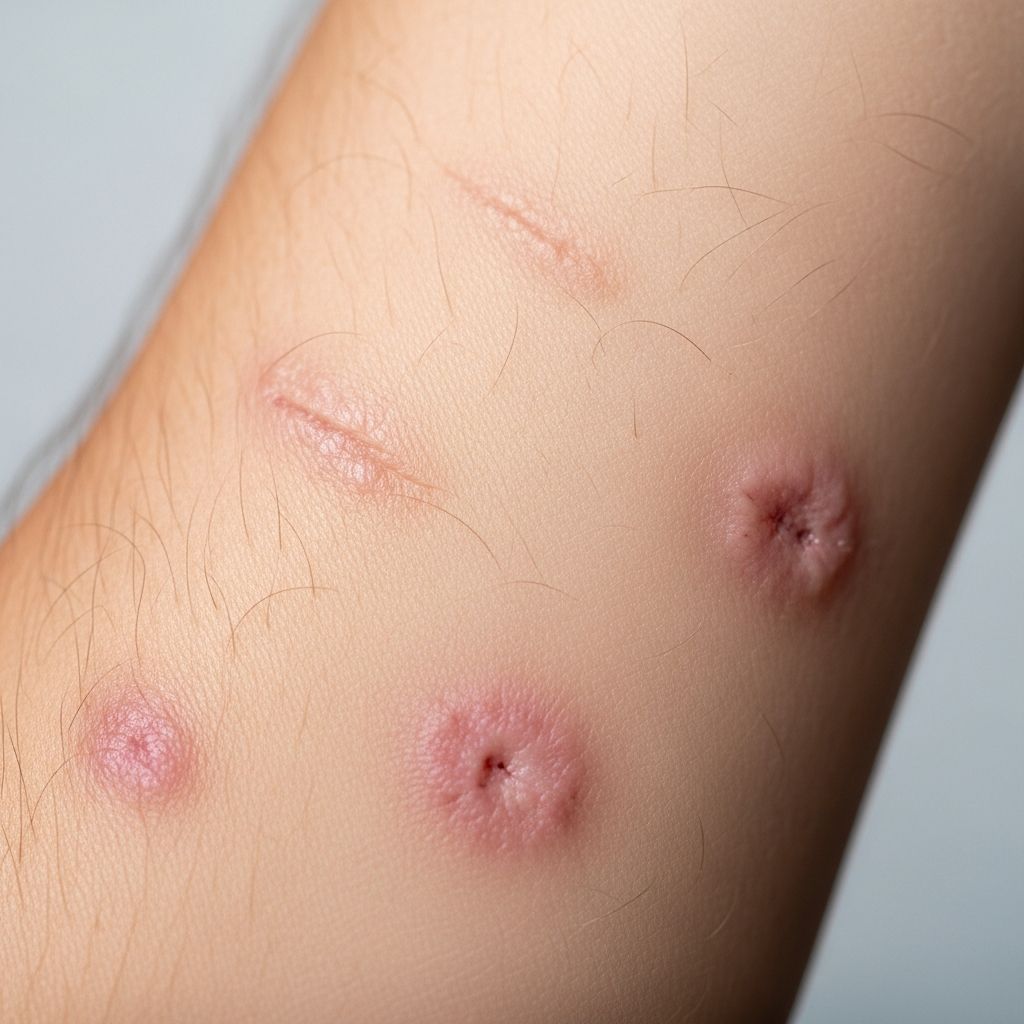
Lesions are bizarre and polymorphic, with sharp margins and geometric patterns uncommon in organic diseases. Key features include:
- Distribution: Easily accessible areas – face, hands, arms, legs, anterior trunk; often non-dominant side; spares interscapular region.
- Morphology: Erosions, ulcers, burns, blisters, excoriations, purpura, necrosis; linear, geometric, or clustered shapes.
- Evolution: Rapid onset with ‘hollow’ history; heal under occlusion but recur elsewhere.
- Patient demeanour: Indifferent (la belle indifférence) to severe lesions.
| Lesion Type | Description | Common Method |
|---|---|---|
| Erosions/Ulcers | Well-demarcated, geometric | Scratching, cutting |
| Burns | Cigarette-shaped or linear | Heat, chemicals |
| Blisters | Tense or ruptured | Friction, suction |
| Purpura/Necrosis | Sharply outlined | Trauma, injection |
Diagnosis
Diagnosis relies on high clinical suspicion; no single test confirms it. Criteria include:
- Lesions in accessible areas with bizarre shapes.
- Normal skin between lesions.
- Healing under occlusion or supervision.
- Patient denial despite evidence.
Related Stories



Investigations: Rule out mimics with swabs, biopsy (non-specific, shows non-inflammatory changes), blood tests. Confrontation is avoided; instead, build rapport.
Differential diagnosis
Dermatitis artefacta mimics many conditions:
- Infections (herpes, ecthyma).
- Autoimmune (vasculitis, pyoderma gangrenosum).
- Blistering disorders (pemphigus, porphyria).
- Artefactual mimics (neurotic excoriation, delusions of parasitosis).
| Feature | Dermatitis Artefacta | Organic Disease |
|---|---|---|
| Shape | Geometric/linear | Irregular |
| Distribution | Accessible sites | Symmetric/generalized |
| History | Hollow/denied | Consistent |
| Occlusion test | Heals rapidly | No change |
Management and treatment
Treatment is multidisciplinary, challenging, and chronic. Avoid confrontation; focus on empathy and rapport-building.
Wound care
- Occlusive dressings to prevent access and promote healing.
- Topical antibiotics for secondary infection; oral if severe.
- Hospital admission for supervision if needed.
Psychiatric intervention
- Refer to psychiatry once trust established.
- SSRIs (e.g., high-dose sertraline 200 mg/day), antipsychotics (olanzapine), anxiolytics.
- Cognitive behavioural therapy (CBT) if motivated.
- Address suicide/self-harm risk regularly.
Prognosis varies; recurrence common without psychiatric treatment.
Prevention
Early recognition prevents unnecessary tests/treatments. Educate healthcare providers on psychocutaneous signs. Long-term psychiatric support reduces relapse.
FAQs
Q: Is dermatitis artefacta the same as self-harm?
A: No. Dermatitis artefacta is factitious, driven by psychological need for care without suicidal intent, whereas self-harm often aims to relieve tension or self-punish.
Q: Can children get dermatitis artefacta?
A: Yes, but suspect Munchausen by proxy if caregiver-related.
Q: How is it diagnosed without confrontation?
A: Through clinical pattern recognition, occlusion test, and exclusion of organics.
Q: What is the best treatment?
A: Multidisciplinary: dermatological care + psychiatry; SSRIs and CBT show promise.
Q: Does it heal completely?
A: Lesions heal with occlusion, but recurrence is common without addressing psyche.
References
- A Brief Review of Dermatitis Artefacta and Management Strategies for Physicians — The Primary Care Companion for CNS Disorders. 2023. https://www.psychiatrist.com/pcc/brief-review-dermatitis-artefacta-management-strategies-physicians/
- Dermatitis Artefacta: Causes, Symptoms, and Treatment — Patient.info. 2024-10-15. https://patient.info/doctor/mental-health/dermatitis-artefacta
- Dermatitis artefacta. Clinical features and approaches to treatment — PubMed (Acta Derm Venereol). 2001-11-01. https://pubmed.ncbi.nlm.nih.gov/11702305/
- Dermatitis artefacta — Wikipedia (sourced from primary refs). 2025. https://en.wikipedia.org/wiki/Dermatitis_artefacta
- Dermatitis Artefacta — MD Searchlight. 2024. https://mdsearchlight.com/skin-problems-and-treatments/dermatitis-artefacta/
Similar Articles








Read full bio of Sneha Tete