Dermatofibroma (Fibrous Histiocytoma) Pathology
Comprehensive histopathological analysis of dermatofibroma variants, features, and diagnostic challenges in dermatopathology practice.
Dermatofibromas, also known as fibrous histiocytomas, represent one of the most prevalent benign cutaneous mesenchymal tumours, comprising approximately 3% of all skin biopsy specimens submitted for histopathological evaluation. These lesions typically manifest as firm, brownish nodules on the extremities, particularly the legs, and are more common in adults, especially women. While clinically benign, their histopathological diagnosis requires careful scrutiny due to morphological overlap with more aggressive neoplasms such as dermatofibrosarcoma protuberans (DFSP) and atypical fibroxanthoma. This article provides an in-depth exploration of the histopathological features, variants, immunohistochemical profile, and differential diagnoses of dermatofibroma, drawing from authoritative dermatopathology literature to aid precise diagnosis and management.
Histology of dermatofibroma
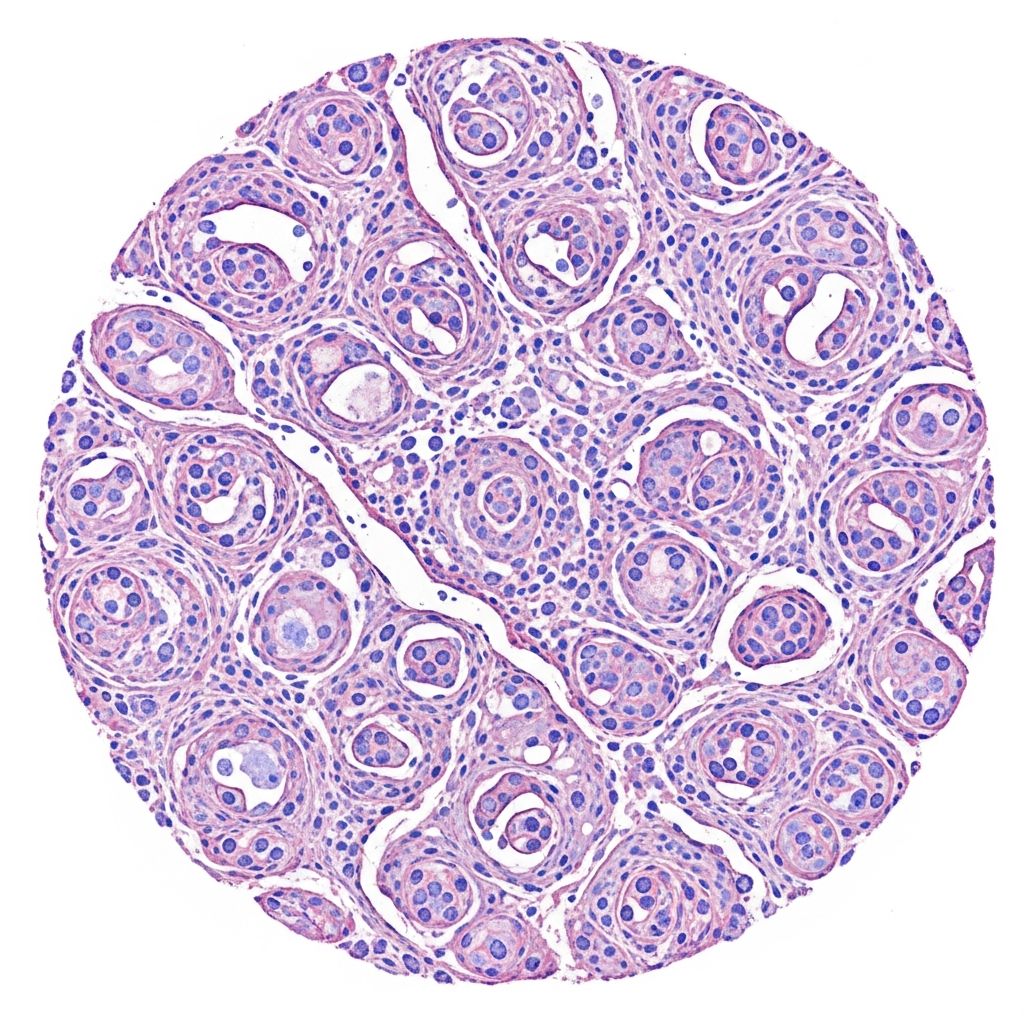
Dermatofibromas are characterised by a poorly circumscribed proliferation of fibrohistiocytic cells confined to the dermis, often exhibiting a distinctive
trapping of collagen
at the lesion’s periphery. A hallmark feature is the presence of aGrenz zone
, a thin band of normal collagen separating the tumour from the overlying epidermis, which helps distinguish it from more infiltrative processes. The epidermis frequently displays reactive changes, includingacanthosis
(epidermal thickening),hyperkeratosis
, andbasal layer hyperpigmentation
, contributing to the lesion’s clinical dimple sign upon lateral compression. In some cases, basaloid induction—small nests of basaloid cells protruding into the dermis—may mimic basal cell carcinoma or follicular tumours, necessitating higher magnification for accurate interpretation.The tumour cells comprise a mixture of spindle-shaped fibroblasts and histiocyte-like cells arranged in a
storiform pattern
(cartwheel-like whorls). Scattered multinucleated giant cells, foamy macrophages, and siderophages are common, reflecting the lesion’s postulated reactive origin from minor trauma, such as insect bites or folliculitis. Long-standing lesions evolve into more fibrotic or hyalinised forms with reduced cellularity, underscoring the spectrum of histological maturity.Dermatofibroma variants
Dermatofibromas exhibit remarkable histological heterogeneity, with over ten recognised variants. While the common fibrous histiocytoma predominates (accounting for ~80% of cases), atypical variants pose diagnostic challenges due to their aggressive-appearing features. Awareness of these subtypes is crucial, as some carry increased risks of local recurrence or, rarely, metastasis.
Common dermatofibroma
The prototypic form features ill-defined dermal expansion by bland spindle cells entrapping thickened collagen bundles at the margins. Epidermal hyperplasia with basal pigmentation is evident in up to 77% of cases, and a Grenz zone in 53%. Subcutaneous extension occurs in 31%, more frequently in certain variants.
Cellular dermatofibroma
This variant displays heightened cellularity with a swirling storiform architecture and reduced peripheral collagen trapping. It often infiltrates subcutaneous fat, shows increased mitotic activity (up to 5 per 10 high-power fields), and may harbour central necrosis in 10% of cases. Though benign, incomplete excision yields a 10% recurrence rate, prompting conservative re-excision if margins are involved. Differential includes DFSP, but cellular dermatofibroma lacks CD34 expression and t(17;22) translocation.
Epithelioid dermatofibroma
Characterised by polygonal epithelioid cells with abundant eosinophilic cytoplasm, vesicular nuclei, and prominent nucleoli, this subtype forms well-circumscribed sheets or storiform arrays beneath an epidermal collarette. Nuclear atypia and mitoses are permitted, accompanied by mixed inflammation. The epithelioid morphology risks confusion with melanoma or Spitz naevus, but factor XIIIa positivity and absence of S100 confirm fibrohistiocytic lineage.
Aneurysmal dermatofibroma
Featuring striking haemorrhagic clefts and cyst-like spaces devoid of endothelial lining, this variant (5.7% prevalence) mimics angiosarcoma. Surrounding cellular fibrohistiocytic areas, haemosiderin-laden macrophages, and lack of CD31/CD34 in pseudovascular spaces clinch the diagnosis. Extravasated erythrocytes and focal haemorrhage are consistent features.
Related Stories



Hemosiderotic dermatofibroma
A precursor to aneurysmal form (also 5.7%), it shows abundant haemosiderin deposition from chronic haemorrhage, with small vessels, extravasated red cells, and Prussian blue-positive pigment. Subcutaneous involvement is common (81.8%), and Grenz zone prominence aids identification.
Lipidised dermatofibroma
Predilected to ankles (‘ankle-type’), this rare variant (2.1%) is dominated by foamy lipid-laden histiocytes amid hyalinised, amyloid-like collagen. Hyperkeratosis and basal pigmentation occur in 75%.
Atrophic dermatofibroma
Rare (1%), with dermal atrophy, sclerotic collagen, low cellularity, and prominent elastic fibres around vessels. Epidermal acanthosis is universal (100%). Postulated vascular compromise explains the atrophic phenotype.
Fibrocollagenous dermatofibroma
Enriched in collagen and fibroblast-like cells with prominent storiform pattern. Noted in immunosuppressed patients with disseminated disease.
Clear cell dermatofibroma
Extremely rare (0.5%), with clear cytoplasm due to glycogen.
Deep fibrous histiocytoma
Occurs in deep subcutis/soft tissues of limbs (head/neck/trunk less common). Storiform growth, haemangiopericytoma-like vessels (staghorn pattern in 40%), and CD34 positivity distinguish it from superficial counterparts. Recurrence in 20%, rare metastasis.
Immunohistochemistry
Dermatofibromas consistently express
factor XIIIa
(a transglutaminase in dermal dendrocytes), present in >90% of cases.CD68
highlights histiocytic components, whileFXIIIa+/CD34-
contrasts with DFSP (CD34+/FXIIIa-). ScatteredCD163
and weakSMA
reactivity occur, but desmin is negative. Proliferative index (Ki67) is low (<5%), except in cellular variants. Endothelial markers (CD31/CD34) decorate entrapped vessels only, critical for aneurysmal subtype.| Marker | Common DF | Cellular | DFSP (Differential) | Notes |
|---|---|---|---|---|
| Factor XIIIa | ++++ | ++++ | – | Dermal dendrocyte marker |
| CD34 | – | – | ++++ | Negative in DF, positive in DFSP |
| CD68 | ++ | ++ | – | Histiocytic cells |
| SMA | +/- | +/- | – | Focal fibroblastic |
| Ki67 | <5% | 5-10% | Variable | Low proliferation |
Differential diagnosis
- Dermatofibrosarcoma protuberans (DFSP): Infiltrative, monomorphic storiform spindle cells honeycombing fat, CD34+, t(17;22)/COL1A1-PDGFB fusion. Lacks collagen trapping/Grenz zone.
- Leiomyosarcoma: Fascicular, cigar nuclei, atypia, diffuse SMA/desmin+.
- Atypical fibroxanthoma: Superficial ulcerated, pleomorphic, solar elastosis background.
- Angiosarcoma: Endothelial-lined channels, CD31/CD34+.
- Melanoma/Spitz: S100/MART1+, epithelioid variants overlap.
Frequently Asked Questions
What is the most common histological variant of dermatofibroma?
Common fibrous histiocytoma accounts for 80% of cases, featuring collagen entrapment and epidermal hyperplasia.
Which variant has the highest recurrence risk?
Cellular dermatofibroma, with 10% recurrence if margins involved, due to subcutis extension.
How does immunohistochemistry distinguish DF from DFSP?
Factor XIIIa positive and CD34 negative in DF; reverse in DFSP.
Is aneurysmal dermatofibroma malignant?
No, despite alarming haemorrhage; lacks endothelial lining and true atypia.
What clinical sign supports dermatofibroma diagnosis?
Dimple sign: central depression on lateral squeeze due to tethered dermis.
References
- Dermatofibroma (fibrous histiocytoma) pathology — DermNet NZ. 2023. https://dermnetnz.org/topics/dermatofibroma-fibrous-histiocytoma-pathology
- Dermatofibroma – StatPearls — NCBI Bookshelf / NIH. 2023-10-01. https://www.ncbi.nlm.nih.gov/books/NBK470538/
- Variants of dermatofibroma – a histopathological study — PMC / NIH. 2014-06-11. https://pmc.ncbi.nlm.nih.gov/articles/PMC4056706/
- WHO Classification of Skin Tumours — IARC Press (4th Edition). 2018. https://publications.iarc.who.fr/Book-And-Report-Series/Who-Classification-Of-Tumours/WHO-Classification-of-Skin-Tumours-2018
- Enzinger and Weiss Surgical Pathology — Elsevier (11th Edition). 2020. https://www.elsevier.com/books/enzinger-and-weiss-surgical-pathology/978-0-323-61830-0
- Dermatopathology — Elsevier (2nd Edition, McKee). 2016. https://www.elsevier.com/books/mckee-pathology-of-the-skin/978-0-7020-5122-2
Similar Articles








Read full bio of Sneha Tete