Dermatofibroma: Complete Guide To Diagnosis And Treatment
Common benign skin growth: causes, symptoms, diagnosis, and management of dermatofibromas.
Authoritative facts about dermatofibroma (histiocytoma): What it is, causes, clinical features, diagnosis, and management options.
What is dermatofibroma?
Dermatofibroma, also known as
histiocytoma
, is a common benign skin lesion characterized by a fibrous nodule in the dermis. These growths consist of an overgrowth of fibroblasts and histiocytes, forming a firm, dome-shaped papule or nodule typically measuring 3–10 mm in diameter. Dermatofibromas are rooted in the deeper dermal layers and may protrude slightly above the skin surface or appear flush with it. They are harmless, non-cancerous, and do not spread or metastasize, but can occasionally cause cosmetic concerns, itchiness, tenderness, or pain.These lesions are among the most frequent benign skin tumors encountered in dermatology practice, affecting individuals of all ages but more commonly adults, particularly women. While usually solitary, multiple lesions occur in about 10% of cases. Dermatofibromas are stable and do not resolve spontaneously, persisting indefinitely unless removed.
Who gets dermatofibroma?
Dermatofibromas predominantly affect
adults
, with a higher prevalence inwomen
(female-to-male ratio approximately 2:1). They can occur at any age but are most common between ages 20–50 years. Children and elderly individuals are less frequently affected. Immunosuppressed patients, such as organ transplant recipients, may develop multiple eruptive forms.- **Prevalence**: Very common; estimated to affect up to 10–20% of the population over time.
- **Risk factors**: Female sex, history of minor skin trauma.
- **Associations**: Rarely linked to systemic conditions, but multiple lesions seen in immunosuppression.
Geographically, no specific predilection, though they are reported worldwide.
Causes of dermatofibroma
The exact
etiology
of dermatofibromas remains unclear, debated as either areactive hyperplasia
to injury or a trueneoplasm
. Many patients recall a preceding event at the site, such as:- Insect or spider bites (most common trigger).
- Minor trauma, cuts, scratches, or abrasions.
- Splinters, thorns, or puncture wounds.
- Injections or vaccinations (rare).
These insults lead to proliferation of fibroblasts and histiocytes in the dermis as part of the repair process. Genetic factors or viral triggers are not established. Dermatofibromas are
not contagious
and do not arise from sun exposure or infections.Clinical features of dermatofibroma
Dermatofibromas present as
small, firm, round-to-oval nodules
fixed to the dermis but mobile over subcutaneous tissue. Key characteristics include:- Size: 3–10 mm (up to 15 mm in some variants).
- Shape: Dome-shaped or plaque-like; smooth surface.
- Color: Pink, red-brown, brown, dark brown, or black; may darken over time.
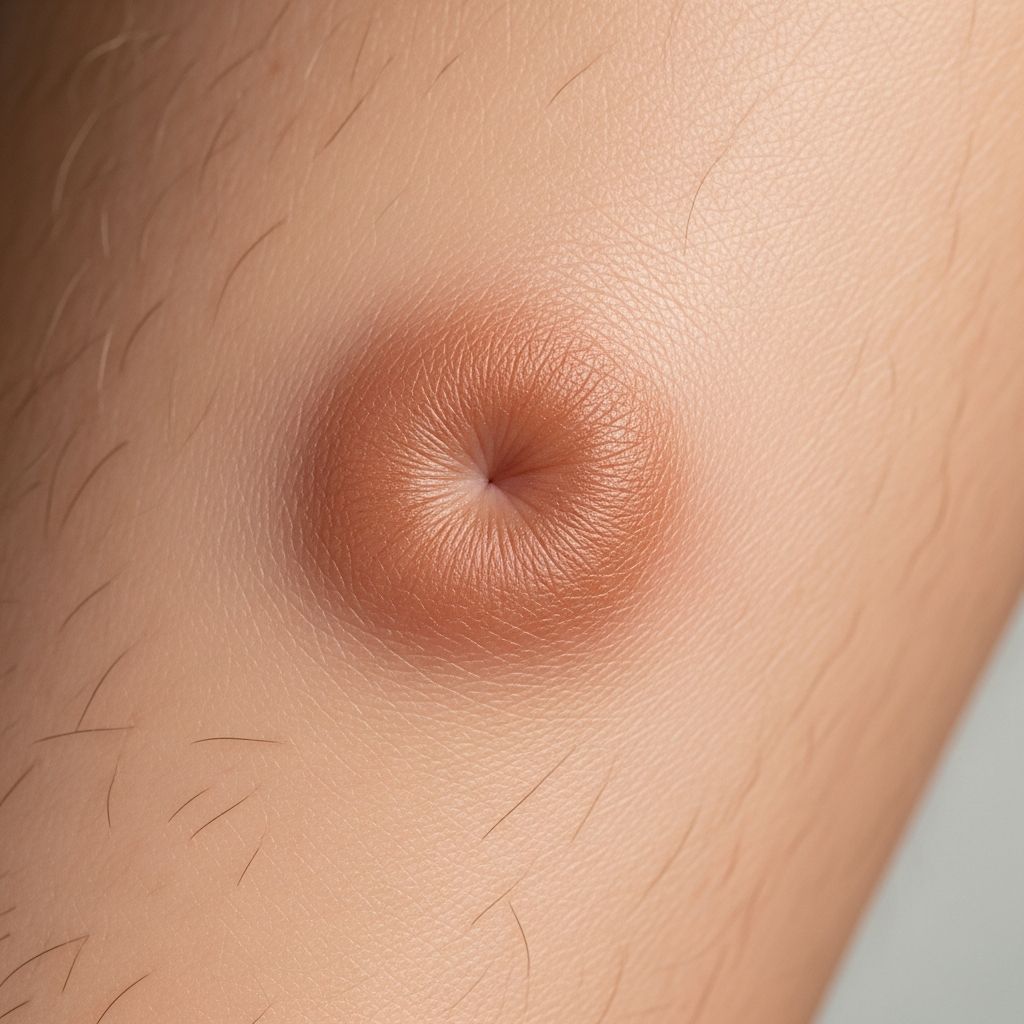
- Surface: Often shows central umbilication or dimple sign; may have adherent scale.
- Consistency: Hard, ‘rock-like’ or ‘button-like’ on palpation.
Location: Predominantly on
lower legs
(especially women), but also arms, trunk, ankles, or feet. Oral mucosa rare.Symptoms: Most are asymptomatic. Some cause:
- Itchiness (pruritus).
- Tenderness or pain on pressure.
- Inflammation or irritation from clothing/rubbing.
Dimple sign: Pathognomonic; squeezing sides causes central depression due to tethering.
Related Stories



Images of dermatofibroma
Typical appearance: Firm brown nodule on leg with dimple sign (description based on clinical images: reddish-brown dome-shaped papule, 5 mm, lower extremity).
Variants of dermatofibroma
Several clinicopathological subtypes exist:
| Variant | Features |
|---|---|
| Common (fibrocollagenous) | Typical fibrous nodule, collagen trapping. |
| Cellular | Larger, cellular fascicles; higher recurrence risk. |
| Aneurysmal | Hemorrhagic, bruise-like; mimics melanoma. |
| Haemorrhagic | Vascular, dark purple. |
| Atrophic | Scar-like depression. |
| Lipidized (ankle-type) | Foamy cells, common on ankles. |
| Pigmented | Dark due to melanin. |
| Giant | >20 mm diameter. |
| Eruptive/multiple |
Histology distinguishes: spindled fibroblasts, collagen balls, Grenz zone, dirty feet sign.
Diagnosis of dermatofibroma
Primarily
clinical
, supported by dermoscopy and biopsy if atypical.- Examination: Dimple sign, firmness, leg location.
- Dermoscopy: Central white area, peripheral pigment network.
- Skin biopsy: Essential for suspicious lesions (e.g., rapid growth, asymmetry). Shows fibroblastic proliferation, trapped collagen.
- Differential diagnosis: Melanoma, basal cell carcinoma, Kaposi sarcoma, leiomyoma.
Sonography aids: hypoechoic dermal mass.
Treatment of dermatofibroma
**Observation** is standard as lesions are benign and asymptomatic in most cases. Removal is optional for:
- Cosmetic reasons.
- Symptoms (pain, itch).
- Diagnostic uncertainty.
Management options:
| Method | Description | Pros/Cons |
|---|---|---|
| Surgical excision | Elliptical incision with stitches; full removal. | Curative but scars; best for complete excision. |
| Cryotherapy | Liquid nitrogen freezing. | Non-invasive; may not fully remove, pigment changes. |
| Laser therapy | CO2 or vascular lasers. | Minimal scarring; variable efficacy. |
| Cortisone injections | Intralesional steroids. | Reduces size/itch; temporary. |
| Observation | Monitor only. | No intervention; safest. |
Avoid home removal: risks bleeding, infection, scarring. Recurrence rare post-excision except cellular variant.
What is the outlook for dermatofibroma?
Excellent prognosis: benign, no malignant potential. Lesions persist but cause no harm. Post-removal scarring may be more noticeable than original lesion. Multiple eruptive forms monitored in immunosuppressed patients.
Prevention of dermatofibroma
No proven prevention, as cause multifactorial. Minimize trauma: insect repellent, careful shaving. Early trauma site monitoring unproven.
Related topics
- Melanocytic naevus
- Basal cell carcinoma
- Leiomyoma
- Dermoscopy
- Skin biopsy
Frequently Asked Questions
Q: Is dermatofibroma cancerous?
No, dermatofibroma is benign and does not turn into cancer.
Q: What does the dimple sign indicate?
It confirms dermatofibroma: pinching causes central dimple due to dermal tethering.
Q: Do dermatofibromas go away on their own?
No, they persist indefinitely unless treated.
Q: Can I remove it myself?
No, seek professional care to avoid complications.
Q: Why are they more common on legs?
Likely due to frequent minor trauma/insect bites in exposed areas.
References
- Dermatofibroma – StatPearls – NCBI Bookshelf — Al-Dhubb J, et al. 2023-10-01. https://www.ncbi.nlm.nih.gov/books/NBK470538/
- Dermatofibroma: Symptoms, Causes, Prevention, and Treatment — Westlake Dermatology. 2023-01-15. https://www.westlakedermatology.com/blog/dermatofibroma-treatment-options/
- Dermatofibroma: Causes, images, and treatment — Medical News Today. 2023-05-20. https://www.medicalnewstoday.com/articles/318870
- Dermatofibromas Treatment Porter Ranch Dermatologist — Porter Ranch Dermatologist. 2024-02-10. https://porterranchdermatologist.com/medical-dermatology/dermatofibromas/
- Cellular Dermatofibroma: Causes, Symptoms & Treatment — Cleveland Clinic. 2024-06-12. https://my.clevelandclinic.org/health/diseases/22668-cellular-dermatofibroma
Similar Articles








Read full bio of medha deb