Dermatofibrosarcoma Protuberans Pathology
Comprehensive pathology of DFSP: from clinical features to advanced variants and molecular diagnostics for optimal management.
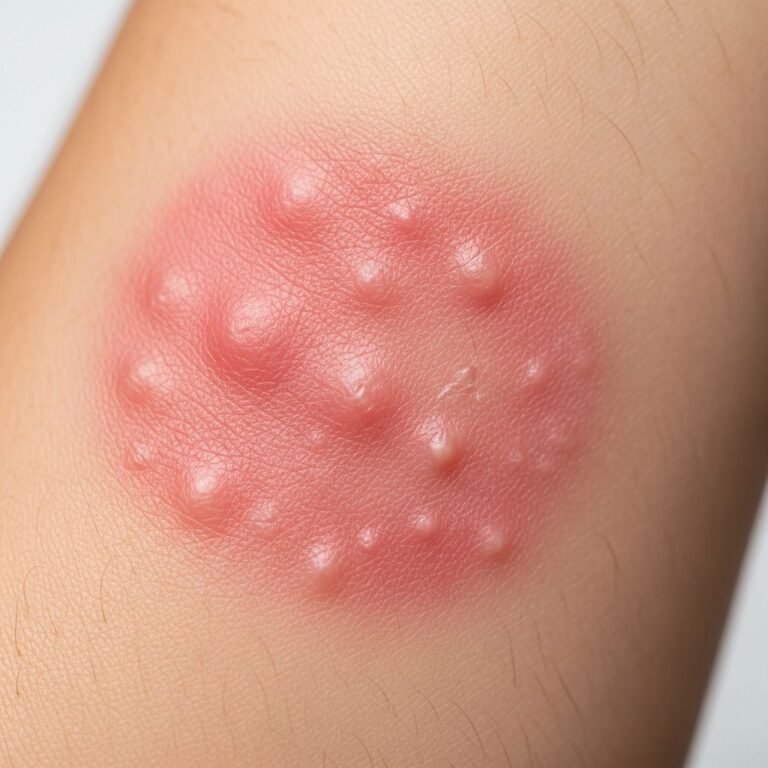
Dermatofibrosarcoma protuberans (DFSP) represents a rare, locally aggressive cutaneous neoplasm originating from fibroblasts in the dermis. This slow-growing sarcoma typically manifests initially as a skin-coloured plaque that evolves into a red or brown-hued, nodular protuberant lesion over time. While metastasis is uncommon, DFSP is notorious for high local recurrence rates if not adequately excised, necessitating precise pathological evaluation for diagnosis and management.
Introduction
Dermatofibrosarcoma protuberans accounts for approximately 0.1% of all malignancies and 1% of soft tissue sarcomas, predominantly affecting adults aged 20–50 years, with a slight male predominance. It most commonly arises on the trunk (especially chest and back), followed by proximal extremities, head, and neck. Risk factors include prior skin trauma, burns, or sites of scarring, and a small subset harbours the pathognomonic COL1A1-PDGFB gene fusion, driving tumorigenesis through PDGFB overexpression. Congenital cases, though rare, may present as atrophic plaques that later protuberate.
Clinically, early DFSP appears as an asymptomatic, indurated plaque, often mistaken for keloid or dermatofibroma. Progression leads to protuberant nodules with a “button-like” elevation, displaying colours from pink-red to bluish-brown. The lesion expands peripherally in a “carpet-like” fashion, infiltrating subcutaneous fat while sparing overlying epidermis superficially.
Histology
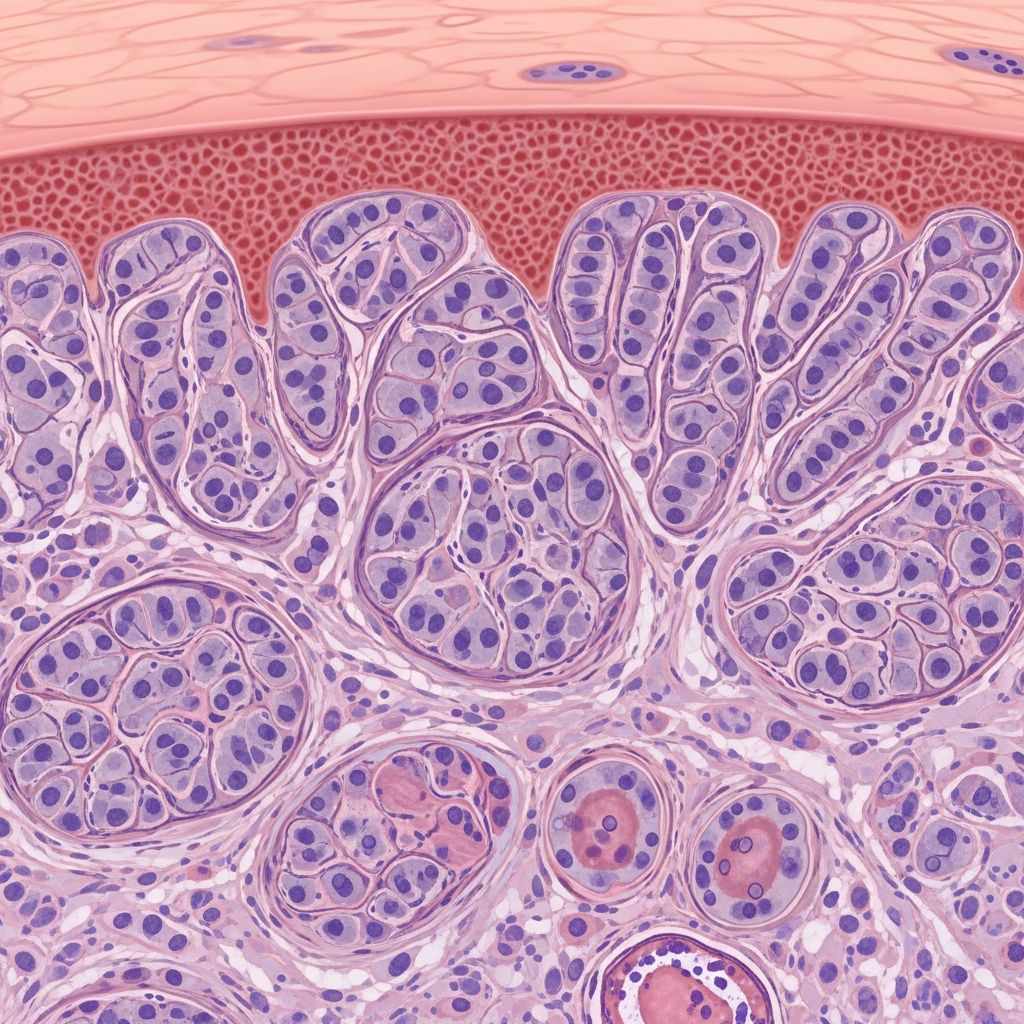
The histopathological hallmark of DFSP is a monotonous proliferation of uniform spindle-shaped cells embedded in a scant, delicate collagenous stroma, extending from the deep dermis into subcutaneous septa. Tumour cells exhibit elongated, wavy nuclei with minimal atypia or pleomorphism, arranged in interwoven fascicles often adopting a storiform (cartwheel) pattern.
A distinctive feature is the multi-layer infiltration pattern: tumour cells honeycomb through adipocytes, trapping fat in a lace-like network (Figure 1 equivalent description: low-power view showing deep dermal and subcutaneous infiltration). Higher magnification reveals slender cells with tapered ends and aligned nuclei (Figures 3–5). Mitotic activity is low (<5/10 HPF in classic cases), and necrosis is absent.
- Deep dermis involvement: Uniform spindled cells with storiform architecture.
- Subcutaneous extension: Infiltrative growth dissecting fat lobules.
- Muscle invasion: Occasional in advanced lesions.
- Superficial sparing: Epidermis typically uninvolved, though ulceration may occur in bulky tumours.
Histopathology images
Pathological images depict: (1) Scanning magnification showing plaque-like dermal expansion into subcutis; (2) Infiltrative subcutaneous involvement; (3–5) Uniform spindle cells with low mitotic rate; (6) Classic storiform pattern; (7) Immunohistochemical staining highlighting CD34 positivity.
Immunohistochemistry
DFSP shows characteristic immunoreactivity: diffusely positive for CD34 (endothelial marker often co-expressed in fibroblasts), positive for vimentin, and negative for CD31, smooth muscle actin (SMA), desmin, S100, and factor XIIIa. CD34 positivity is patchy in some variants but remains a key diagnostic marker.
| Marker | Staining in DFSP | Notes |
|---|---|---|
| CD34 | Positive (diffuse) | Membranous/cytoplasmic; 90–100% cases |
| Vimentin | Positive | Nonspecific mesenchymal marker |
| SMA | Negative | Distinguishes from leiomyosarcoma |
| S100 | Negative | Excludes neural tumours |
| Factor XIIIa | Negative | Contrasts with dermatofibroma |
Genetics
The molecular signature of DFSP is the t(17;22)(q22;q13) translocation fusing COL1A1 on chromosome 17 to PDGFB on chromosome 22 in over 90% of cases. This fusion places PDGFB under the COL1A1 promoter, leading to autocrine PDGF signalling and tumour proliferation. Detection via FISH, RT-PCR, or NGS confirms diagnosis, especially in CD34-negative or atypical cases. Ring chromosomes or supernumerary rings containing the fusion gene are also reported.
Related Stories



Variants
DFSP exhibits several histological variants, each with prognostic implications:
- Fibrosarcomatous DFSP (FS-DFSP): 10–15% of cases; high-grade transformation with herringbone fascicles, increased mitoses (>10/10 HPF), pleomorphism, and necrosis. Higher recurrence (30–50%) and metastasis risk (10–20%) to lungs.
- Myxoid DFSP: Hypovascular with abundant mucin; mimics myxofibrosarcoma but CD34+.
- Giant cell fibroblastoma: Paucicellular with pseudovascular spaces and giant cells; often in children, harbours same fusion.
- Bednar tumour: Pigmented variant with melanin-laden cells.
- Atrophic/congenital DFSP: Rare, presents as depressed plaque; evolves tuberously.
Differential diagnoses
Distinguishing DFSP from mimics relies on clinicohistological correlation:
| Entity | Key Features | IHC |
|---|---|---|
| Cellular dermatofibroma | Radial growth, haemosiderin, epidermal hyperplasia | FXIIIa+, CD34-/focal |
| Dermal sarcoma | High pleomorphism, mitoses | Variable |
| Leiomyosarcoma | Cigar nuclei, mitoses | SMA+ |
| Desmoplastic melanoma | Fibrosis, lymphocytes | S100+ |
| Neurofibroma | Mast cells, wavy fibres | S100+ |
| FS-DFSP | Herringbone, cellular; reduced CD34 | CD34 reduced |
Management
Wide local excision (2–3 cm margins) or Mohs micrographic surgery is standard, with sentinel node biopsy for high-risk (FS) variants. Imatinib targets PDGFB fusion in advanced/recurrent disease, achieving partial responses in 50–80%. Recurrence rates: 20–50% post-excision, lower (4–5%) with Mohs.
Frequently Asked Questions
Q: Is DFSP metastatic?
A: Rarely (<5%); FS variant increases risk to 10–20%, typically to lungs.
Q: What is the role of CD34 in diagnosis?
A: Strong positivity supports DFSP; negative in 5–10%, then pursue molecular testing.
Q: How does FS-DFSP differ?
A: More aggressive with fascicular growth, higher mitoses, metastasis potential.
Q: Is genetic testing necessary?
A: Essential for variants or equivocal IHC; detects COL1A1-PDGFB in >90%.
References
- Dermatofibrosarcoma protuberans pathology — DermNet NZ. 2023. https://dermnetnz.org/topics/dermatofibrosarcoma-protuberans-pathology
- Dermatofibrosarcoma Protuberans (DFSP): Causes & Treatment — Cleveland Clinic. 2024-01-15. https://my.clevelandclinic.org/health/diseases/24068-dermatofibrosarcoma-protuberans
- Dermatofibrosarcoma Protuberans — CancerIndex. 2023. http://www.cancerindex.org/clinks2sd.htm
- Dermatofibrosarcoma Protuberans — Orthobullets. 2024. https://www.orthobullets.com/pathology/8066/dermatofibrosarcoma-protuberans
- Soft Tissue Sarcoma Pathology Outlines — Pathology Outlines (official pathology resource). 2025-06-01. https://www.pathologyoutlines.com/topic/softtissuedfp.html
- DFSP: Update on Diagnosis and Treatment — American Society of Clinical Oncology (ASCO). 2024-05-20. https://ascopubs.org/doi/10.1200/EDBK_432345
Similar Articles








Read full bio of medha deb