Dermatopathological Terminology: Comprehensive Glossary
Comprehensive glossary of key terms used in dermatopathology for accurate skin biopsy interpretation and diagnosis.
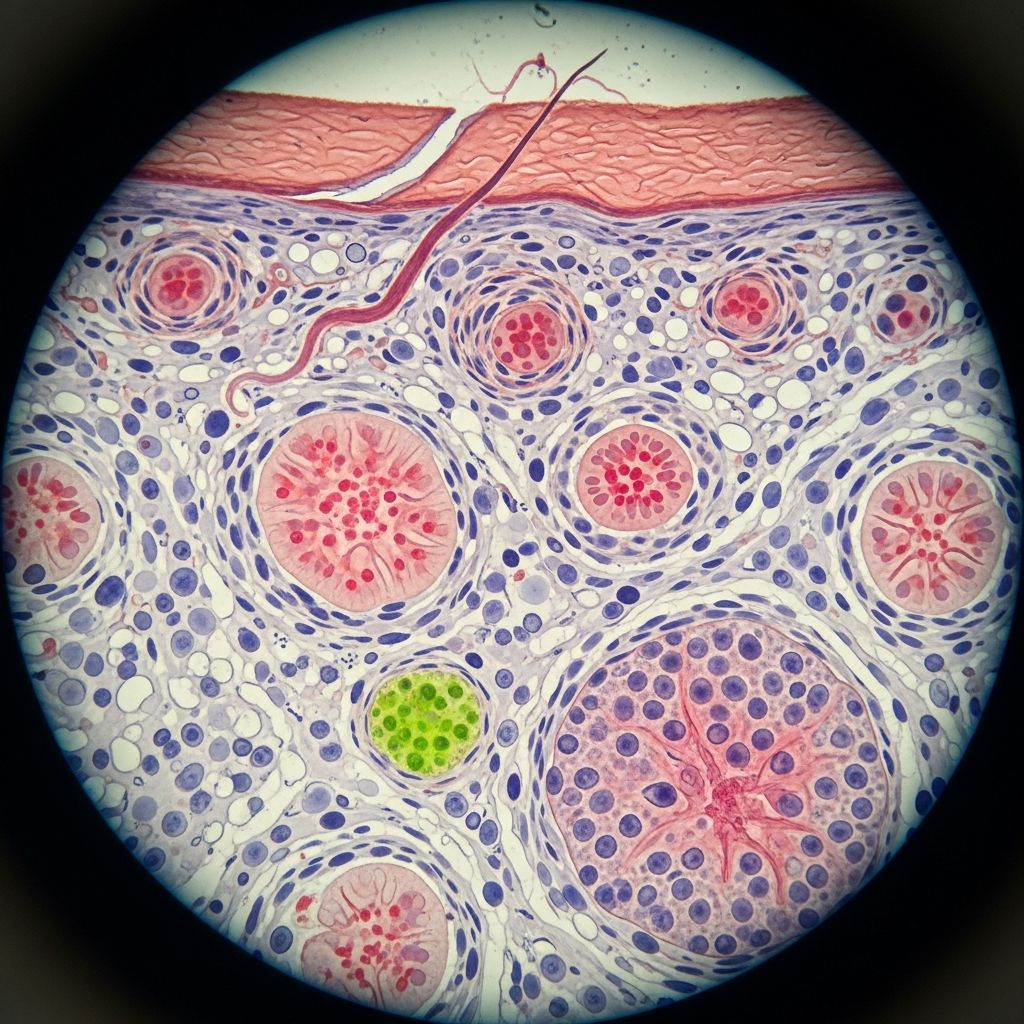
This comprehensive glossary outlines key terms used in dermatopathology, the microscopic study of skin diseases. Understanding these terms is crucial for interpreting skin biopsies accurately, distinguishing between inflammatory, neoplastic, and degenerative processes. Dermatopathologists rely on these descriptors to diagnose conditions ranging from eczema to melanoma.
Introduction
Dermatopathology involves examining skin tissue under a microscope to identify disease patterns. Terms describe changes in the
epidermis
,dermis
, cellular alterations, and inflammatory patterns. These standardized descriptors ensure consistent communication among clinicians and pathologists worldwide. Common patterns include spongiotic dermatitis (eczema-like), psoriasiform (psoriasis-like), and lichenoid (interface) reactions.Acantholysis
**Acantholysis** refers to the loss of cohesion between keratinocytes (epidermal cells), resulting in intraepidermal clefts or blisters. It occurs due to breakdown of desmosomal attachments. Classic examples include pemphigus vulgaris, where autoantibodies target desmogleins, leading to rounded acantholytic cells (“row of tombstones”). In Hailey-Hailey disease, genetic defects cause similar separation. Clinically, this manifests as flaccid blisters and erosions.
Acantholytic Dyskeratosis
**Acantholytic dyskeratosis** combines acantholysis with dyskeratosis (premature keratinization). Affected keratinocytes appear dysplastic with hyperchromatic nuclei and eosinophilic cytoplasm, forming ‘corps ronds’. Seen in Darier disease, warty dyskeratoma, and actinic keratosis. This focal change helps differentiate benign from premalignant lesions.
Acanthosis
**Acanthosis** is epidermal thickening due to increased spinous layer keratinocytes. It appears as elongation of rete ridges. Causes include chronic irritation (psoriasis, lichen simplex chronicus), obesity (acanthosis nigricans), or endocrine disorders. Regular acanthosis shows uniform rete elongation; irregular suggests neoplasia like squamous cell carcinoma.
Anagen
**Anagen** is the active growth phase of the hair cycle, lasting 2-6 years. Follicles produce hair shaft rapidly. Anagen effluvium, from chemotherapy, causes sudden hair loss by halting this phase. Histologically, anagen follicles are large with open hair shafts and prominent inner root sheath.
Apoptosis
**Apoptosis** (programmed cell death) appears as shrunken keratinocytes with pyknotic nuclei and eosinophilic cytoplasm, often in the basal layer. Seen in graft-versus-host disease, lichen planus, and viral infections. Clusters form ‘satellite cell necrosis’ when adjacent to damaged cells.
Atrophy
**Atrophy** denotes thinning of the epidermis or dermis. Epidermal atrophy shows flattened rete ridges; dermal from reduced collagen (steroid-induced, aging). In lichen sclerosus, atrophic epidermis overlies hyalinized dermis. Clinically, skin appears shiny and wrinkled.
Basement Membrane
The
basement membrane
is a thin acellular layer separating epidermis from dermis, visualized with PAS stain. Thickening occurs in dystrophic epidermolysis bullosa; duplication in lichen planus. It anchors epithelium and filters molecules.Birefringence
**Birefringence** is the optical property where material splits polarized light, appearing bright against dark background. Useful for identifying amyloid (apple-green), collagen, or fibrin. Absent in necrosis, aiding differential diagnosis.
Bulla(e)
**Bullae** are large blisters (>0.5 cm) filled with fluid. Subepidermal (e.g., bullous pemphigoid) show intact epidermal roof; intraepidermal (pemphigus) have acantholytic bases. Tense bullae suggest subepidermal; flaccid intraepidermal.
Calcinosis Cutis
**Calcinosis cutis** involves dystrophic calcium deposition in damaged dermis. Basophilic granules or plates around vessels or eccrine ducts. Associated with scleroderma, lupus, or trauma. Dystrophic type follows inflammation; idiopathic is normocalcemic.
Related Stories



Catagen
**Catagen** is the involution phase of hair cycle (2-3 weeks), where follicle shrinks, apoptosis occurs, and bulb ascends. Seen in normal cycling or telogen effluvium triggers. Histology shows wrinkled outer root sheath.
Cornoid Lamella
**Cornoid lamella** is a thin parakeratotic column with absent granular layer beneath, overlying vacuolated keratinocytes. Hallmark of porokeratosis; also in actinic keratosis or squamous cell carcinoma.
Crust
**Crust** (scab) forms from dried serum, blood, or pus on skin surface. Histologically, eosinophilic with embedded neutrophils. Common in impetigo, infected eczema.
Cyst
**Cyst** is a cavity lined by epithelium containing keratin or fluid. Epidermoid cysts have stratified squamous lining; trichilemmal show abrupt keratinization. Rupture causes granulomatous inflammation.
Dermal Oedema
**Dermal oedema** widens collagen bundles with pale spaces. Acute in urticaria; chronic leads to fibrosis. Perivascular in insect bites.
Dermis
The
dermis
is connective tissue supporting epidermis, containing collagen, elastin, vessels, nerves. Superficial (papillary) is loose; reticular is dense. Solar damage affects both.Dyskeratosis
**Dyskeratosis** is aberrant keratinization in lower epidermis, producing round eosinophilic cells (corps ronds, grains). Seen in viral warts, Bowen disease, Darier disease.
Elastosis
**Elastosis** (solar elastosis) is basophilic amorphous dermal material from sun-damaged elastic fibers. Amorphous on H&E; verified with elastic stain. Causes leathery skin in photoaging.
Flame Figures
**Flame figures** are eosinophilic deposits around hair follicles from degenerated eosinophils in eosinophilic cellulitis or Wells syndrome. Mimic Wells syndrome histologically.
Foam Cells
**Foam cells** are lipid-laden macrophages with foamy cytoplasm. Seen in xanthomas, dermatofibroma, or regressing melanomas.
Epidermis
The
epidermis
is stratified keratinized epithelium from basal to stratum corneum. Layers: basal, spinous, granular, corneum. Hyperplasia or atrophy alters thickness.Epidermolytic Dyskeratosis
**Epidermolytic dyskeratosis** shows compact orthokeratosis, vacuolar keratinocytes, and clumped keratin filaments. Seen in epidermolytic ichthyosis, ichthyosis bullosa, palmoplantar keratoderma.
Epidermotropism
**Epidermotropism** is atypical lymphocytes migrating single-file into epidermis, hallmark of mycosis fungoides. Lacks spongiosis; forms Pautrier microabscesses.
Exocytosis
**Exocytosis** is inflammatory cells (lymphocytes, neutrophils) migrating into epidermis randomly. Common in spongiotic dermatitis like eczema.
Fibrinoid Necrosis
**Fibrinoid necrosis** is bright eosinophilic homogeneous material in vessel walls from fibrin deposition. Seen in vasculitis, collagen vascular diseases.
Fibrosis
**Fibrosis** is increased dermal collagen with reduced cellularity. Early sclerotic; late hyalinized. In scars, morphea, nephrogenic systemic fibrosis.
Follicular Plugging
**Follicular plugging** is keratin and debris filling follicles, forming comedones in acne or horny plugs in lupus erythematosus.
Granuloma
**Granuloma** is organized aggregate of epithelioid histiocytes, often with multinucleate giants. Foreign body type has polarizable material; palisaded in granuloma annulare.
Grenz Zone
**Grenz zone** is preserved compact dermis beneath subacute spongiotic epidermis, seen in early mycosis fungoides or insect bites.
Haemophagocytosis
**Haemophagocytosis** is macrophages engulfing blood cells, in histiocytic disorders or viral infections like EBV.
Haemosiderin Deposition
**Haemosiderin deposition** is golden-brown pigment from RBC breakdown, Prussian blue-positive. In stasis dermatitis, angiomas, amyloidosis.
Horn Cyst
**Horn cyst** is keratin-filled epidermal invagination, laminated. Seen in inverted follicular keratosis, trichilemmoma.
Hypergranulosis
**Hypergranulosis** is thickened granular layer, focal or diffuse, in warts, granular parakeratosis.
Hyperkeratosis
**Hyperkeratosis** is increased stratum corneum thickness. Orthokeratotic (no nuclei); parakeratotic (retained nuclei). In psoriasis, calluses.
Hyalinisation of Collagen
**Hyalinisation of collagen** is glassy homogenization of dermal collagen, pink on H&E. In lichen sclerosus, porphyria cutanea tarda.
Inflammation
**Inflammation** involves leukocyte infiltration responding to injury. Acute neutrophilic; chronic lymphocytic/histiocytic. Patterns: perivascular, lichenoid.
Interface Dermatitis
**Interface dermatitis** shows vacuolar basal layer change with apoptotic keratinocytes and lymphocytic infiltrate. In lupus, lichen planus, erythema multiforme.
Keratinisation
**Keratinisation** is terminal epidermal differentiation forming keratin. Aberrant in dyskeratosis.
Koilocytes
**Koilocytes** are HPV-infected keratinocytes with perinuclear halo, raisinoid nuclei. Hallmark of condyloma acuminatum.
Leucocytoclasia
**Leucocytoclasia** is karyorrhexis of neutrophils, in leukocytoclastic vasculitis with fibrinoid necrosis.
Lichenoid Reaction
**Lichenoid reaction** mimics lichen planus: band-like dermal lymphocytic infiltrate hugging epidermis, basal vacuolization. In drug eruptions, viral exanthems.
Mucinosis
**Mucinosis** is dermal mucopolysaccharide accumulation, Alcian blue-positive. In lupus, myxoid cysts, follicular mucinosis.
Necrobiosis
**Necrobiosis** is collagen degeneration with granulomatous response, eosinophilic swollen fibers. In granuloma annulare, necrobiosis lipoidica.
Necrosis
**Necrosis** is cell death with nuclear changes: pyknosis, karyorrhexis, karyolysis. Coagulative in infarcts; caseous in TB.
Neoplasm
**Neoplasm** is abnormal tissue growth, benign or malignant. Classified by origin: epithelial, melanocytic, mesenchymal.
Nodular Infiltrate
**Nodular infiltrate** is well-circumscribed dermal cellular aggregate, in lymphoma, metastases.
Oedema
**Oedema** is tissue fluid accumulation, pale spaces on histology. Clears with diastase.
Osteoma Cutis
**Osteoma cutis** is bone formation in skin, dystrophic post-trauma or progressive osseous heteroplasia.
Orthokeratosis
**Orthokeratosis** is basket-weave stratum corneum without nuclei, normal or thickened.
Pagetoid Spread
**Pagetoid spread** is intraepidermal malignant cell migration mimicking Paget disease, in melanoma, T-cell lymphoma.
Panniculus
**Panniculus** is subcutaneous fat layer, site of panniculitis.
Panniculitis
**Panniculitis** is septal or lobular fat inflammation, e.g., erythema nodosum (septal), pancreatic (lobular).
Papillary Mesenchymal Bodies
**Papillary mesenchymal bodies** are dilated capillaries with hyalinized stroma in papillary dermis, in regressing porokeratosis.
Papillomatosis
**Papillomatosis** is surface undulation with contiguous papillae, in warts, seborrheic keratosis.
Parakeratosis
**Parakeratosis** is stratum corneum with retained nuclei, in psoriasis, dermatophytosis.
Pautrier Microabscess
**Pautrier microabscess** is epidermal collection of atypical lymphocytes in mycosis fungoides.
Peri-adnexal Inflammation
**Peri-adnexal inflammation** surrounds follicles or glands, in rosacea, lupus.
Perivascular Lymphocytic Infiltrate
**Perivascular lymphocytic infiltrate** is superficial/deep lymphocytes around vessels, nonspecific in viral exanthems, early CTCL.
Pigment Incontinence
**Pigment incontinence** is melanin dropping into dermis from damaged basal cells, melanophages. In lichen planus, post-inflammation.
Pseudoepitheliomatous Hyperplasia
**Pseudoepitheliomatous hyperplasia** is reactive epidermal hyperplasia mimicking squamous cell carcinoma, in infections, halogenoderma.
Psoriasiform Hyperplasia
**Psoriasiform hyperplasia** shows regular acanthosis, thinned suprapapillary plates, parakeratosis. In psoriasis, Reiter syndrome.
Pustule
**Pustule** is intraepidermal neutrophil collection. Spongiform in pustular psoriasis; subcorneal in impetigo.
Pyknosis
**Pyknosis** is nuclear shrinkage in early necrosis/apoptosis.
Scale Crust
**Scale crust** combines parakeratosis, serum, inflammatory cells, in infected eczema.
Solar Elastosis
**Solar elastosis** is sun-induced dermal elastin/collagen degeneration, basophilic material.
Spongiosis
**Spongiosis** is intercellular edema causing epidermal spongelike appearance, in acute eczema.
Squamous Eddy
**Squamous eddy** is whorled keratinizing keratinocytes, in irritated seborrheic keratosis, squamous cell carcinoma.
Telogen
**Telogen** is resting hair phase (3 months), fibrous stremma, club hair. Effluvium shows increased telogen follicles.
Transepidermal Elimination
**Transepidermal elimination** extrudes dermal material (collagen, elastin) through epidermis, in perforating disorders like Kyrle disease.
Tumour
**Tumour** is solid neoplasm mass, from Latin ‘swelling’. Benign or malignant.
Vacuolar Degeneration
**Vacuolar degeneration** is basal keratinocyte cytoplasmic vacuoles progressing to apoptosis, in interface dermatitis.
Vasculitis
**Vasculitis** is vessel wall inflammation with fibrinoid necrosis, leukocytoclasia. Leukocytoclastic most common.
Vesicle
**Vesicle** is small blister (<0.5 cm). Similar to bulla but size-based.
Viral Inclusion Bodies
**Viral inclusion bodies** are intranuclear/cytoplasmic aggregates: eosinophilic (herpes), basophilic (HPV). Diagnostic clue.
Frequently Asked Questions (FAQs)
What is the difference between spongiosis and acantholysis?
Spongiosis is intercellular edema without cell separation; acantholysis involves loss of desmosomes causing clefts.
How does solar elastosis appear histologically?
As basophilic, amorphous dermal material with clumped elastic fibers on Verhoeff stain.
What causes Pautrier microabscesses?
Epidermotropism of atypical cerebriform lymphocytes in mycosis fungoides.
Is interface dermatitis always lichen planus?
No, also in lupus, drug eruptions, graft-versus-host disease.
What stain confirms haemosiderin?
Perls Prussian blue turns it blue.
References
- Dermatopathological terminology — DermNet New Zealand. 2023-10-15. https://dermnetnz.org/topics/dermatopathological-terminology
- Glossary of dermatopathological terms — BAD DermpathPRO Learning Hub. 2024-01-12. https://dermpathpro.com/glossary_of_terms/
- Dermatopathology: An Abridged Compendium — PMC (NCBI). 2013-05-29. https://pmc.ncbi.nlm.nih.gov/articles/PMC3663391/
- Dermatology Glossary of Terms — Robert Miller MD. 2022-08-05. http://www.robertmillermd.com/derma_glossary.html
- Dermatology Dictionary — PCDS. 2024-03-20. https://www.pcds.org.uk/dermatology-dictionary
Similar Articles








Read full bio of Sneha Tete