Dermoid Cyst: Causes, Symptoms, Diagnosis, And Treatment Guide
Comprehensive guide to dermoid cysts: causes, symptoms, diagnosis, treatment, and management of these benign growths.
Authoritative facts about dermoid cysts: what they are, who gets them, causes, symptoms, diagnosis, treatment, and more from high-quality medical sources.
What is a dermoid cyst?
A
dermoid cyst
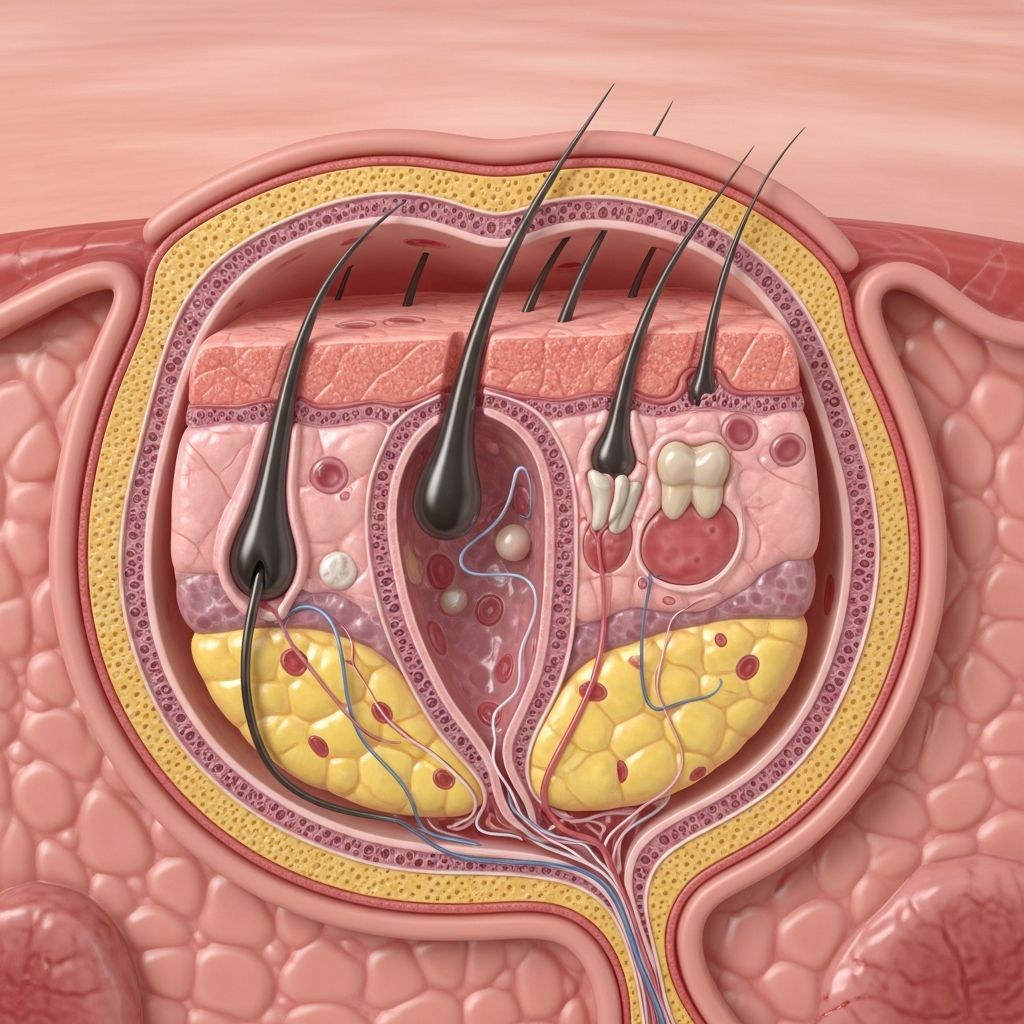
is a benign congenital sac-like growth filled with tissues typically found on the body’s surface, such as skin, hair, sweat glands, teeth, or fat. These cysts arise from ectodermal elements trapped during embryonic development along fusion lines of the body. They form when totipotent germ cells—capable of differentiating into any tissue type—misplace and proliferate, creating a cyst lined by epidermis containing adnexal structures like sebaceous glands and hair follicles.Unlike malignant tumors, dermoid cysts are non-cancerous and slow-growing, often present at birth or appearing shortly after. They can occur anywhere but are most common on the head, neck, face, or ovaries. Superficial cysts present as painless subcutaneous nodules, while deeper ones may involve bone or vital structures.
Who gets dermoid cysts?
Dermoid cysts affect individuals of all ages but are frequently diagnosed in children and young adults due to their congenital origin. They occur equally in males and females, except ovarian dermoids, which exclusively impact women of reproductive age.
- Cutaneous dermoids: Common in infants and children, often on the head (60-70% of cases), neck, or trunk.
- Ovarian dermoids (mature cystic teratomas): Predominant in women aged 20-40 years, comprising 15-25% of all ovarian tumors.
- Multiple cysts are rare but reported, particularly in genetic syndromes.
What causes dermoid cysts?
The primary cause is
embryologic entrapment
of ectodermal tissue during fetal development. As the neural tube closes (3-5 weeks gestation), surface ectoderm gets sequestered along fusion lines, forming inclusion cysts. In ovarian cases, abnormal germ cell development leads to totipotent cells forming teratomas with diverse tissues like bone, cartilage, or neural elements.Risk factors include:
- Genetic predisposition (rare familial cases).
- Intrauterine developmental anomalies.
- No strong environmental triggers identified.
What are the clinical features of dermoid cyst?
Cutaneous dermoid cysts
Appear as firm, painless, flesh-colored or yellowish subcutaneous nodules, 0.5-5 cm in size, often mobile under intact skin. Common sites:
- Head/scalp (most frequent, especially supraorbital ridge).
- Neck, face (periorbital, nasal).
- Spine (may signal spinal dysraphism if midline).
A central punctum may exude cheesy material, hair, or sebaceous debris if squeezed. Periorbital cysts can cause proptosis or bone remodeling.
Ovarian dermoid cysts
Often asymptomatic until large (>5-10 cm). Symptoms include pelvic pain, bloating, irregular menses, or dyspareunia. Imaging reveals characteristic ‘Rokitansky nodule’ with hair/teeth.
How is a dermoid cyst diagnosed?
Diagnosis combines clinical exam and imaging:
- Physical exam: Palpable, non-tender mass; check for punctum, mobility, overlying skin changes.
- Ultrasound: First-line; shows hyperechoic cyst wall with internal echoes (fat/hair). 98-100% specific for ovarian types.
- CT/MRI: For deep cysts; delineates bone involvement, contents (fat density confirms diagnosis).
- Fine-needle aspiration: Avoided due to rupture/infection risk.
Related Stories



| Test | Use Case | Findings |
|---|---|---|
| Ultrasound | All types | Cystic mass with solid/echogenic components (hair, fat) |
| MRI | Deep/head | T1-hyperintense fat, T2-heterogeneous; confirms teratoma |
| CT | Bone involvement | Calcifications (teeth/bone) |
What are the complications of dermoid cysts?
Though benign, complications arise from growth or location:
- Infection: Redness, pus, fever; common if punctum manipulated.
- Rupture: Chemical peritonitis, acute pain (ovarian: 1-2% risk).
- Torsion: Ovarian ovary twisting (15% dermoids); severe pain, nausea.
- Compression: Vision loss (orbital), spinal issues (midline back).
- Malignant transformation: Rare (<2%), squamous cell carcinoma in adults.
How are dermoid cysts treated?
Surgical excision is curative and recommended for all symptomatic or growing cysts to prevent complications. Observation may suffice for small, asymptomatic pediatric cases.
- Excision: Complete removal with intact capsule via elliptical incision. Head/neck: cosmetic approach; ovarian: cystectomy/laparoscopy.
- Minimal access: Sclerotherapy or ablation for select superficial cysts.
- No medical therapy; cysts do not involute.
Post-op: Low recurrence if fully excised; monitor for infection/hematoma.
Prevention of dermoid cysts
No known preventive measures, as they are congenital. Early detection via prenatal/postnatal exams aids timely intervention.
Other names for dermoid cysts
- Mature cystic teratoma (ovarian).
- Benign cystic teratoma.
- Inclusion cyst, epithelial inclusion cyst.
Related topics
- Teratoma
- Epidermoid cyst
- Sebaceous cyst
- Ovarian cyst
- Branchial cleft cyst
Frequently Asked Questions (FAQs)
Are dermoid cysts cancerous?
No, most are benign. Malignant change is rare (<2%) in longstanding ovarian cysts.
Do dermoid cysts go away on their own?
No, they persist and may grow; surgical removal is standard.
Can dermoid cysts cause infertility?
Ovarian ones may via torsion/rupture, but cystectomy preserves fertility in most cases.
Is surgery for dermoid cyst risky?
Low risk; laparoscopic approaches minimize scarring/complications.
What does a dermoid cyst look like inside?
Contains hair, sebum, teeth, skin; ‘hairball’ on ultrasound.
References
- Dermoid Cyst Causes, Symptoms, and Impact on Fertility — V-IVF. 2025-07-01. https://www.v-ivf.com/2025/07/causes-and-symptoms-of-dermoid-cyst/
- Dermoid Cyst Symptoms and Treatment — UPMC Children’s Hospital. 2024-01-15. https://www.chp.edu/our-services/plastic-surgery/conditions/dermoid-cyst
- Dermoid Cyst — Children’s Hospital of Philadelphia. 2023-11-20. https://www.chop.edu/conditions-diseases/dermoid-cyst
- Dermoid Cysts: Symptoms, Diagnosis and Ablation Treatment — Nationwide Children’s Hospital. 2024-05-10. https://www.nationwidechildrens.org/conditions/dermoid-cyst
- Teratomas and Dermoid Cysts — Tampa General Hospital. 2023-09-12. https://www.tgh.org/institutes-and-services/conditions/teratomas-dermoid-cysts
- Dermoid Cyst: Causes, Symptoms and Treatment — Cleveland Clinic. 2025-02-14. https://my.clevelandclinic.org/health/diseases/21864-dermoid-cyst
- Ovarian Dermoid Cyst: Causes, Symptoms & Treatment — Cleveland Clinic. 2025-03-22. https://my.clevelandclinic.org/health/diseases/23931-ovarian-dermoid-cyst
Similar Articles








Read full bio of medha deb