Dermoscopic Features: Essential Guide To Skin Lesion Diagnosis
Essential guide to colours, patterns, and vascular structures in dermoscopy for accurate skin lesion diagnosis.
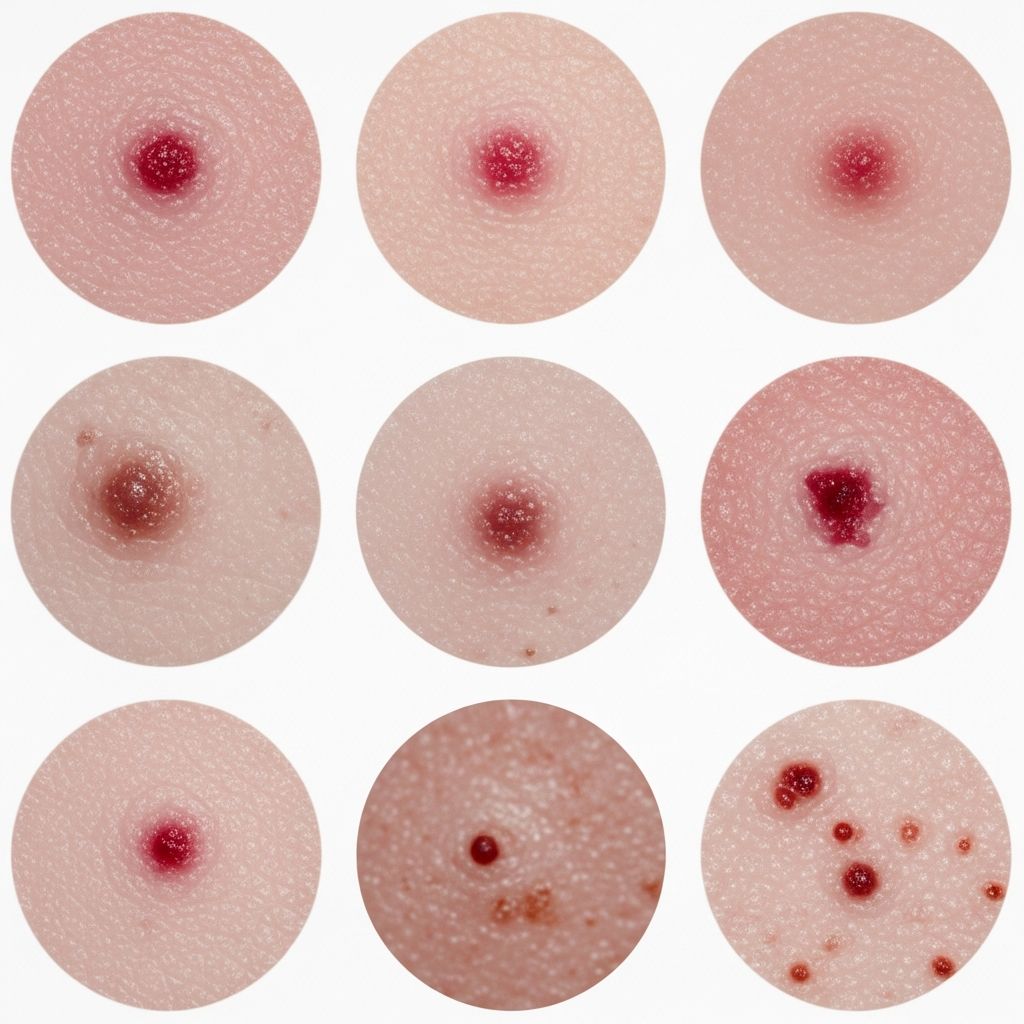
Dermoscopy, also known as dermatoscopy, enhances the visualization of subsurface skin structures using 10-14x magnification and specialized lighting. This technique reveals pigmentation patterns, vascular features, and other diagnostic clues invisible to the naked eye, aiding in the differentiation of benign and malignant lesions. Images in this guide approximate 12 mm field width for consistency.
Pigmentation
By dermoscopy, lesion pigmentation is assessed by
colours
: black, dark brown, tan, grey, steel blue, purple, white, yellow, and red. These hues correspond to melanin depth and distribution, haemoglobin, or other chromophores.- Black: Epidermal or suprabasal melanin, often in globules or structureless areas.
- Dark brown: Melanin in upper epidermis or stratum corneum.
- Tan/light brown: Diffuse epidermal melanin.
- Grey: Melanin in papillary dermis or keratin.
- Steel blue: Deep dermal melanin.
- Purple/red: Haemoglobin from blood vessels or haemorrhage.
- White: Fibrosis, hypopigmentation, or keratin.
- Yellow: Lipid droplets or serum crust.
Practice by examining personal or family moles: note predominant colours and correlate with lesion type.
Lines and Structures
Dermoscopic patterns comprise
lines
(straight, curved, wavy) androunded structures
(dots, globules, clods). Structureless areas lack defined patterns. These elements form global patterns like networks, streaks, or homogenous areas.Pigment Network
**Pigment network** appears as honeycomb-like brown lines surrounding hypopigmented holes, typical of epidermal melanin in rete ridges. Variations include:
- Normal: Uniform, thin brown lines.
- Atypical: Thick, irregular, branched, or polymorphic networks signal melanoma.
- White network: Fibrotic stroma in regressing lesions or BCC.
Perifollicular networks outline hair follicles in actinic keratosis.
Dots and Globules
**Dots** are small (<0.1 mm), round, black/grey structures;
globules
are larger (0.1-0.2 mm), brown/black. Aggregates suggest naevi; irregular, confluent dots indicate melanoma.Streaks/Radial Streaming
Irregular, finger-like projections of pigment at lesion periphery, highly suspicious for melanoma.
Structureless Zones
Homogenous hypopigmented or hyperpigmented areas without lines/structures, seen in Spitz naevi or regressing melanoma.
Vascular Features
Vessels are classified by shape, size, and distribution. Non-pigmented lesions rely heavily on vascular patterns for diagnosis.
| Diagnosis | Vascular Features |
|---|---|
| Amelanotic melanoma | Dotted, atypical, corkscrew, pink blush, or polymorphous vessels |
| Benign melanocytic naevus | Comma-shaped vessels |
| Seborrhoeic keratosis | Hairpin vessels with white halo |
| Basal cell carcinoma | Irregular arborising vessels (thicker lesions) |
| Actinic keratosis | Network of perifollicular vessels |
| Squamous cell carcinoma in situ (Bowen disease) | Focal grouped glomerular vessels |
| Haemangioma | Uniform red, blue, or purple lacunes |
| Telangiectasia | Dilated linear and branched vessels |
| Haemorrhage | Red-blue lacunes within a tumour |
| Venous stasis | Diffuse small glomerular vessels |
| Psoriasis | Uniform globular vessels |
| Lichen planus | Very few vessels or uniform fine linear vessels |
Key vascular types:
- Comma vessels: Curved, branching; benign naevi.
- Dotted vessels: Tiny red dots; melanoma or BCC.
- Glomerular vessels: Rounded loops; Bowen disease, viral warts.
- Hairpin vessels: U-shaped with white halo; seborrhoeic keratosis.
- Arborising vessels: Branching, tree-like; diagnostic for BCC.
- Lacunes: Large, round/oval spaces filled with blood; haemangioma.
Other Features
Regression
White structureless areas with grey dots/granularity (peppering) or blue-white veil indicate fibrosis and melanin/ haemorrhage remnants.
Shiny White Lines
Orthogonal or polymorphous lines from fibrosis, common in BCC and scars.
Milky Red Areas
Vascular blush in inflamed or amelanotic lesions.
Chrysalis Structures
Segmented, shiny white lines in thickened epidermis (e.g., solar lentigo).
Related Stories



Pattern Analysis
Expert dermoscopists use
pattern analysis
to assess global (reticular, globular, spitzoid, etc.) and local features simultaneously. Chaos (asymmetry, multiple patterns) with melanoma clues (atypical network, blue-white veil, atypical vessels) indicates malignancy.- Global patterns: Reticular (network-dominant), globular (globule-dominant).
- Melanoma clues: Atypical pigment network, blue-white structures, atypical vascular pattern, radial streaming, dots in periphery, polymorphous vessels.
Diagnostic Algorithms
The
three-point checklist
simplifies triage: asymmetry, atypical network, blue-white structures. Presence of ≥2 suggests biopsy. Advanced algorithms like seven-point incorporate more features for higher specificity.Clinical Application
Dermoscopy improves melanoma sensitivity/specificity when used by experts but beginners may overdiagnose. Always integrate with clinical suspicion; biopsy changing/atypical lesions. Digital imaging enables monitoring, teledermoscopy, and mole mapping.
Frequently Asked Questions (FAQs)
What magnification is standard in dermoscopy?
10-14x magnification using a high-quality dermatoscope with immersion fluid or polarized light.
Can dermoscopy diagnose all melanomas?
No, 92% show typical features; 8% require monitoring for change. Never override clinical suspicion.
What is the ugly duckling sign?
A lesion differing from a patient’s other moles, warranting closer scrutiny.
Is dermoscopy useful for non-melanoma skin cancers?
Yes, specific vascular patterns distinguish BCC (arborizing), SCC (glomerular), and others[10].
How to start learning dermoscopy?
Practice on personal lesions, use digital photography, progress through structured courses, and consult atlases.
Practice Exercises
Examine moles under dermoscopy noting colours, networks, vessels. Compare benign naevi (regular network, comma vessels) vs. suspicious (atypical features, chaos).
References
- Dermoscopy. Introduction to dermoscopy — DermNet NZ. 2008 (updated). https://dermnetnz.org/cme/dermoscopy-course/introduction-to-dermoscopy
- Dermatoscopic features — DermNet NZ. 2008. https://dermnetnz.org/cme/dermoscopy-course/dermoscopic-features
- Dermoscopy Course Contents — DermNet NZ / University of Auckland. 2008. https://dermnetnz.org/cme/dermoscopy-course
- Dermoscopy (Dermatoscopy) — DermNet NZ. 2023-10-01. https://dermnetnz.org/topics/dermoscopy
- Pattern analysis — DermNet NZ. 2008. https://dermnetnz.org/cme/dermoscopy-course/pattern-analysis
Similar Articles








Read full bio of Sneha Tete