Dermoscopy Of Achromic Naevus: 5 Key Dermoscopic Signs
Detailed guide to dermoscopic features, diagnosis, and management of achromic naevus for dermatologists and clinicians.
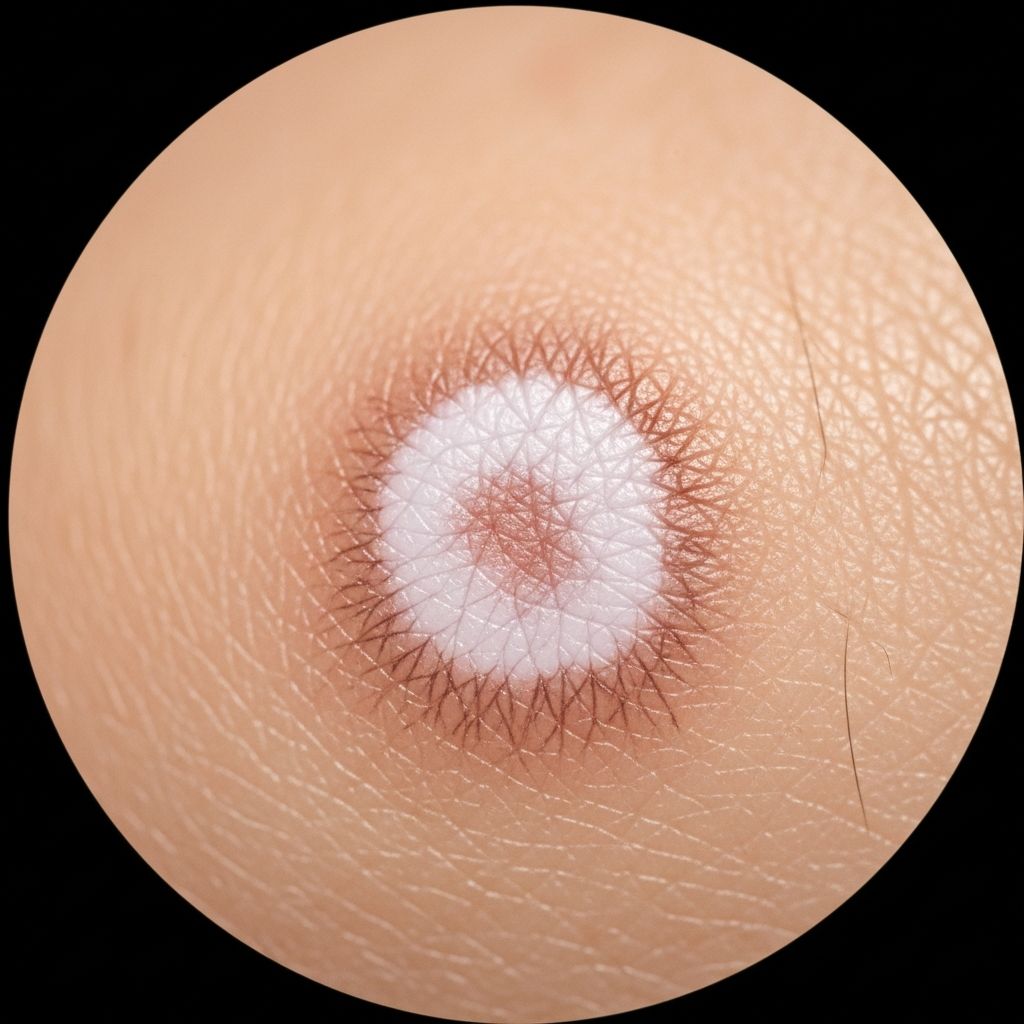
Achromic naevus, also known as naevus depigmentosus, is a benign hypopigmented birthmark characterized by well-defined pale patches on the skin. Dermoscopy plays a crucial role in its identification by revealing specific patterns that distinguish it from other hypopigmented conditions like vitiligo.
What is Achromic Naevus?
Achromic naevus is an uncommon congenital or early childhood skin lesion presenting as a hypopigmented macule or patch, typically several centimetres in diameter with an irregular yet well-defined border. The term ‘achromic’ refers to its reduced pigmentation, though not complete depigmentation as seen in vitiligo. These lesions often have a ‘splash of paint’ appearance due to smaller satellite hypopigmented macules at the periphery.
Unlike vitiligo, which involves total absence of melanocytes (amelanosis), achromic naevus retains some melanocytes with impaired melanin production. It is usually solitary, affecting the trunk in about 50% of cases, but can appear on limbs or follow Blaschko lines, indicating cutaneous mosaicism.
Who Gets Achromic Naevus and Why?
Achromic naevus is typically noted at birth or during early childhood, though it may become more visible in fair-skinned individuals later. It arises from a postzygotic mutation leading to a clonal population of melanocytes with decreased melanin synthesis capacity. Melanocyte numbers are normal or slightly reduced, with smaller or fewer melanosomes and impaired transfer to keratinocytes.
The lesion grows proportionally with the child but remains stable otherwise. It is not hereditary in a mendelian sense but represents somatic mosaicism. Rarely, it associates with neurocutaneous syndromes or co-localized lentigines, possibly due to reverse mutations.
Clinical Features
Clinically, achromic naevus appears as a hypopigmented patch with:
- Well-defined, irregular borders
- Variable size and shape, often oval or linear
- Satellite lesions resembling paint splatters
- Off-white to pale pink hue, more noticeable under Wood’s lamp
- Most common on trunk, but can occur anywhere
In skin of colour, it stands out prominently as structureless white areas on dermoscopy. The lesion is asymptomatic, non-scaling, and does not evolve into malignancy.
Dermoscopy of Achromic Naevus
Dermoscopy is invaluable for confirming achromic naevus and differentiating it from mimics. Key dermoscopic features include:
- Serrated or geographic borders: Irregular, jagged edges delineating the hypopigmented area.
- Diffuse pallor: Uniform hypopigmentation with structureless white zones, especially prominent in darker skin types.
- Faint pigment network: Subtle residual pigmentation in a reticular pattern at the periphery.
- Absence of pigment globules or dots: Unlike some naevi, no clustered pigmentation.
- Occasional hair follicles: Visible within the pale area, indicating intact skin architecture.
In one descriptive study, these features were consistent across cases, with white structureless areas marked prominently. Compared to halo naevi, achromic naevus lacks central pigmentation and symmetrical hypopigmentation.
Wood’s Lamp Examination
Under Wood’s lamp (ultraviolet light), achromic naevus shows off-white fluorescence, contrasting with the bright chalk-white of vitiligo, which highlights complete melanocyte loss.
Pathology
Histologically, achromic naevus demonstrates:
- Normal or mildly reduced melanocyte density.
- Decreased melanin content in melanocytes and keratinocytes.
- Smaller, less mature melanosomes on electron microscopy.
- Impaired melanosome transfer, leading to aggregates in keratinocytes.
- No inflammation, epidermal atrophy, or scarring.
These findings confirm the diagnosis of mosaicism rather than inflammatory hypopigmentation.
Related Stories



Diagnosis
Diagnosis relies on clinical appearance, dermoscopy, and exclusion of differentials. Coupe’s 1976 criteria include:
- Leukoderma present at birth or early infancy.
- No progression after childhood.
- Stable size relative to body growth.
- Off-white under Wood’s lamp.
- Normal or reduced melanocytes on biopsy.
Dermoscopy enhances specificity by showing serrated borders and pallor without vitiligo’s sharp demarcation or tuberous sclerosis ash-leaf spots’ multiplicity.
Differential Diagnosis
Achromic naevus must be differentiated from:
| Condition | Key Differentiators | Dermoscopy |
|---|---|---|
| Vitiligo | Progresses, chalk-white on Wood’s lamp, symmetrical | Sharp borders, complete depigmentation, no network |
| Tuberous sclerosis ash-leaf spots | Multiple, oval, associated systemic features | Similar pallor, but multiple lesions |
| Pityriasis alba | Scaly, post-inflammatory, resolves | Fine scales, perifollicular pigment |
| Post-inflammatory hypopigmentation | History of inflammation, resolves | Irregular, with residual inflammation |
| Segmental pigmentation disorder | Follows Blaschko lines strictly | Structureless white areas in skin of colour |
Malignant mimics are rare, but persistent or changing lesions warrant biopsy.
Treatment
Treatment is usually unnecessary as achromic naevus is benign and stable. Options for cosmetic improvement include:
- Cosmetic camouflage with makeup.
- Topical photochemotherapy (PUVA).
- Excimer laser therapy (308 nm) for repigmentation.
- Autologous skin grafting (limited use).
- Observation with serial dermoscopy monitoring.
Excimer laser shows variable success, with repigmentation in some cases but relapse possible. Patient education on stability prevents unnecessary interventions.
Variants of Achromic Naevus
- Segmental achromic naevus: Linear, following Blaschko lines.
- Checkerboard pattern: Whorled distribution.
- Co-localized lentigines: Dark spots within pale patch (reverse mutation).
- Progressing naevus depigmentosus: Slowly enlarging, rare.
Associated Conditions
Rarely linked to neurocutaneous disorders like phakomatosis pigmentovascularis. Multiple lesions suggest tuberous sclerosis evaluation.
Frequently Asked Questions (FAQs)
Q: Is achromic naevus the same as vitiligo?
A: No. Achromic naevus is stable, congenital hypopigmentation with residual melanocytes, while vitiligo is progressive autoimmune depigmentation.
Q: Does achromic naevus turn into skin cancer?
A: No, it is benign with no malignant potential. Monitor for changes via dermoscopy.
Q: Can achromic naevus be treated effectively?
A: Cosmetic options exist, but repigmentation is inconsistent. Camouflage is often sufficient.
Q: What does dermoscopy show in achromic naevus?
A: Serrated borders, pallor, faint pigment network, and structureless white areas.
Q: When should I biopsy an achromic naevus?
A: If changing, irregular, or atypical features suggest alternative diagnosis.
Conclusion
Dermoscopy is essential for accurate diagnosis of achromic naevus, highlighting its benign nature and distinguishing it from serious conditions. Early recognition prevents overtreatment and alleviates patient concerns.
References
- Achromic naevus. Naevus depigmentosus — DermNet New Zealand. 2013. https://dermnetnz.org/topics/achromic-naevus
- Dermoscopy. Benign melanocytic lesions — DermNet New Zealand. Accessed 2026. https://dermnetnz.org/cme/dermoscopy-course/dermoscopy-of-benign-melanocytic-lesions
- Dermoscopy. Atypical naevi — DermNet New Zealand. Accessed 2026. https://dermnetnz.org/cme/dermoscopy-course/dermoscopy-of-atypical-naevi
- Achromic naevus image — DermNet New Zealand. Accessed 2026. https://dermnetnz.org/imagedetail/8951-achromic-naevus
- Segmental pigmentation disorder image — DermNet New Zealand. Accessed 2026. https://dermnetnz.org/imagedetail/2810-segmental-pigmentation-disorder
- Hypopigmented Macules — StatPearls, NCBI Bookshelf. 2023. https://www.ncbi.nlm.nih.gov/books/NBK563245/
Similar Articles








Read full bio of medha deb