Dermoscopy Of Atypical Naevi: A Comprehensive Guide
Mastering dermoscopic evaluation of atypical naevi to differentiate from melanoma and guide clinical decisions effectively.
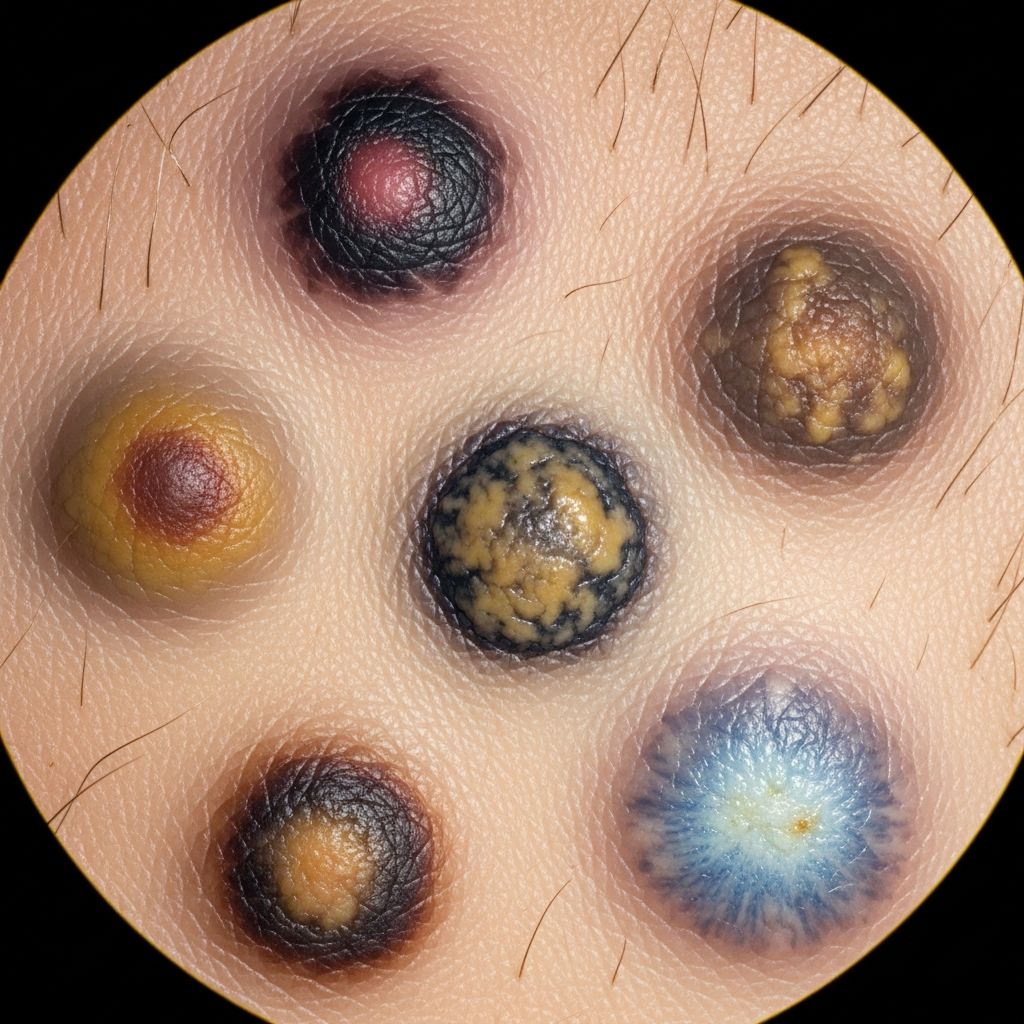
Atypical naevi, also known as Clark’s naevi or ‘funny-looking’ moles, are common skin lesions that closely mimic melanoma both clinically and dermoscopically. These benign yet concerning moles require expert dermoscopic interpretation to avoid unnecessary excisions while identifying true malignancies, as distinguishing features can be subtle and misleading.
Introduction to Atypical Naevi
Atypical naevi represent a broad spectrum of melanocytic lesions with unusual clinical and dermoscopic appearances that prove benign on histology. They are significant because melanoma may appear identical, necessitating biopsy in ambiguous cases. Stable atypical naevi vastly outnumber melanomas, so excision should target only high-risk lesions. Pathologists sometimes struggle with diagnosis, highlighting the need for precise dermoscopic assessment.
Some classifications distinguish ‘dysplastic naevi’ based on specific microscopic features, but clinically, atypical naevi encompass any mole with aberrant traits. Dysplastic naevi exhibit at least three clinical hallmarks:
- Size larger than 5 mm
- Ill-defined or fuzzy borders
- Variegated colour (brown, black, red, pink, blue)
- Suspicious structure (e.g., central mass with peripheral pigment)
- Eccentric location of the central mass
A solitary high-grade dysplastic naevus warrants excision due to melanoma mimicry, while multiple ones signal predisposition, especially in familial atypical multiple mole melanoma (FAMMM) syndrome. Melanomas in these patients often arise de novo rather than from precursor naevi.
Sporadic atypical naevi predominantly affect fair-skinned individuals (phototypes I-II) with sun exposure history, whereas familial cases involve hundreds of lesions.
Dermoscopic Features of Atypical Naevi
Dermoscopy reveals irregular pigment patterns in atypical naevi that lack melanoma-specific signs, yet differentiation remains challenging. Best indicators of histological atypia involve structural organization and pigment distribution. Patients with multiple atypical naevi often show a predominant pattern type.
Key Structures in Atypical Naevi:
- Irregular network: Branched streaks wider or narrower than normal, with variable spacing and interrupted segments.
- Atypical globules/globular rings: Segmented, irregular in size, shape, and distribution; may be dotted, large, or clumped.
- Structureless zones: Amorphous hypopigmented or hyperpigmented areas disrupting network or globules.
The coexistence of all three structures strongly suggests melanoma. Complex patterns (network + globules ± structureless areas) correlate with higher melanoma risk in affected patients.
Pigment Distribution Patterns
Pigmentation in atypical naevi varies asymmetrically:
- Central hyperpigmentation: Homogeneous or amorphous, common in midlife with scaly surfaces; tape stripping often uncovers reticular patterns beneath.
- Peripheral hyperpigmentation: Faceless edge or striations (finger-like projections).
- Central hypopigmentation: Regression-like, though true regression in naevi shows peppering (granular remnants).
Combined macular (flat) and papular (raised) components are frequent. Compound naevi feature junctional and dermal elements, while combined naevi pair with blue naevus components.
Other Notable Dermoscopic Features
- Polymorphous vessels (commas, hairpins, dots, glomerular)
- Shiny white lines (orthogonal or linear)
- Angulated lines
- Blue-whitish veil
- Peripheral light brown structureless areas
Related Stories



These elements, when symmetric and regular, support benignity.
Specific Types Mimicking Atypical Naevi
Spitz Naevi
Spitz naevi evolve rapidly, appearing pink (classic) or black (pigmented/Reed), especially in children, and involute over time. Dermoscopically challenging, they show:
- Starburst pattern (large globules at periphery)
- Symmetrical pigmentation
- White lines
- Vascular structures
Biopsy is often required despite benign histology.
Other Benign but Atypical-Looking Naevi
Lesions with clinical atypia but benign histology display irregular networks, globules, or central hyperpigmentation. Examples include naevi with eccentric globules, dotted vessels, or subtle regression simulating melanoma.
Changes in Naevi Over Time
Benign naevi commonly evolve dermoscopically, particularly in children: globular patterns transition to networks or homogeneous areas. Sun exposure shifts globules peripherally. Non-malignant changes include:
- Central fading (normal involution)
- Crusting or scale
- Hair growth
Worrisome alterations in flat atypical naevi (10-15% melanoma risk) involve shape, size, or structural changes. Mild changes justify 3-month follow-up; elevated/changing lesions demand low excision threshold due to nodular melanoma risks.
Serial dermoscopy with photography enables early melanoma detection in high-risk patients by documenting subtle evolutions.
Management and Monitoring
Most atypical naevi require monitoring, not excision. Digital dermatoscopy archives track changes efficiently. Excision biopsy is indicated for:
| Indication | Rationale |
|---|---|
| Suspicious dermoscopic melanoma criteria | Asymmetry, irregular borders, color variation, diameter >6mm, evolution |
| Rapid change in size/shape | 10-15% malignancy risk |
| Solitary high-grade atypia | High melanoma mimicry |
| Patient/family history of melanoma | FAMMM syndrome risk |
Partial biopsies risk sampling error; full excision preferred. Photographic surveillance clinics aid multiple-mole patients.
Frequently Asked Questions (FAQs)
What defines an atypical naevus?
An atypical naevus is a melanocytic lesion with unusual size (>5mm), borders, colour variegation, or structure, often mimicking melanoma but benign histologically.
Can dermoscopy reliably distinguish atypical naevi from melanoma?
No, features overlap significantly; expert interpretation combined with monitoring or biopsy is essential, as atypical patterns lack melanoma-specific signs.
How should changing atypical naevi be managed?
Mild changes in flat naevi warrant 3-month review; elevated or rapidly changing ones require prompt excision due to nodular melanoma potential.
What is the role of serial photography in monitoring?
It detects early melanoma by documenting dermoscopic evolution in high-risk patients with multiple atypical naevi.
Are all dysplastic naevi atypical clinically?
No, many dysplastic naevi appear banal; only a minority show clinical atypia.
Conclusion
Dermoscopy enhances atypical naevus evaluation but demands expertise. By recognizing benign patterns, tracking changes, and excising judiciously, clinicians optimize melanoma detection while minimizing overtreatment. Ongoing education and imaging surveillance are pivotal for high-risk cohorts.
References
- Dermoscopy of Atypical Naevi — DermNet NZ. 2008 (updated). https://dermnetnz.org/cme/dermoscopy-course/dermoscopy-of-atypical-naevi
- Atypical Melanocytic Naevus — DermNet NZ. Accessed 2026. https://dermnetnz.org/topics/atypical-melanocytic-naevus
- Dermoscopy of Benign Melanocytic Lesions — DermNet NZ. Accessed 2026. https://dermnetnz.org/cme/dermoscopy-course/dermoscopy-of-benign-melanocytic-lesions
- Early Detection of Melanoma — bpac.org.nz. 2021-01-01. https://bpac.org.nz/2021/docs/melanoma-detection.pdf
Similar Articles








Read full bio of Sneha Tete