Dermoscopy Of Basal Cell Carcinoma: Key Features
Master dermoscopic features of basal cell carcinoma for accurate diagnosis and early skin cancer detection.
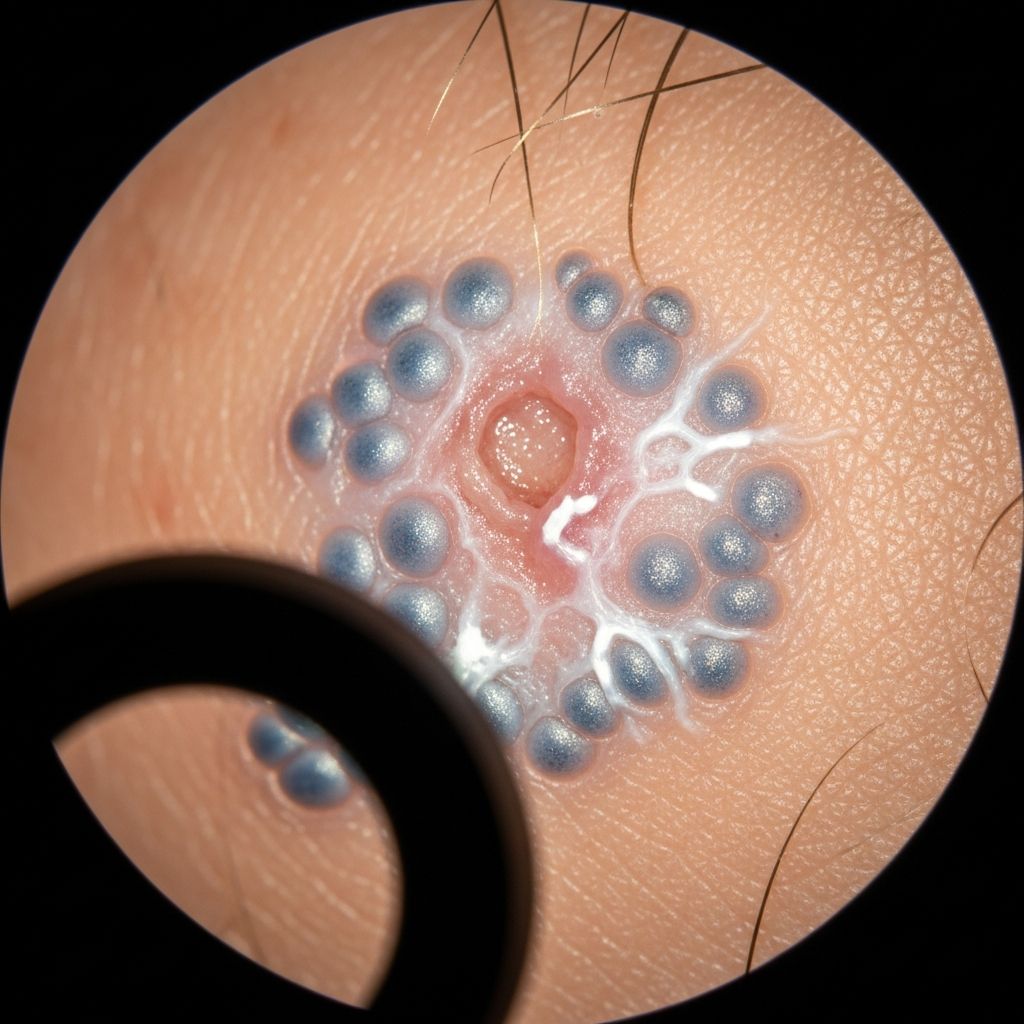
This module explores the dermoscopic features of basal cell carcinoma (BCC), the most common skin malignancy. Dermoscopy enhances diagnostic accuracy by revealing specific vascular and structural patterns not visible to the naked eye. Understanding these features is crucial for early detection and appropriate management.
Introduction to Basal Cell Carcinoma
Basal cell carcinoma arises from basal keratinocytes in the epidermis and is strongly associated with ultraviolet radiation exposure. It typically presents as a pearly papule or nodule with telangiectasia on sun-exposed areas like the face. While locally invasive, BCC rarely metastasizes, making early diagnosis via dermoscopy vital.
Clinically, BCC appears as a shiny, translucent nodule, often with rolled borders and central ulceration (rodent ulcer). Variants include nodular, superficial, pigmented, and morpheaform subtypes, each with distinct dermoscopic signatures.
Clinical Variants of BCC
BCC manifests in several forms, influencing dermoscopic findings:
- Nodular BCC: Most common, presenting as a raised, pearly nodule with telangiectasia.
- Superficial BCC: Flat, erythematous patch, often on the trunk.
- Pigmented BCC: Blue-gray pigmentation, more frequent in darker skin types.
- Morpheaform (sclerosing) BCC: Scar-like plaque with ill-defined borders, aggressive behavior.
- Cystic BCC: Translucent, bluish nodule resembling a cyst.
These variants guide targeted dermoscopic evaluation.
Dermoscopic Features of BCC
Dermoscopy of BCC reveals a constellation of vascular, pigmentary, and structural clues. The absence of a pigment network distinguishes BCC from melanocytic lesions.
Key Vascular Structures
Arborizing vessels are the hallmark of BCC, appearing as branching, tree-like red vessels with well-focused tips, best seen in nodular subtypes. These reflect tumor angiogenesis.
- Thick, branching vessels in nodular BCC.
- Short, fine vessels in superficial BCC.
- Comma-like or linear vessels in some variants.
Pigmented Structures
Pigmented BCC shows:
- Blue-gray ovoid nests: Large, well-defined blue-gray areas corresponding to dermal melanin aggregates.
- Blue-gray globules: Roundish, dot-like melanin deposits.
- Leaf-like areas: Maple leaf-shaped pigmented zones.
- Spoke-wheel areas: Radial wheel-like structures.
These features aid differentiation from melanoma.
Non-pigmented Structures
Common across subtypes:
- Ulceration: White or yellow structureless areas with polymorphous vessels.
- Shiny white streaks: Indicate fibrosis, prominent in morpheaform BCC.
- White clods or rosettes: Keratin cysts or calcifications.
Subtype-Specific Features
| Subtype | Key Dermoscopic Features |
|---|---|
| Nodular | Arborizing vessels, ulceration, blue-gray ovoids (if pigmented) |
| Superficial | Short fine telangiectasia, shiny white streaks, erythema |
| Pigmented | Blue-gray globules, leaf-like areas, spoke-wheel |
| Morpheaform | Shiny white streaks, ill-defined borders, thin vessels |
| Cystic | Blue-whitish veil, arborizing vessels at periphery |
This table summarizes diagnostic patterns for rapid recognition.
Diagnostic Algorithm for BCC
A stepwise dermoscopic approach improves specificity:
- Identify arborizing vessels: High specificity for BCC.
- Look for pigment structures: Blue-gray ovoids or globules confirm pigmented BCC.
- Assess background: Shiny white areas suggest fibrosis; ulceration supports diagnosis.
- Rule out mimics: Absence of pigment network excludes nevus; irregular streaks exclude melanoma.
Sensitivity exceeds 90% with experienced use.
Differential Diagnosis
BCC mimics include:
- Melanocytic lesions: Pigment network, atypical streaks absent in BCC.
- Seborrheic keratosis: Comedo-like openings, milia-like cysts.
- Squamous cell carcinoma: Glomerular vessels, keratin mass.
- Actinic keratosis: Strawberry pattern, thin vessels.
- Benign vascular lesions: Homogeneous lacunae.
Related Stories



Dermoscopy reduces unnecessary biopsies by distinguishing these entities.
High-Risk Features in Dermoscopy
Certain patterns indicate aggressive BCC:
- Absence of classic arborizing vessels.
- Predominance of atypical vessels (e.g., polymorphous, hairpin).
- Amorphous gray areas suggesting ulceration or fibrosis.
- Ill-defined borders in morpheaform type.
These warrant biopsy and potential Mohs surgery.
Case Examples
Case 1: Nodular BCC on nose
Dermoscopy shows prominent arborizing vessels branching from center to periphery, with central ulceration covered by crust. Blue-gray globules at the base confirm diagnosis.
Case 2: Superficial BCC on back
Multiple short, fine telangiectatic vessels on erythematous background with shiny white streaks. No arborizing vessels, consistent with superficial type.
Case 3: Pigmented BCC on cheek
Large blue-gray ovoid nest surrounded by leaf-like pigmentation and spoke-wheel areas peripherally. Arborizing vessels visible through translucent areas.
Case 4: Morpheaform BCC on temple
Diffuse shiny white streaks with poorly focused thin vessels and ill-defined borders, mimicking a scar.
Management Implications
Dermoscopy guides biopsy site selection and treatment. Low-risk BCC (classic features, small size) may undergo curettage or cryotherapy; high-risk features prompt excision with margins or Mohs micrographic surgery. Regular follow-up is essential due to field cancerization.
Frequently Asked Questions (FAQs)
What is the most specific dermoscopic feature of BCC?
Arborizing vessels—branching, red vessels with sharp tips—are highly specific for BCC, particularly nodular subtypes.
Can dermoscopy differentiate pigmented BCC from melanoma?
Yes, BCC lacks a pigment network and shows blue-gray ovoid nests or globules, unlike melanoma’s irregular pigmentation and network.
Is dermoscopy useful for superficial BCC?
Absolutely; short fine telangiectasia and shiny white streaks on red background are characteristic, aiding non-invasive diagnosis.
What if arborizing vessels are absent?
Consider morpheaform or early BCC; biopsy is recommended if suspicious features like white streaks or ulceration persist.
How accurate is dermoscopy for BCC diagnosis?
Diagnostic sensitivity and specificity exceed 90% in experienced hands, reducing unnecessary excisions.
Conclusion
Dermoscopy revolutionizes BCC diagnosis by highlighting pathognomonic vascular and pigmentary structures. Mastery of these patterns enables precise differentiation from mimics, optimizes management, and improves patient outcomes in skin cancer care.
References
- Basal Cell Carcinoma – StatPearls — NCBI Bookshelf / NIH. 2023. https://www.ncbi.nlm.nih.gov/books/NBK482439/
- Basal Cell Carcinoma Warning Signs and Images — Skin Cancer Foundation. 2023. https://www.skincancer.org/skin-cancer-information/basal-cell-carcinoma/bcc-warning-signs-images/
- Basal cell carcinoma: From symptoms to treatments — American Academy of Dermatology (AAD). 2024. https://www.aad.org/public/diseases/skin-cancer/basal-cell-carcinoma
- Basal Cell Carcinoma Symptoms & Diagnosis — Baptist Health Miami Cancer Institute. 2023. https://baptisthealth.net/services/cancer-care/miami-cancer-institute/our-approach/adult-cancers/skin-cancers/basal-cell-carcinoma/symptoms-and-diagnosis
- Basal Cell Carcinoma — Memorial Sloan Kettering Cancer Center (MSKCC). 2024. https://www.mskcc.org/cancer-care/types/basal-cell-carcinoma
- Basal cell carcinoma – Diagnosis & treatment — Mayo Clinic. 2024. https://www.mayoclinic.org/diseases-conditions/basal-cell-carcinoma/diagnosis-treatment/drc-20354193
Similar Articles








Read full bio of Sneha Tete