Dermoscopy Of Melanoma: 8 Essential Dermoscopic Features
Mastering dermoscopic features to detect malignant melanoma early and accurately.
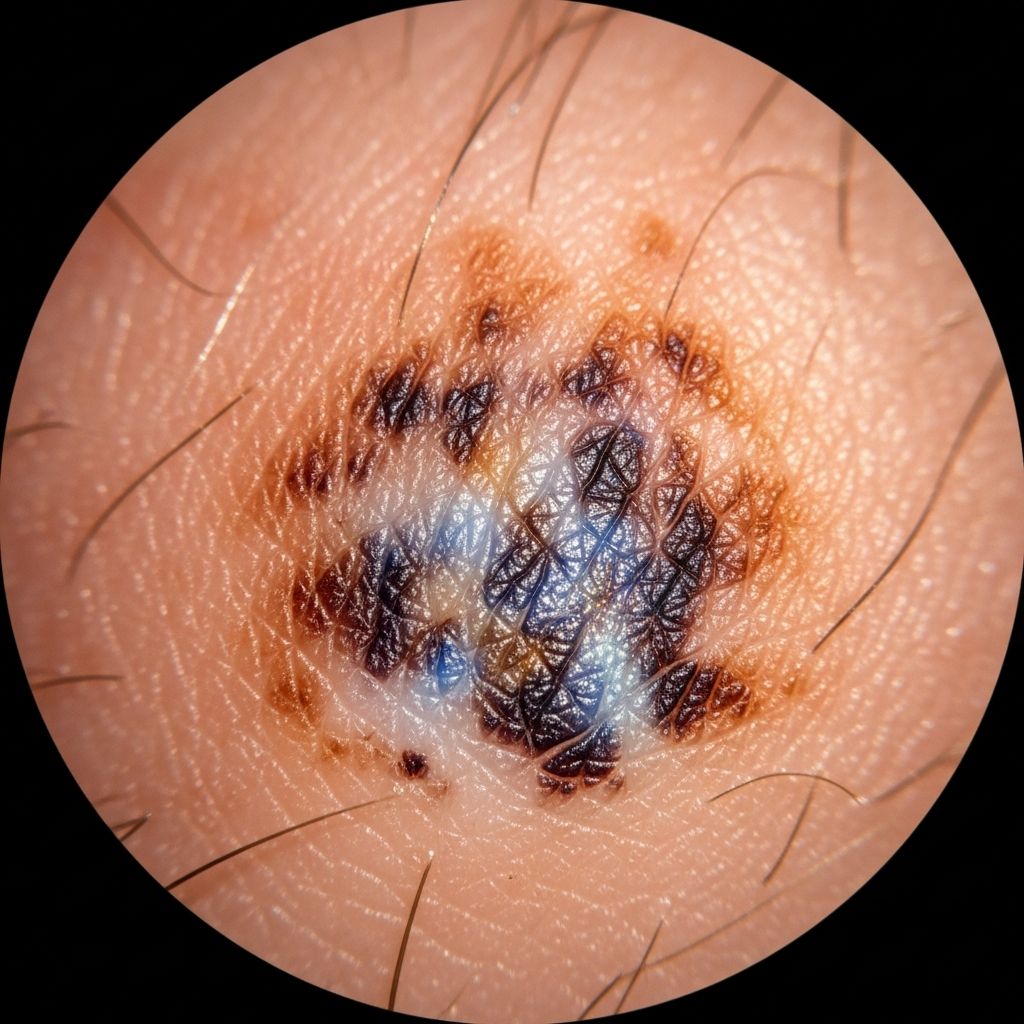
Malignant melanoma is a serious form of skin cancer originating from melanocytes, which can arise de novo, from acquired naevi, dysplastic naevi, or solar lentigines. Dermoscopy plays a crucial role in identifying its characteristic features, enabling early detection when clinical appearance may be ambiguous.
Learning Objectives
Upon completing this module, learners will be able to:
- Describe the dermoscopic features of malignant melanoma.
- Identify key melanoma-specific criteria such as atypical pigment networks and blue-white veils.
- Differentiate melanoma subtypes including superficial spreading, nodular, and lentigo maligna melanoma.
- Apply pattern analysis to distinguish melanoma from benign lesions.
Introduction
Malignant melanoma may develop from melanocytes on the skin surface, mucosal areas, subungual regions, or rarely in the meninges. While most melanomas arise de novo, some evolve from common acquired naevi, dysplastic naevi, solar lentigines, or atypical lentigines. The dermoscopic appearance of melanoma is highly variable, reflecting its progression from relatively organized early stages to disorganized advanced lesions.
Dermoscopy enhances diagnostic accuracy by revealing subsurface structures invisible to the naked eye. It uses 10-14x magnification with polarized or non-polarized light and immersion fluid to visualize patterns like pigment networks, dots, and globules. Experts achieve up to 92% sensitivity for melanoma detection, though beginners may initially overdiagnose.
Dermoscopic Features of Melanoma
Melanoma exhibits a range of dermoscopic structures, often showing increasing chaos with progression. Key elements include lines (networks, streaks) and rounded structures (dots, globules), with structureless areas indicating disruption.
Colors
Early melanomas may display only 2-3 colors dermoscopically (e.g., brown, black, gray), even if clinically appearing more uniform. Advanced invasive melanomas reveal multiple colors including blue, white, and red due to deeper pigmentation, fibrosis, and vascular changes.
Melanoma-Specific Criteria
These are pathognomonic features strongly suggestive of melanoma:
- Atypical pigment network: Thick, irregular, branched lines disrupting the normal lattice-like pattern.
- Blue-white veil: Iridescent blue-white structureless area over dilated blood vessels or fibrosis.
- Atypical dots/globules: Irregular, asymmetrical black or gray dots/globules, often segmental.
- Streaks (pseudopods): Radial, finger-like projections at the periphery, irregular and asymmetric.
- Crinkled lines/fingerprint-like structures: Parallel thin lines resembling fingerprints, seen in regression.
- Shiny white lines: Bright white orthogonal lines indicating fibrosis, common in invasive melanoma.
- Typical melanoma vessels: Atypical polymorphous vessels like dotted, comma-shaped, or linear irregular forms.
- Peripheral light brown structureless areas: Suggestive of regression or early invasion.
Presence of one or more of these criteria warrants excision, especially with asymmetry or chaos.
Global Patterns in Melanoma
| Pattern | Description | Associated Melanoma Type |
|---|---|---|
| Atypical network | Disrupted, irregular meshwork | Superficial spreading |
| Spoke-wheel/granular | Segmental brown globules in wheel pattern | Early Reed/Spitzoid |
| Homogeneous | Diffuse structureless pigmentation | Nodular |
| Starburst | Heavy peripheral pigmentation with streaks | Spitzoid/nodular |
| Chaos | Multiple disorganized patterns | Advanced invasive |
Chaos, defined as multiple patterns with asymmetry in color and structure, is hallmark of melanoma and non-melanocytic malignancies.
Subtypes of Melanoma
Superficial Spreading Melanoma (SSM)
The most common subtype, often on intermittently sun-exposed skin. Dermoscopy shows atypical pigment networks, irregular dots/globules, streaks, and blue-white veils. Early SSM may have subtle features like peripheral tan structureless areas.
Related Stories



Nodular Melanoma
Aggressive, symmetric clinically but dermoscopically reveals blue-white veils, shiny white lines, atypical vascular patterns, and homogeneous blue/gray pigmentation. Lacks network due to dermal growth.
Lentigo Maligna (LM) and Lentigo Maligna Melanoma (LMM)
Arises on chronically sun-damaged skin (face, scalp). LM (in situ) features include:
- Angulated lines (rhomboidal structures)
- Zigzag projections
- Annular-granular pattern
- Targeted globules
- Increased vascularity (polymorphous vessels)
LMM adds invasive features like blue-white veils and atypical dots.
Acral Lentiginous Melanoma
On palms/soles, shows parallel ridge pattern disruption, irregular diffuse pigmentation, and lattice-like networks.
Mucosal Melanoma
Rare, with blue, gray, white structureless areas and atypical vessels.
Other Variants
- Spitzoid melanoma: Starburst pattern with atypical globules.
- Desmoplastic melanoma: Shiny white lines, sparse pigmentation.
Diagnostic Algorithms
Incorporate dermoscopy into triage:
- 3-Point Checklist: High sensitivity for non-experts. Malignancy if ≥2: asymmetry, atypical network, blue-white structures.
- Pattern Analysis: Assess global pattern, local features, and melanoma criteria. First classify melanocytic vs. non-melanocytic.
For borderline lesions, monitor with sequential imaging (mole mapping).
Challenges and Pitfalls
Early melanomas may mimic naevi; rely on change over time. Nevi resemble each other (‘ugly duckling’ sign for outliers). Overdiagnosis common in novices. Always correlate with clinical suspicion—excise if doubt persists.
Management Implications
Dermoscopy guides biopsy decisions. Breslow thickness (invasion depth) is key prognosticator. Staging per AJCC uses thickness, ulceration, nodes. Sentinel node biopsy for high-risk cases.
Frequently Asked Questions (FAQs)
Q: What is the most reliable dermoscopic sign of melanoma?
A: Atypical pigment network combined with blue-white veil or streaks offers high specificity.
Q: Can dermoscopy miss melanoma?
A: Experts detect 92%; remainder via change monitoring. Never override clinical suspicion.
Q: How does lentigo maligna differ dermoscopically?
A: Features angulated lines, granular patterns, and increased vessels on sun-damaged skin.
Q: Is training required for dermoscopy?
A: Yes; beginners may overdiagnose. Progress slowly with practice.
Q: Role of digital dermoscopy?
A: Enables teledermoscopy, mole mapping for high-risk patients.
References
- Dermoscopy. Introduction to dermoscopy — DermNet NZ. 2008 (updated). https://dermnetnz.org/cme/dermoscopy-course/introduction-to-dermoscopy
- Dermoscopy. Three-point checklist — DermNet NZ. 2008 (updated). https://dermnetnz.org/cme/dermoscopy-course/three-point-checklist
- Melanoma Skin Cancer: Images, Diagnosis, and Treatment — DermNet NZ. 2008 (updated). https://dermnetnz.org/topics/melanoma
- Pattern analysis – Dermoscopy — DermNet NZ. 2008 (updated). https://dermnetnz.org/cme/dermoscopy-course/pattern-analysis
- Dermoscopy. Malignant melanoma — DermNet NZ. 2008 (updated). https://dermnetnz.org/cme/dermoscopy-course/dermoscopy-of-melanoma
- Common skin lesions. Melanoma — DermNet NZ. 2008 (updated). https://dermnetnz.org/cme/lesions/melanoma
- Teledermatology for suspected skin cancers — DermNet NZ. 2008 (updated). https://dermnetnz.org/cme/teledermatology-skin-cancer
Similar Articles








Read full bio of Sneha Tete