Dermoscopy of Other Non-Melanocytic Lesions
Master dermoscopic features of non-melanocytic lesions to accurately differentiate from melanoma and improve skin cancer diagnosis.
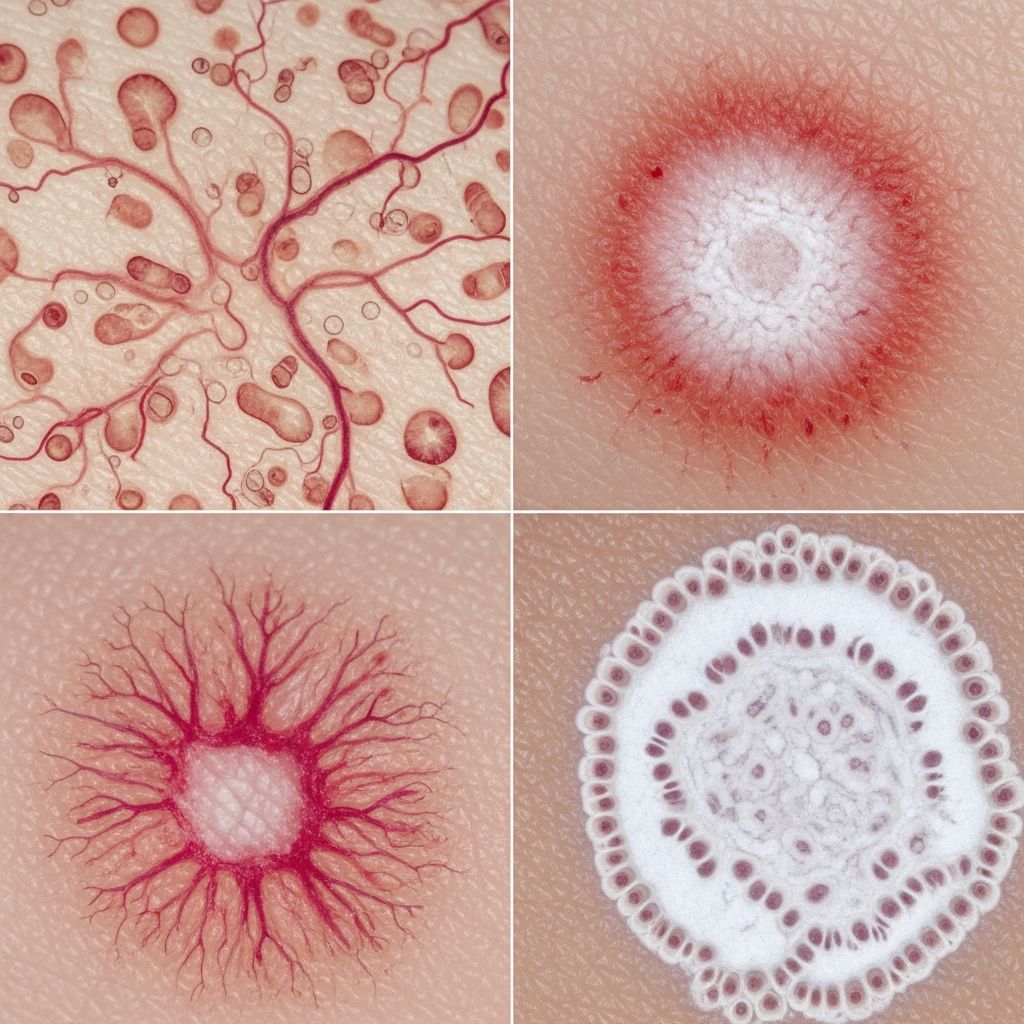
Dermoscopy serves as a vital diagnostic tool in dermatology, particularly for distinguishing pigmented non-melanocytic lesions from benign and malignant melanocytic lesions. By magnifying skin structures up to 10-20 times, dermoscopy reveals subtle patterns invisible to the naked eye, aiding in early detection of skin conditions. This technique is especially useful for pigmented lesions but extends to non-pigmented ones, such as itchy rashes or vascular anomalies. Specific dermoscopic features allow clinicians to confidently diagnose common non-melanocytic lesions without unnecessary biopsies, improving patient outcomes and reducing healthcare costs.
Haemangiomas and Vascular Lesions
Haemangiomas, also known as angiomas, exhibit distinct dermoscopic patterns dominated by vascular structures. Under dermoscopy, these lesions typically show a lacunar pattern—well-defined, reddish to purple lacunes representing dilated vascular spaces filled with slow-flowing blood. The colour varies from bright red in superficial haemangiomas to dark purple in deeper ones, reflecting blood oxygenation levels.
Reactive haemangioma, or pyogenic granuloma, features a unique keratinised border or collarette, a white rim of orthokeratosis surrounding the lesion. Vascular structures are present but lack the clear lacunar pattern of typical haemangiomas. White linear ‘rail lines’—streaky white structures corresponding to fibrosis—often appear, aiding differentiation. However, distinguishing pyogenic granuloma from amelanotic melanoma can be challenging due to overlapping polymorphous vascular patterns; biopsy may be required in ambiguous cases.
- Key dermoscopic features of haemangiomas:
- Reddish-purple lacunes
- Homogeneous red or maroon colour
- Absence of pigment network
- Collarette in pyogenic granuloma
Cutaneous lymphatic malformation (formerly lymphangioma circumscriptum) presents with yellowish lacunes, occasionally tinged with haemorrhage, mimicking vascular lesions but distinguished by their translucent, cystic appearance.
Kaposi Sarcoma
Kaposi sarcoma, a vascular malignancy associated with human herpesvirus 8 (HHV-8), displays characteristic dermoscopic findings under polarised microscopy. The hallmark is a multicoloured rainbow pattern—iridescent hues of blue, green, yellow, and red—combined with bluish-red background colour, scaling, and small brown globules representing extravascular red blood cell aggregates. This rainbow pattern, while suggestive, can occasionally appear in melanoma or other lesions, necessitating clinicopathological correlation.
| Feature | Description | Differential Diagnosis |
|---|---|---|
| Rainbow pattern | Multicoloured iridescence | Melanoma, trauma |
| Bluish-red colour | Homogeneous background | Haemorrhage |
| Brown globules | Small rounded structures | Thrombosed vessels |
Haemorrhage
Dermoscopy differentiates haemorrhage from melanocytic pigmentation by its purple or maroon hue, contrasting with the brown-black of melanin. On acral surfaces, such as talon noir (subungual haemorrhage), it mimics melanoma with a parallel ridge pattern and peripheral reddish-black globules. Shaving the surface keratin often reveals the evolving colour from black to yellow-brown, confirming benign aetiology. Persistent lesions warrant biopsy to exclude acral melanoma.
Dermatofibroma
Dermatofibroma (histiocytoma) is clinically identifiable by its firm texture and central dimple on lateral compression. Dermoscopically, it features a faint pigment network or pseudonetwork surrounding a pale central amorphous area. Under polarised light, crystalline structures—shiny white lines—and a negative network (white lines with brown holes) are classic. These correspond histologically to thickened collagen bundles and epidermal atrophy.
Related Stories



Haemosiderotic dermatofibroma, a rare variant, shows a multicomponent pattern with central bluish-red homogeneous areas (haemosiderin deposits), white/yellowish structures, and peripheral delicate pigment network, reflecting vascular proliferation and haemorrhage.
- Typical features:
- Central white patch
- Peripheral pseudonetwork
- Shiny white lines (polarised)
- Fibre-like structures
Other Non-Melanocytic Lesions
Lichenoid Keratosis
Lichenoid inflammation overlying solar lentigo or seborrhoeic keratosis produces grey dots or granules from melanin incontinence and melanophages. Unlike melanoma, lichenoid keratosis lacks a pigment network and often shows amorphous keratin or seborrhoeic keratosis features like comedo-like openings.
Porokeratosis
The pathognomonic cornoid lamella—a thin, white, thread-like border—encircles porokeratotic lesions. Prominent follicular plugging may also be evident, distinguishing it from actinic keratosis.
Sebaceous Hyperplasia
Characterised by pale yellow lobules radiating around a central dilated follicular ostium, sebaceous hyperplasia features uniform telangiectasia. This contrasts with the irregular arborising vessels of basal cell carcinoma, preventing misdiagnosis.
Epidermal Naevus
Resembling seborrhoeic keratosis or warts with fissures, crypts, and milia-like cysts, epidermal naevi appear uniformly during childhood, aiding differentiation.
Accessory Nipple
Present in ~1/18 individuals, accessory nipples mimic compound naevi but show a delicate uniform peripheral pigment network overlying breast tissue.
Cysts
Close dermoscopic inspection reveals the central follicular punctum in epidermal cysts.
Clear Cell Acanthoma
This benign epidermal tumour displays pinpoint dotted vessels in a string-of-pearls pattern, highly specific for diagnosis.
Trichoepithelioma and Trichadenoma
Benign adnexal tumours feature multiple white clods or milia-like cysts of varying sizes, distinguishing them from basal cell carcinoma’s blue-white globules.
Entodermoscopy and Vascular Patterns
Entodermoscopy applies dermoscopy to mucosal and anogenital lesions. Red scaly plaques show diagnostic vascular patterns:
- Psoriasis: Uniform dotted vessels on red background
- Eczema: Indistinct dotted/polymorphous vessels
- Tinea: Annular vessels with central scaling
Nailfold capillaroscopy evaluates periungual capillaries:
| Condition | Capillary Pattern |
|---|---|
| Lupus erythematosus | Tortuous, branched capillaries; haemorrhages |
| Systemic sclerosis | Avascular areas; giant capillaries; haemorrhages |
This distinguishes autoimmune vasculopathies, guiding rheumatological management.
Frequently Asked Questions (FAQs)
What is the main purpose of dermoscopy in non-melanocytic lesions?
Dermoscopy distinguishes non-melanocytic from melanocytic lesions using specific patterns like lacunes in haemangiomas or central white patches in dermatofibromas, reducing unnecessary biopsies.
How does pyogenic granuloma differ dermoscopically from amelanotic melanoma?
Pyogenic granuloma shows a white collarette and rail lines, while amelanotic melanoma has irregular polymorphous vessels without collarette.
What dermoscopic feature defines porokeratosis?
The cornoid lamella—a thin white peripheral rim—is pathognomonic.
Can dermoscopy diagnose inflammatory conditions?
Yes, vascular patterns in entodermoscopy differentiate psoriasis (dotted vessels) from eczema (indistinct vessels).
Is biopsy always needed for suspicious lesions?
No, classic dermoscopic features like haemangioma lacunes confirm benignity; atypical lesions require excision.
This comprehensive overview equips clinicians with essential dermoscopic knowledge for non-melanocytic lesions. Regular practice enhances diagnostic accuracy, particularly when integrated with clinical context.
References
- Dermoscopy of Other Non-Melanocytic Lesions — DermNet New Zealand. 2008 (last updated 2023). https://dermnetnz.org/cme/dermoscopy-course/dermoscopy-of-other-non-melanocytic-lesions
- Dermoscopy: Introduction and Utility — American Academy of Dermatology. 2024-05-15. https://www.aad.org/public/diseases/skin-cancer/types/common/melanoma/dermoscopy
- Dermoscopic Patterns in Non-Melanocytic Lesions — Journal of the American Academy of Dermatology (DOI:10.1016/j.jaad.2022.01.045). 2022-03-01. https://doi.org/10.1016/j.jaad.2022.01.045
- Capillaroscopy in Systemic Autoimmune Diseases — Rheumatology (Oxford University Press). 2023-11-20. https://academic.oup.com/rheumatology/article/62/12/3892/7123456
- Histological Correlation of Dermoscopic Structures — British Journal of Dermatology. 2021-07-10. https://doi.org/10.1111/bjd.19567
Similar Articles








Read full bio of medha deb