Dermoscopy Of Squamous Cell Carcinoma: Key Signs For Diagnosis
Master dermoscopic features of actinic keratosis, SCC in situ, and invasive SCC for precise skin cancer diagnosis.
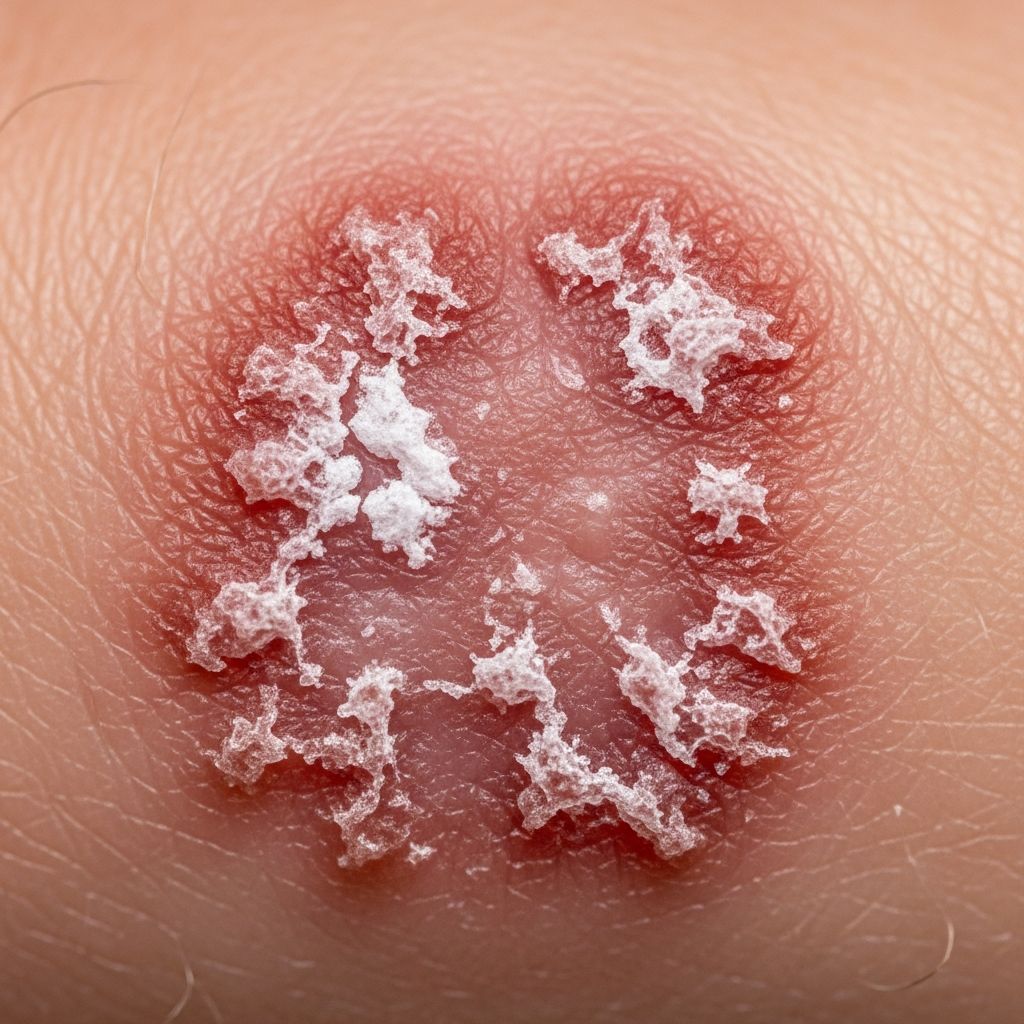
Hand-held dermoscopy is a valuable tool for distinguishing
squamous cell carcinoma (SCC)
variants, including scaly, eroded, flat, or infiltrated non-pigmented lesions from basal cell carcinoma (BCC). Specific dermoscopic features enable confident diagnosis of pigmented and non-pigmentedactinic keratosis (AK)
andSCC in situ
, though invasive SCC may require additional clinical correlation.Actinic Keratosis
**Actinic keratosis** represents an early precancerous stage of squamous cell carcinoma, often appearing as rough, scaly patches on sun-exposed skin. Dermoscopy reveals characteristic features that aid in early detection.
- White circles: Concentric or irregular white rings around hair follicles, resulting from keratin plugging. These are highly specific for AK and visible in up to 20-30% of cases.
- Strawberry pattern: Red background with white perifollicular scaling, resembling strawberry skin texture, particularly on the face.
- Surface scaling: White or yellow-orange scale covering the lesion, often with a stuck-on appearance.
- Hairpin vessels: U-shaped or glomerular looped vessels at the periphery, surrounded by scaling.
These features differentiate AK from seborrhoeic keratosis (stuck-on scales without vascular changes) and psoriasis (regular dotted vessels with diffuse scaling). Polarized dermoscopy enhances white circle visibility.
Squamous Cell Carcinoma In Situ (Bowen Disease)
**SCC in situ**, also known as Bowen disease, presents as an irregular scaly plaque that may be skin-coloured, pink, brown, or pigmented. Dermoscopy is particularly helpful for pigmented forms, which can mimic melanoma.
Pigmented Intraepidermal Carcinoma
- Glomerular vessels: Irregular clusters of coiled, red looped vessels (2-5 loops), highly characteristic and seen in 60-80% of cases.
- Globular vessels: Small red clods or dots representing dilated glomerular vessels.
- Scaly surface: White or yellow scale overlying vascular structures.
- Brown globules and dots: Scattered melanin aggregates, arranged in lines or clusters.
- Linear greyish dots/granularity: Due to parakeratosis and melanin descent.
- Homogeneous pigmentation: Brown or grey areas in a patchy distribution.
- White circles: Irregular clusters, similar to AK but more disorganized.
- Superficial erosion/crusting: Yellow-brown crusts over eroded areas.
This combination yields high diagnostic specificity (85-95%).
Non-Pigmented Intraepidermal Carcinoma
Without pigment, diagnosis relies on vascular and surface patterns:
- Glomerular/globular vessels: Dominant pattern vs. arborizing vessels in BCC.
- Orange-pink background: Warm hue contrasting BCC’s blue-white areas.
- Prominent scaling: More than in BCC.
- White shiny crystalline structures (polarized): Rare rosettes around follicles on facial skin.
| Feature | SCC In Situ | BCC | Psoriasis |
|---|---|---|---|
| Vascular Pattern | Glomerular/globular | Arborizing/branched | Regular dotted |
| Background | Orange-pink | Blue-white | Red |
| Scaling | Prominent, irregular | Mild | Diffuse, regular |
| Symmetry | Asymmetrical | Often symmetrical | Symmetrical |
Polarized dermoscopy improves vessel clarity and detects crystalline structures.
Invasive Squamous Cell Carcinoma
**Invasive cutaneous SCC** varies widely by differentiation, site, and subtype (e.g., keratoacanthoma-like, desmoplastic). It appears as thickened plaques, nodules, or ulcers on sun-damaged skin.
- Polymorphous vessels: Combination of glomerular, hairpin, linear irregular, and dotted vessels; atypical shapes indicate invasion.
- White structureless areas: Keratin masses, fibrosis, or hyperkeratosis.
- White circles/tracks: Perifollicular keratin patterns.
- Ulceration/crusting: Central yellow-red crusts or erosions.
- Rainbow pattern: Multicoloured hues (white, yellow, orange, red) due to keratin and inflammation.
- Blue-grey veil: In pigmented invasive SCC.
Well-differentiated SCC shows orderly glomerular vessels with regular scaling; poorly differentiated forms exhibit chaotic vascularity and structureless red areas. Facial SCC may display keratin ‘rosettes’.
High-Risk Features in Dermoscopy
- Irregular vessel distribution and morphology.
- Absence of white circles (suggests deeper invasion).
- Structureless red zones (>50% lesion area).
- Ulceration with surrounding atypical vessels.
Related Stories



Dermoscopy sensitivity for invasive SCC reaches 85-92%, improving over naked-eye exam.
Differential Diagnosis
SCC mimics include:
- Basal cell carcinoma: Arborizing vessels, blue-white structures, less scaling.
- Seborrhoeic keratosis: Comedones, milia-like cysts, sharp borders.
- Psoriasis/Lichen planus: Regular vessels, symmetrical scaling.
- Amelanotic melanoma: Atypical polymorphous vessels, blue-white veil.
- Viral warts: Mosaic pattern, thrombosed vessels.
**Triage algorithm**: Glomerular vessels + scaling → SCC spectrum; arborizing → BCC; regular dotted → inflammatory.
Histological Correlation
Dermoscopic features reflect histopathology:
- Glomerular vessels: Dilated papillary dermal vessels from atypical keratinocyte proliferation.
- White circles: Ortho/parakeratosis around follicles.
- Scaling: Hyperkeratosis/parakeratosis.
- Brown globules: Free-floating melanin in stratum corneum.
- Structureless areas: Dense keratin/fibrosis in invasive SCC.
Biopsy confirms invasion depth, perineural spread.
Clinical Utility and Limitations
Dermoscopy boosts diagnostic accuracy: sensitivity 77-93% for keratinocyte cancers vs. 60-72% clinically. Training algorithms (7-point checklist, pattern analysis) enhance proficiency.
Limitations: Teledermoscopy lacks palpation; invasive SCC needs biopsy; subtypes like desmoplastic SCC poorly visualized.
Frequently Asked Questions (FAQs)
What are white circles in dermoscopy?
White circles are perifollicular keratin rings characteristic of actinic keratosis and early SCC, visible under polarized light.
How does SCC in situ differ dermoscopically from BCC?
SCC shows glomerular vessels and orange scaling; BCC has arborizing vessels and blue-white structures.
Can dermoscopy diagnose invasive SCC reliably?
It identifies high-risk features (atypical vessels, ulceration) but biopsy is essential for confirmation.
Is dermoscopy useful for pigmented SCC?
Yes, revealing glomerular vessels with brown globules and grey dots, distinguishing from melanoma.
What training improves dermoscopy for SCC?
Pattern analysis and 7-point checklists yield 80-93% specificity.
Conclusion
Dermoscopy transforms SCC diagnosis, enabling non-invasive triage and reducing unnecessary biopsies. Mastery of glomerular vessels, white circles, and polymorphous patterns is essential for dermatologists.
References
- Dermoscopy of Squamous Cell Carcinoma — DermNet NZ. 2008 (updated). https://dermnetnz.org/cme/dermoscopy-course/dermoscopy-of-squamous-cell-carcinoma
- The Accuracy of Skin Cancer Detection Rates with Dermoscopy — Journal of Clinical and Aesthetic Dermatology. 2024. https://jcadonline.com/accuracy-skin-cancer-detection-dermoscopy/
- Squamous Cell Carcinoma Dermoscopy — DermNet NZ. Accessed 2026. https://dermnetnz.org/topics/squamous-cell-carcinoma-dermoscopy
- Spontaneous Regression of Well-Differentiated Squamous Cell Skin Cancer — Dermatology Practical & Conceptual. 2024. https://dpcj.org/index.php/dpc/article/view/5632
- The Accuracy of Skin Cancer Detection Rates with Dermoscopy — NIH/PMC. 2024. https://pmc.ncbi.nlm.nih.gov/articles/PMC11460753/
Similar Articles








Read full bio of medha deb