Dermoscopy Of The Nail: 5 Key Dermoscopic Signs Of Melanoma
Master nail dermoscopy to differentiate benign pigmentation from melanoma and other nail pathologies effectively.
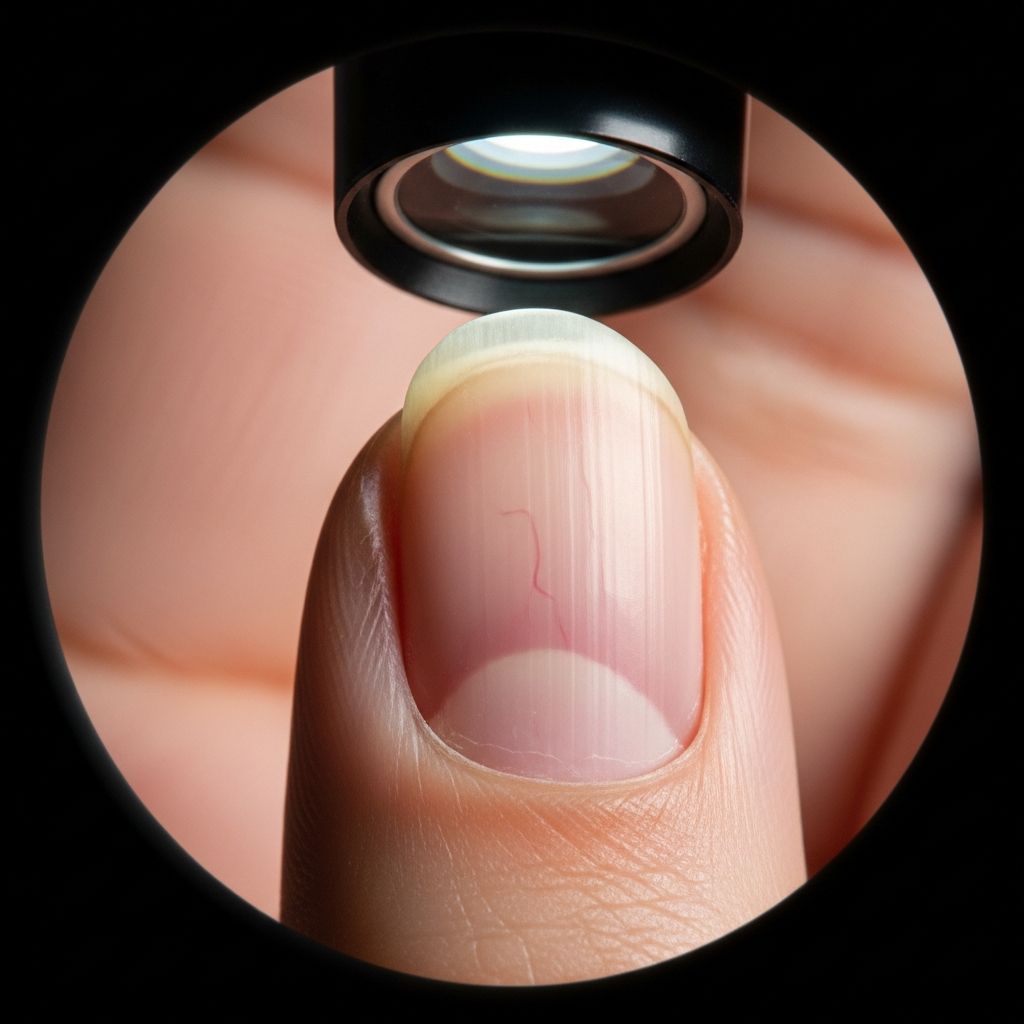
Dermoscopy of the nail plate enhances visualization of subsurface structures, aiding differentiation between benign pigmentation, haemorrhage, and malignancy. Images in this guide are standardized at 12 mm field width for consistent magnification.
Introduction to Nail Pigmentation
The nail plate is a semi-transparent keratinous structure, normally unpigmented. Discolouration arises from pigment or blood on the nail plate surface, within the plate, or beneath on the nail bed. Melanin from distal or proximal matrix melanocytes causes longitudinal melanonychia, more prevalent in darker skin types, affecting one or multiple nails. Total melanonychia spans the entire nail width, while transverse melanonychia is rare.
Nails grow slowly (months to distal edge), so longitudinal melanonychia indicates melanin deposition site, not production origin.
Causes of Longitudinal Melanonychia
- Benign activation: Ethnic melanonychia (common in Fitzpatrick types IV–VI), pregnancy, drugs (chemotherapy, antimalarials), systemic disorders (Addison disease, AIDS).
- Trauma or inflammation: Post-trauma, lichen planus, psoriasis.
- Infection: AIDS-related, onychomycosis.
- Neoplastic: Melanocytic naevus, lentigo, melanoma.
Dermoscopic Technique for Nails
Apply ultrasound gel to the nail plate for optimal imaging. Examine from above (dorsal view) and end-on at the free edge. End-on view reveals nail bed patterns, matrix keratin, and pigmentation depth. Dermoscopy targets pigmented streaks/bands from proximal nail fold to distal edge.
Melanonychia: Key Dermoscopic Structures
Assess bands for:
- Colour: Brown, grey, black uniformity.
- Width: Proximal vs. distal changes.
- Edges: Regular/irregular.
- Spacing: Between lines.
- Pattern: Homogeneous, heterogeneous, lattice-like.
| Feature | Benign | Suspicious |
|---|---|---|
| Band width | Regular, <3 mm | Irregular, widening proximally >3 mm |
| Colour | Uniform brown-grey | Multicoloured, black/pepper grains |
| Edges | Smooth | Blurred, irregular |
| Proximal changes | Stable | Disruption, Hutchinson sign |
These structures guide risk stratification.
Melanocytic Naevus of the Nail Apparatus
Benign naevi show uniform brown-grey bands, equal proximal/distal width, regular edges on pale background. Congenital naevi may exhibit:
- Multiple thin lines.
- Thick central band with feathered edges.
- Granular pattern.
- Absence of Hutchinson sign.
Pseudo-Hutchinson sign occurs when pigmentation shows through transparent proximal nail fold.
Nail Matrix / Nail Bed Melanoma
Suspicious for single nail involvement, recent onset in adults (thumb, great toe common). Features include:
- Irregular bands: width >3 mm, proximal widening, colour variation, disrupted pattern.
- Irregular spacing, blurred edges, pepper grains (black dots/globules).
- True Hutchinson sign (periungual pigmentation).
- Nail dystrophy.
ABCDEF rule for pigmented lesions: Asymmetry, Border irregularity, Colour variation, Diameter >3 mm, Evolving, Fill. Biopsy essential for confirmation; dermoscopy not fully reliable.
Subungual Haemorrhage
Most common pigmentation mimic; history often unclear. Dermoscopy shows well-circumscribed red-purple-blue-black spots (dots, globules, blotches):
- Proximal edge: rounded, sharp.
- Distal edge: tapered, linear streaks (follow nail growth).
- Non-longitudinal shape.
- Slower distal migration (under plate).
Recurrent spots warrant tumour investigation.
Tumours of the Nail Unit
Often non-pigmented, delaying diagnosis. Evaluate:
- Vascular structures: glomerular, hairpin, comma.
- Nail plate: dystrophy, thickening.
- Surrounding skin: ulceration, granulation.
Examples: pyogenic granuloma (copious red lakes), squamous cell carcinoma (keratin masses, serpiginous vessels), onychomatricoma (whorled channels).
Related Stories



Other Nail Conditions
Onychomycosis
Dermoscopy reveals jagged proximal edges, distal tapering bands, yellow streaks, spikes, scales.
Bacterial Infections
Green nail syndrome: proximal green discolouration.
Non-Melanocytic Pigmentation
Exogenous (smoke, chemicals), endogenous (lentigo: uniform brown plate).
Indications for Nail Biopsy
Biopsy if:
- Adult-onset single band.
- Band changes (widening, darkening, dystrophy).
- Irregular dermoscopic features.
- Hutchinson sign.
- Thumb/toe involvement.
Avoid in children unless progressive.
Frequently Asked Questions (FAQs)
Q: When is dermoscopy preferred over naked eye for nails?
A: For pigmented bands/streaks to assess irregularity, haemorrhage vs. melanin.
Q: What distinguishes benign melanonychia from melanoma?
A: Benign: uniform colour/width <3 mm; melanoma: irregular, proximal widening, pepper grains.
Q: Is gel necessary for nail dermoscopy?
A: Yes, improves image quality by reducing reflection.
Q: Can subungual haemorrhage mimic melanoma?
A: Yes; check distal linear streaks, proximal sharp margin.
Q: What tumours show vascular dermoscopic patterns?
A: Glomerular (granuloma), polymorphous (SCC).
References
- Dermoscopy of the nail — DermNet NZ. 2008 (updated). https://dermnetnz.org/cme/dermoscopy-course/dermoscopy-of-the-nail
- Melanoma of the nail unit — DermNet NZ. 2023-10-01. https://dermnetnz.org/topics/melanoma-of-the-nail-unit
- Introduction to dermoscopy — DermNet NZ. 2008. https://dermnetnz.org/cme/dermoscopy-course/introduction-to-dermoscopy
- Fungal nail infections — DermNet NZ. 2024-05-15. https://dermnetnz.org/topics/fungal-nail-infections
- Dermoscopy (Dermatoscopy) — DermNet NZ. 2023. https://dermnetnz.org/topics/dermoscopy
Similar Articles








Read full bio of medha deb