Pityriasis Versicolor Dermoscopy: 5 Diagnostic Patterns
Understanding dermoscopic features and diagnostic patterns of pityriasis versicolor infection.
Dermoscopy of Pityriasis Versicolor: Clinical and Diagnostic Overview
Pityriasis versicolor is a mild chronic infection of the skin caused by lipophilic yeast of the genus Malassezia. This common superficial fungal infection presents as discrete or confluent macules and patches with varying pigmentation patterns on the skin’s surface. Dermoscopy has emerged as a valuable diagnostic tool for identifying the characteristic microscopic features of this condition, particularly when clinical presentation is ambiguous or when differentiation from other hypopigmented or hyperpigmented dermatologic conditions is needed.
Introduction to Pityriasis Versicolor
Pityriasis versicolor affects the trunk, neck, and proximal arms, appearing as asymptomatic flaky patches that persist for months or years. The infection is more prevalent in hot, humid climates or in individuals who sweat heavily, making it prone to seasonal recurrence. The term “pityriasis” refers to scale appearance similar to bran, while “versicolor” reflects the multiple colors these lesions can display.
The condition manifests in three distinct clinical variants: hyperpigmented patches that appear coppery brown on pale skin, hypopigmented patches that appear paler than surrounding skin (particularly common in darker skin types), and pink patches indicating mild inflammation. Sometimes lesions transition through these stages, beginning as scaly and brown before resolving through a non-scaly white stage.
Clinical Presentation and Affected Populations
Most dermoscopy studies of pityriasis versicolor have been conducted in patients with Fitzpatrick IV and V dark skin types. In darker skin, the infected areas appear notably paler than normal surrounding skin, a presentation known as pityriasis versicolor alba. In pale-skinned individuals, the patches may appear pink or coppery, since the causative organism produces azelaic acid that impairs melanocyte function, preventing normal tanning in affected areas.
The lesions are typically asymptomatic, though some patients report mild itching. The patches generally do not predispose affected areas to increased or decreased sunburn susceptibility compared to surrounding skin.
Dermoscopic Features of Hypopigmented Pityriasis Versicolor
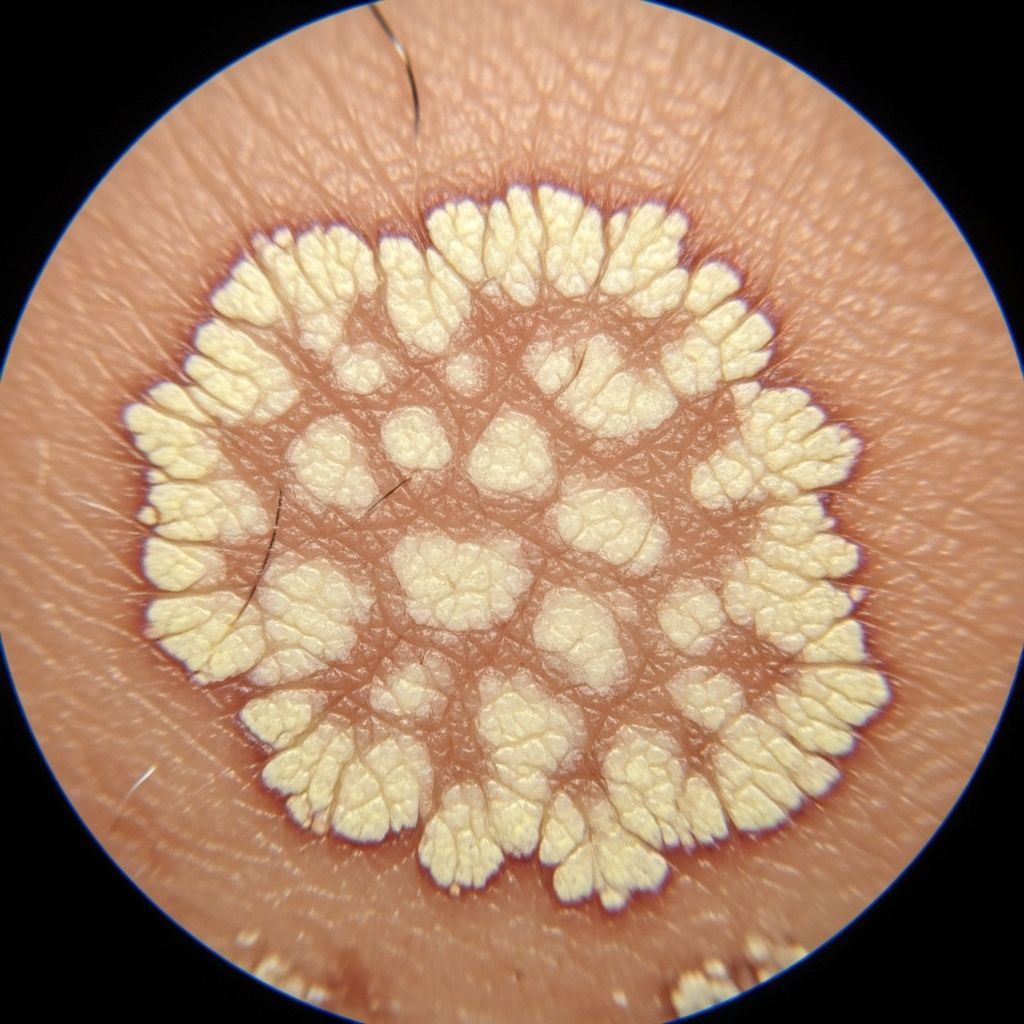
Hypopigmented lesions display characteristic dermoscopic findings that facilitate diagnosis. Dermoscopy of hypopigmented pityriasis versicolor shows diffuse white structureless areas with a faint pigment network. The patches are generally poorly defined, exhibiting non-uniform pigmentation and fine white scale.
The distribution of scale in hypopigmented variants can be:
- Diffuse or focal within the lesion
- Following natural skin lines and creases
- Concentrated around hair follicles
- Localized at the lesion periphery
A distinctive “wire-fence pattern” may be observed when fine scales align within natural skin creases. When skin is gently stretched, the scales characteristically break into two parts along skin cleavage lines, creating what clinicians refer to as the “double-edged scale” sign. This finding is highly suggestive of pityriasis versicolor and aids in clinical differentiation from other conditions.
A patchy pattern of scale is seen more commonly in hypopigmented pityriasis versicolor compared to hyperpigmented variants, making this an important diagnostic distinguishing feature.
Dermoscopic Features of Hyperpigmented Pityriasis Versicolor
Dermoscopy of hyperpigmented patches presents a distinctly different appearance from hypopigmented lesions. These lesions demonstrate diffuse or perifollicular fine whitish scale combined with a pigmented network of brown stripes or diffuse brownish pigmentation.
Related Stories



The scale in hyperpigmented variants is typically:
- Fine and whitish in appearance
- Distributed around hair follicles (perifollicular pattern)
- Sometimes arranged diffusely across the lesion surface
- Less patchy compared to hypopigmented forms
The background shows a characteristic pigmented network, distinguishing it from the faint or structureless patterns seen in hypopigmented disease. This pigmentation corresponds to increased basal layer melanin production influenced by the Malassezia infection.
Pink Pityriasis Versicolor
Pink pityriasis versicolor represents a mildly inflamed variant, with inflammation induced by Malassezia or its metabolites. This presentation may coexist with seborrheic dermatitis, as both conditions associate with Malassezia overgrowth. Dermoscopic evaluation of pink lesions may reveal additional vascular features or inflammatory changes beyond those seen in purely hyperpigmented or hypopigmented variants.
Differential Diagnoses and Dermoscopic Distinctions
Accurate diagnosis requires differentiation from several other skin conditions presenting with hypopigmentation or scale. The following comparisons illustrate key distinguishing features:
| Condition | Dermoscopic Features | Key Differences from Pityriasis Versicolor |
|---|---|---|
| Vitiligo | Milky white structureless area with diffuse white glow and absence of pigment network | Well-defined borders with hyperpigmented margins; absent pigment network; white hairs with loss of perifollicular pigmentation |
| Pityriasis Alba | Poorly-defined pale area with fine surface scale scattered randomly | Scale distributed irregularly without pattern; no pigment network |
| Progressive Macular Hypomelanosis | Poorly-defined white macules with faint reticular pigmentation | Usually non-scaly; white scale occasionally present with focal distribution when present |
The presence of a faint pigment network combined with characteristic scale patterns in natural skin distribution makes pityriasis versicolor dermoscopically distinguishable from these mimickers.
Histological Correlation with Dermoscopic Findings
Understanding the histological basis of dermoscopic findings enhances diagnostic accuracy. Skin biopsy of pityriasis versicolor shows mild hyperkeratosis, which corresponds with the white scale visible on dermoscopy. Elongated rete ridges display mild increase in basal layer pigmentation, producing the faint background pigment network observed dermoscopically.
While skin biopsy is not required for diagnosis, histological examination reveals:
- Hyperkeratosis in the stratum corneum
- Acanthosis with elongated rete ridges
- Mild superficial perivascular infiltrate in dermis
- Fungal elements primarily within the stratum corneum, visible with hematoxylin-eosin staining
- Prominent staining with periodic acid-Schiff (PAS) stain
The fungal elements are not always visible on routine histology, but PAS staining reliably highlights them.
Diagnostic Methodology and Testing
While dermoscopy provides valuable supportive information, pityriasis versicolor diagnosis is typically established clinically. When diagnostic uncertainty exists, several confirmatory tests are available:
Potassium Hydroxide (KOH) Preparation: Microscopy of KOH-prepared scales from pityriasis versicolor reveals clusters of yeast cells and long hyphae with a characteristic appearance often described as “spaghetti and meatballs“. The yeast cells resemble meatballs while the hyphae appear as strands of spaghetti, creating this distinctive and highly diagnostic pattern.
Wood’s Lamp Examination: A Wood’s lamp may demonstrate gold-yellow, yellow-green, or coppery-orange fluorescence. However, fluorescence is present in less than 50% of affected patients, limiting its diagnostic utility as a standalone test.
Dermoscopy: Dermoscopy examination is particularly helpful when clinical diagnosis remains unclear, providing detailed visualization of scale distribution, pigment patterns, and characteristic signs like the double-edged scale.
Dermoscopic Patterns and Clinical Significance
Several distinctive dermoscopic patterns carry diagnostic significance:
- Contrast Halo Sign: A ring of hypopigmentation surrounding lesions with increased pigmentary network (seen in hyperpigmented variants) or a ring of increased pigmentation around lesions with decreased pigmentary network (seen in hypopigmented variants)
- Wire-Fence Pattern: Fine scales aligned along natural skin creases and furrows
- Double-Edged Scale: Scale fragments breaking symmetrically along skin tension lines when skin is stretched
- Perifollicular Distribution: Scale concentrated around hair follicle openings, particularly in hyperpigmented variants
- Faint Pigment Network: Subtle reticular pattern visible in hypopigmented lesions, distinguishing them from completely structureless vitiliginous patches
Scale Distribution Patterns
The pattern of scale distribution provides important diagnostic clues. In pityriasis versicolor, scales may be distributed:
- Diffusely across the entire lesion surface
- Focally within specific lesion regions
- Following natural skin lines and creases
- Predominantly around hair follicles (perifollicular pattern)
- Concentrated at lesion periphery
The distribution pattern may vary between hypopigmented and hyperpigmented variants, with hypopigmented lesions more frequently displaying patchy scale distribution.
Clinical Implications of Dermoscopic Findings
Dermoscopic evaluation serves multiple clinical purposes beyond simple diagnosis. It helps clinicians:
- Establish accurate diagnosis when clinical features are ambiguous
- Differentiate pityriasis versicolor from similar-appearing conditions
- Assess disease activity and extent
- Monitor treatment response by tracking scale reduction
- Educate patients about characteristic features visible at magnification
- Document findings for follow-up comparison
Frequently Asked Questions
Q: What causes the color variations in pityriasis versicolor?
A: The hyperpigmented brown patches result from enlarged melanosomes in basal melanocytes induced by the yeast. The hypopigmented white patches occur because Malassezia produces azelaic acid that diffuses into the epidermis and impairs melanocyte function. Pink patches indicate mild inflammation from dermatitis induced by the organism or its metabolites.
Q: Can dermoscopy definitively diagnose pityriasis versicolor?
A: Dermoscopy provides strong supportive evidence with characteristic findings, but clinical diagnosis remains the standard approach. Dermoscopy is most valuable when diagnosis is uncertain or for differentiating from similar conditions.
Q: Why is the “spaghetti and meatballs” appearance diagnostic?
A: This distinctive KOH microscopy appearance—with yeast cells resembling meatballs and hyphae appearing as spaghetti strands—is highly specific for Malassezia species and confirms fungal infection.
Q: How does the double-edged scale sign form?
A: When skin is gently stretched, the scales break symmetrically along Langer’s lines (natural skin tension lines), creating two matching fragments that resemble a double-edged blade.
Q: Is hyperpigmented or hypopigmented pityriasis versicolor more common?
A: Pale patches are particularly common in darker skin types. The presentation depends partly on skin phototype and whether the patient has tanned, but both variants occur frequently.
Q: How long does skin color take to normalize after treatment?
A: The color may persist for weeks or months after the scale clears, particularly hypopigmentation. This does not indicate treatment failure—the infection is considered resolved once the surface scale disappears.
Q: What is the significance of the faint pigment network in hypopigmented lesions?
A: The presence of a faint pigment network distinguishes pityriasis versicolor from vitiligo, which shows a completely absent pigment network. This finding supports the diagnosis and helps exclude other depigmenting disorders.
References
- Dermoscopy of pityriasis versicolor — DermNet New Zealand. 2024. https://dermnetnz.org/topics/dermoscopy-of-pityriasis-versicolor
- Pityriasis versicolor – Fungal skin infections — DermNet New Zealand. 2024. https://dermnetnz.org/cme/fungal-infections/pityriasis-versicolor
- Pityriasis versicolor — DermNet New Zealand. 2024. https://dermnetnz.org/topics/pityriasis-versicolor
- Tinea Versicolor — StatPearls, National Center for Biotechnology Information (NCBI). 2025. https://www.ncbi.nlm.nih.gov/books/NBK482500/
- Pityriasis versicolor epidemiology, pathophysiology, clinical manifestations, and diagnosis — UpToDate. Updated 2025. https://www.uptodate.com/contents/pityriasis-versicolor-epidemiology-pathophysiology-clinical-manifestations-and-diagnosis
Similar Articles








Read full bio of Sneha Tete