Dermoscopy: Expert Guide To Early Melanoma Detection
Essential guide to dermoscopy for early melanoma detection and skin lesion diagnosis in clinical practice.
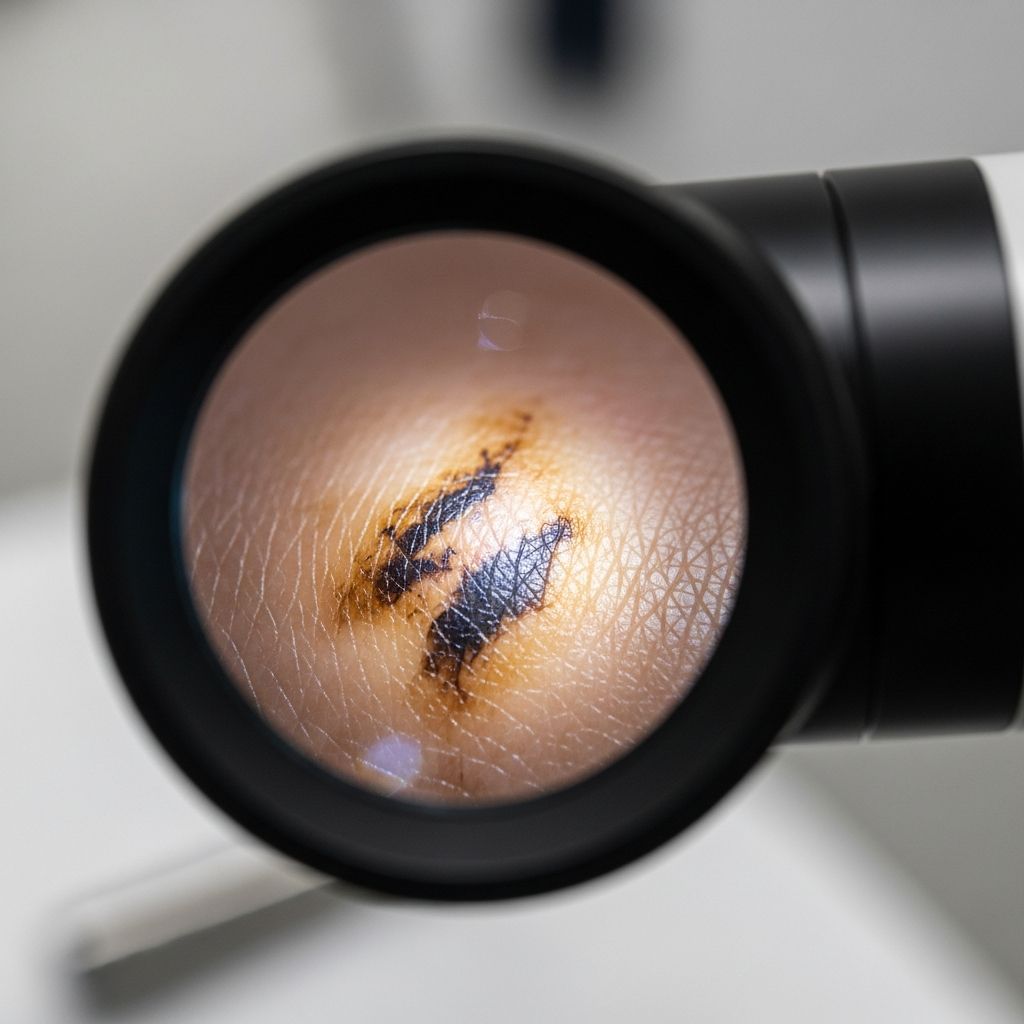
Dermoscopy, also known as dermatoscopy or epiluminescent microscopy, is a non-invasive skin imaging technique primarily used to evaluate pigmented skin lesions for early detection of melanoma and other malignancies.
Introduction
Dermoscopy enables visualization of subsurface skin structures not visible to the naked eye, allowing dermatologists, plastic surgeons, and general practitioners to distinguish malignant lesions like melanoma and pigmented basal cell carcinoma from benign melanocytic naevi and seborrhoeic keratoses. In experienced hands, it improves diagnostic accuracy, with studies showing enhanced sensitivity and specificity for early melanoma detection. However, dermoscopy requires training; beginners may initially overdiagnose melanoma or paradoxically decrease accuracy.
The technique involves using a dermatoscope—a high-quality lens providing 10-14x magnification paired with a powerful light source—to examine skin patterns and structures. Fluid immersion or polarized light dermatoscopes are common, with hand-held, battery-powered devices being lightweight and portable. Digital attachments facilitate photography for monitoring changes over time, crucial since structural changes in superficial melanomas can appear within 3-6 months.
Dermatoscopic Features of Pigmented Lesions
Dermoscopy reveals key features such as pigment networks, dots, globules, streaks, and colors that correlate with histological structures. Pigment network appears as a grid-like pattern; typical networks have uniform holes and thin lines, seen in benign naevi, while atypical networks feature irregular, broadened lines indicative of malignancy.
Blue-white structures, including veils and regression areas, signal potential melanoma. Vascular patterns, white clues, and ulceration are vital for non-pigmented lesions. These features guide differential diagnosis using algorithms like pattern analysis or checklists.
Dermatoscopes
Dermatoscopes vary from standalone devices to smartphone attachments. Key considerations include magnification quality, lighting (non-polarized, polarized, or hybrid), immersion fluid compatibility, and digital imaging capabilities. Polarized dermatoscopes eliminate the need for oil immersion, reducing preparation time.
Advanced tools like the SIAscope use spectrophotometric analysis across 12 wavebands to map melanin, collagen, and vascular distribution. Digital systems support teledermoscopy and mole mapping for remote expert review.
Dermatoscope Comparative Gallery
Images from various dermatoscopes demonstrate differences in resolution and color fidelity, aiding selection for clinical use.
Diagnostic Algorithms
Pattern Analysis
Pattern analysis, favored by experts, first distinguishes melanocytic from non-melanocytic lesions, then assesses all dermoscopic features simultaneously for benign versus malignant differentiation. It evaluates global patterns (e.g., reticular, globular) and local features (e.g., atypical network, blue-white veil).
Three-Point Checklist
This simple tool for non-experts flags malignancy if two of three criteria are met: asymmetry, atypical pigment network, and blue-white structures. It boasts high sensitivity for melanoma but lower specificity than pattern analysis.
- Asymmetry: Lesion lacks mirror-image halves.
- Atypical pigment network: Irregular holes, thick lines, streaming, or pseudopods.
- Blue-white structures: Veils, regression, or subtle blue-white coloring.
Practice with this checklist improves rapid screening.
Dermoscopy of Benign Melanocytic Lesions
Benign lesions show symmetric, uniform patterns. Lentigo simplex displays a dark uniform network. Common naevi exhibit regular globules, homogeneous pigmentation, or typical networks.
| Lesion Type | Key Dermoscopic Features |
|---|---|
| Lentigo Simplex | Dark uniform network across lesion |
| Junctional Naevi | Regular pigment network, symmetric |
| Compound Naevi | Globules, cobblestone pattern |
Related Stories



Dermoscopy of Atypical / Malignant Lesions
Atypical naevi and melanomas deviate from the patient’s naevus pattern—the “ugly duckling” sign. Features include atypical networks, irregular streaks, polymorphous vessels, and blue-white regression. Melanomas often lack identifying features in 8% of cases, diagnosed via change monitoring.
Dermoscopic-Histologic Correlation
Dermoscopic patterns directly correspond to histology: pigment networks reflect elongated rete ridges filled with melanin; globules indicate nested melanocytes. Vascular structures and white areas (e.g., fibrosis) provide clues for amelanotic lesions.
The Dermoscopy Report
Standardized reporting, per International Dermoscopy Society guidelines, includes lesion location, size, clinical-dermoscopic descriptions, and management recommendations. Objective reports are essential for non-routine examiners.
- Location and dimensions
- Colors and patterns observed
- Symmetry and border
- Diagnostic impression
- Follow-up or biopsy advice
Mole Mapping and Surveillance
High-risk patients benefit from total body photography (24-30 images) combined with dermoscopy. Digital mole mapping locates changes precisely; stable lesions avoid unnecessary biopsies. The “little red riding hood” sign highlights subtle melanomas differing only on close inspection.
New/changed naevi are common in youth but suspicious over age 50. Self-examination and physician reviews enhance surveillance.
Training and Practice
Experts recommend gradual learning via courses, textbooks, and daily practice. Digital imaging of lesions with pathology confirmation builds skills. Computer-aided diagnosis compares images to databases.
Frequently Asked Questions (FAQs)
What is dermoscopy used for?
Dermoscopy evaluates pigmented lesions to differentiate melanoma from benign naevi, and aids in diagnosing non-pigmented lesions and inflammatory conditions.
Is dermoscopy better than naked-eye exam?
Yes, in expert hands, it increases melanoma detection sensitivity to 92%.
Can beginners use dermoscopy?
Beginners may overdiagnose; training is essential, starting with simple checklists.
What does the ugly duckling sign mean?
A lesion differing from a patient’s other moles, warranting closer scrutiny.
How often should high-risk patients be monitored?
Regularly with photography and dermoscopy to detect changes early.
Conclusion
Dermoscopy revolutionizes skin cancer screening by revealing hidden patterns, but clinical suspicion must guide decisions. Ongoing practice ensures proficiency.
References
- Introduction to Dermoscopy — DermNet NZ. 2008 (updated). https://dermnetnz.org/cme/dermoscopy-course/introduction-to-dermoscopy
- The Dermoscopy Report — DermNet NZ. 2008 (updated). https://dermnetnz.org/cme/dermoscopy-course/the-dermoscopy-report
- Dermoscopy (Dermatoscopy) — DermNet NZ. Reviewed by Dr Ian Coulson. https://dermnetnz.org/topics/dermoscopy
- Pattern Analysis — DermNet NZ. 2008 (updated). https://dermnetnz.org/cme/dermoscopy-course/pattern-analysis
- Dermatoscopic-Histologic Correlation — DermNet NZ. 2008 (updated). https://dermnetnz.org/cme/dermoscopy-course/dermatoscopic-histologic-correlation
- Three-Point Checklist — DermNet NZ. 2008 (updated). https://dermnetnz.org/cme/dermoscopy-course/three-point-checklist
Similar Articles








Read full bio of Sneha Tete