Desmoplastic Trichoepithelioma: What It Is And How It’s Treated
Understanding desmoplastic trichoepithelioma: a rare, benign facial skin tumour often mistaken for skin cancer.
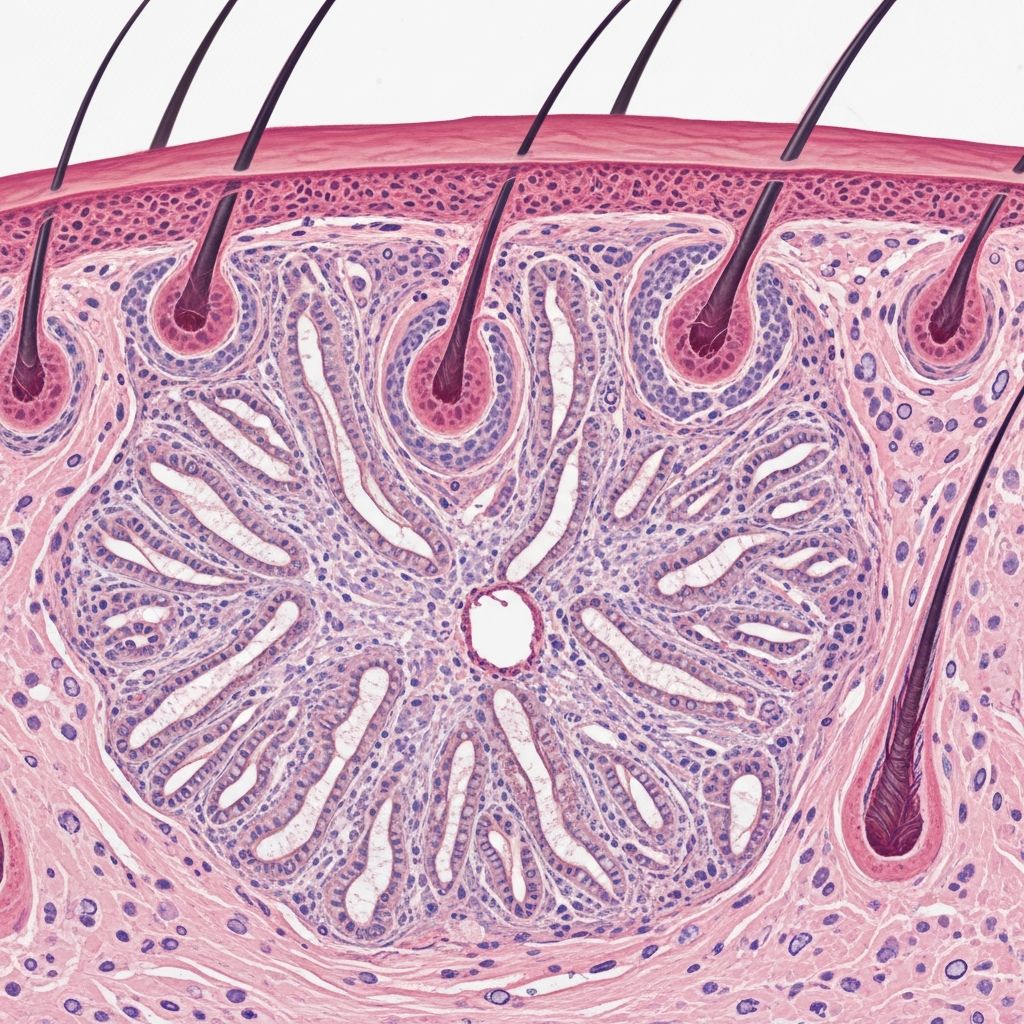
Desmoplastic trichoepithelioma is a harmless facial skin lesion that arises from hair follicle cells. It represents an uncommon variant of trichoepithelioma, with an estimated incidence of 1 in 5000 skin biopsies among adults. Also known as sclerosing epithelial hamartoma, this benign adnexal tumour is characterized by its distinctive clinical and histological appearance, often mimicking more aggressive skin cancers.
What is desmoplastic trichoepithelioma?
Desmoplastic trichoepithelioma (DTE) is a rare benign neoplasm originating from the basal cells of the hair follicle’s outer root sheath. Classified as a hair follicle or adnexal tumour, it features a desmoplastic (sclerosing) stromal response, narrow strands of basaloid cells, and keratinous cysts, forming a diagnostic triad first described by Brownstein and Shapiro in 1977. This tumour grows slowly and remains confined to the dermis, lacking malignant potential.
Historically, DTE has been reported under various names, including benign cystic epithelioma (1904), solitary trichoepithelioma, epithelioma adenoides cysticum, morphea-like epithelioma, and sclerosing epithelial hamartoma, reflecting evolving understanding of its pathology. Familial cases suggest a genetic predisposition, though most occurrences are sporadic. DTE accounts for less than 1% of cutaneous tumours and is identified in approximately 1 in 5000 biopsies.
Who gets desmoplastic trichoepithelioma?
DTE predominantly affects middle-aged females, though it can occur in males and across all age groups, exhibiting a bimodal distribution in adults and young children. Young women are particularly prone, with lesions often appearing on sun-exposed facial areas. Familial clustering has been noted, hinting at hereditary factors, but the majority are isolated. The tumour’s predilection for females may relate to hormonal influences, though this remains unproven.
- Demographics: More common in females (up to 80-90% of cases)
- Age: Middle-aged adults peak; also children
- Risk factors: Sun exposure (cheeks, forehead); possible genetic link in familial cases
Clinical features
Desmoplastic trichoepithelioma typically presents as a solitary, firm, skin-coloured to white-yellowish or reddish annular plaque or nodule, measuring 2-18 mm in diameter, with a raised border and central depression or dell. Commonly located on the upper cheek, it may also appear on the forehead, chin, nose, or less frequently, neck, scalp, or upper trunk. Lesions are asymptomatic, slow-growing, non-ulcerated, and indurated, often persisting for years before medical attention.
Rarely, multiple lesions occur, particularly in familial settings. The clinical resemblance to basal cell carcinoma (BCC), especially morpheaform subtype, frequently leads to misdiagnosis. Growth is stable or gradual, up to 1 cm.
| Feature | Description |
|---|---|
| Appearance | Firm annular papule/plaque with central dimple |
| Size | 2–18 mm |
| Colour | Skin-coloured, white-yellow, red |
| Location | Face (cheek > forehead, chin); rarely trunk |
| Symptoms | Asymptomatic; slow-growing |
Diagnosis
Diagnosis relies on clinical suspicion confirmed by full-thickness skin biopsy, as superficial samples may mimic sclerosing BCC or microcystic adnexal carcinoma (MAC). Histopathology reveals a well-circumscribed lesion in the papillary dermis and upper reticular dermis, featuring:
- Narrow strands and cords of basaloid epithelial cells
- Numerous horn cysts (keratin-filled)
- Dense desmoplastic fibrous stroma
- Occasional calcification, osteoma, or granulomatous reaction
Immunohistochemistry aids differentiation: DTE shows positivity for CK15, CK19, S100 (stroma), and BerEP4 negative, contrasting with BCC (BerEP4 positive). In uncertain cases, complete excision or re-biopsy is recommended.
Related Stories



Differential diagnosis
DTE’s clinical and histological overlap with malignant tumours necessitates careful differentiation.
| Condition | Key Distinguishing Features |
|---|---|
| Morpheaform BCC | Ill-defined, infiltrative; perineural invasion; BerEP4+; ulcerates |
| Microcystic adnexal carcinoma (MAC) | Large, asymmetric, subcutaneous extension; tubular structures; aggressive |
| Syringoma | Multiple small papules on eyelids/cheeks; eccrine ducts; puberty onset |
| Trichoepithelioma (classic) | Less desmoplasia; multiple in Brooke-Spiegler syndrome |
| Solitary trichoepithelioma | Similar but lacks annular depression and fibrosis |
Management
As a truly benign tumour with no malignant potential, excision is not mandatory but recommended for cosmetic reasons, confirmation of diagnosis, or facial location. Observation suffices if diagnosis is certain. Surgical options include:
- Complete excision: Preferred for small lesions
- Mohs micrographic surgery: Ideal for facial sites to preserve tissue and ensure clear margins, given BCC mimicry
- Dermabrasion/laser resurfacing: For multiple lesions (rare)
Recurrence is rare post-excision. Mohs is favoured in cosmetically sensitive areas due to DTE’s aggressive histology despite benign nature.
Prognosis
Excellent; DTE is non-malignant with no metastasis risk. Post-excision, lesions do not recur if fully removed. Long-term follow-up monitors for diagnostic error, as untreated mimickers like BCC progress.
Frequently Asked Questions (FAQs)
Is desmoplastic trichoepithelioma cancerous?
No, it is a benign hair follicle tumour with no malignant potential.
Does desmoplastic trichoepithelioma need to be removed?
Not always; observation is fine if diagnosed confidently, but excision confirms diagnosis and improves cosmesis.
How is desmoplastic trichoepithelioma diagnosed?
By skin biopsy showing basaloid strands, horn cysts, and desmoplastic stroma.
What does desmoplastic trichoepithelioma look like?
A firm, ring-shaped plaque with central depression on the cheek.
Can desmoplastic trichoepithelioma be multiple?
Rarely; usually solitary, but familial cases may have multiples.
References
- Desmoplastic trichoepithelioma — Wikipedia. 2023-10-15. https://en.wikipedia.org/wiki/Desmoplastic_trichoepithelioma
- Desmoplastic trichoepithelioma: a clinicopathological study of three cases and a review of the literature — Spandidos Publications (Oncology Letters). 2015-11-01. https://www.spandidos-publications.com/10.3892/ol.2015.3517
- Desmoplastic trichoepithelioma — DermNet NZ. 2013-01-01. https://dermnetnz.org/topics/desmoplastic-trichoepithelioma
- Hair Follicle Neoplasms – Desmoplastic Trichoepithelioma — Perri Dermatology. 2011-06-05. https://perridermatology.com/dr-perris-blog/hair-follicle-neoplasms-desmoplastic-trichoepithelioma/
- Desmoplastic trichoepithelioma — PubMed (Journal of the American Academy of Dermatology). 2010-02-01. https://pubmed.ncbi.nlm.nih.gov/20082889/
Similar Articles








Read full bio of medha deb