Desquamative Vaginitis Guide: Diagnosis, Symptoms & Treatment
Learn about the causes, symptoms, diagnosis, and management of desquamative vaginitis, a chronic inflammatory vaginal condition.
Author: Reviewed by: Vulvovaginal Dermatologist / Gynaecologist
Desquamative vaginitis, also known as desquamative inflammatory vaginitis (DIV), is a rare and chronic form of vaginitis characterized by persistent vaginal inflammation, purulent discharge, and epithelial disruption. It primarily affects perimenopausal and postmenopausal women, though cases occur across all ages. The condition leads to symptoms such as vaginal burning, itching, dyspareunia (painful intercourse), and discharge that resists standard treatments for common vaginitis.
What is desquamative vaginitis?
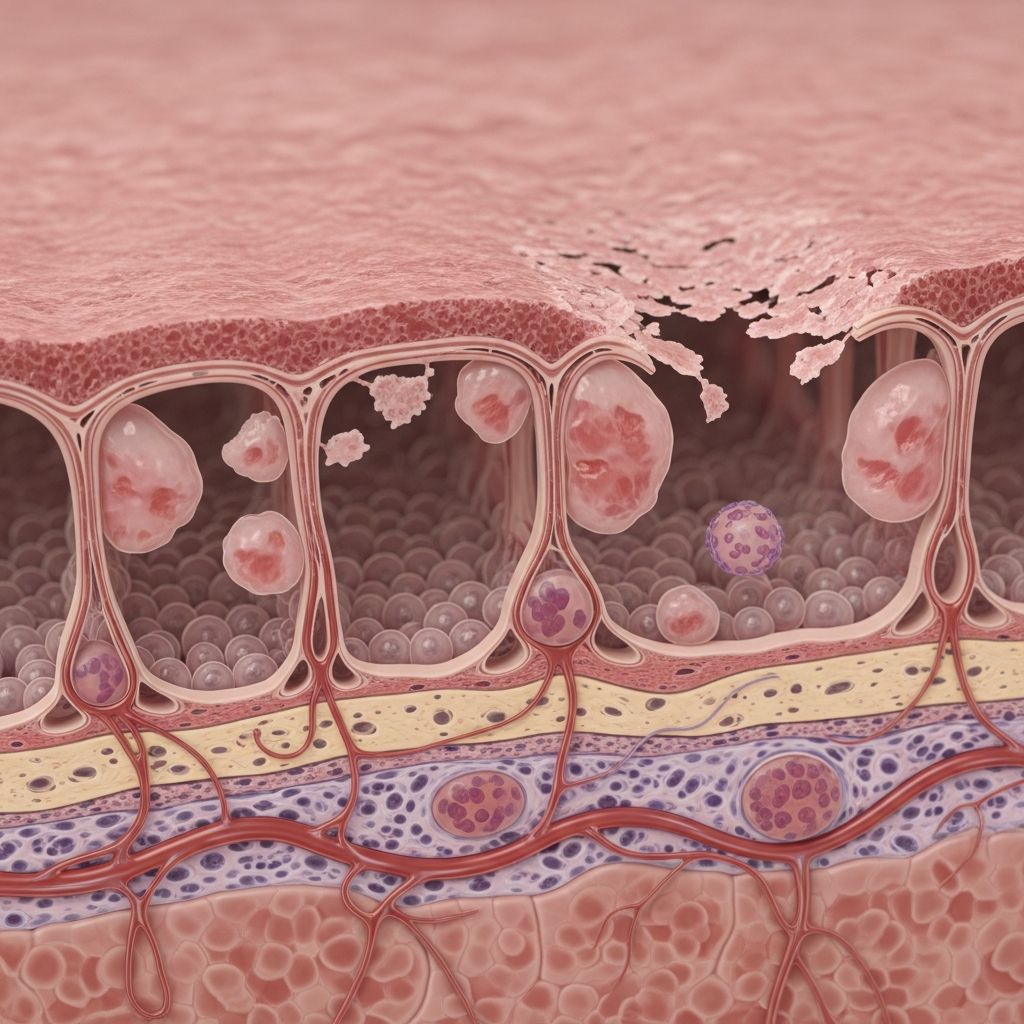
Desquamative vaginitis involves diffuse inflammation of the vaginal mucosa and vestibule, resulting in a ‘fiery red’ appearance, purulent (yellow-green) discharge, and spots or patches of vaginal rash. The vaginal epithelium shows desquamation, with increased parabasal cells and inflammatory cells like neutrophils on microscopy. Unlike infectious vaginitis, no specific pathogen is consistently identified, suggesting a noninfectious etiology possibly involving immune dysregulation or genetic predisposition.
The syndrome was first described in the 1960s and remains poorly understood, with theories of estrogen deficiency, bacterial overgrowth, or autoimmune processes disproven or unconfirmed. It differs from atrophic vaginitis by its purulent discharge and higher inflammatory cell counts.
Who gets desquamative vaginitis?
Desquamative vaginitis most commonly affects white women in perimenopause or menopause, with a mean age of around 48-50 years. In one study of 98 patients, 97 were white, 50% postmenopausal, and symptoms had persisted for years in many cases.
- Predominantly perimenopausal and postmenopausal women
- Can occur premenopausally or in younger women
- Association with autoimmune conditions or lichen planus in some cases
- No clear risk factors like sexual history or hygiene identified
Patients often report failed prior treatments for bacterial vaginosis, candidiasis, or trichomoniasis.
What causes desquamative vaginitis?
The exact cause remains unknown. Proposed mechanisms include:
- Noninfectious inflammation: Abnormal immune response targeting vaginal mucosa elements.
- Loss of Lactobacillus: Reduced protective lactobacilli, leading to pH elevation (≥4.5-5.0) and inflammation.
- Association with lichen planus: Erosive vulvovaginal lichen planus may mimic or coexist with DIV.
- Disproved causes: Estrogen deficiency alone, specific bacterial infections, vitamin D deficiency.
Microscopy reveals parabasal cells >10%, inflammatory-to-squamous cell ratio 1:1 or higher, and absent motile trichomonads.
What are the symptoms of desquamative vaginitis?
Symptoms are chronic and debilitating, often lasting years:
- Purulent vaginal discharge: Yellow-green, copious, malodorous in some cases.
- Vestibulo-vaginal irritation: Burning, itching, rawness.
- Dyspareunia: Pain with intercourse, common in 70-80% of cases.
- Vulvar erythema and discomfort
- Occasional spotting or postcoital bleeding from erosions.
Symptoms worsen with menstruation or intercourse and persist despite antibiotics or antifungals.
What does desquamative vaginitis look like?
On examination:
- Vaginal mucosa: Fiery red inflammation, edema, petechiae, ecchymosis, erosions in spotted/linear patterns.
- Discharge: Purulent, yellow-green, adherent to walls.
- Vestibule: Erythema, tenderness.
- Cervix: Colpitis macularis (small erythematous macules) in ~27%.
- Rash patterns: White reticulated areas, hemorrhage.
Related Stories



No lactobacilli predominance; pH ≥5.
How is desquamative vaginitis diagnosed?
Diagnosis is clinical, supported by lab findings. Exclude infections first.
Clinical evaluation
- History: Chronic symptoms unresponsive to standard therapy.
- Speculum exam: Inflammation, purulent discharge, petechiae.
- pH testing: ≥4.5-5.0 from lateral sidewall.
Microscopy (wet mount)
| Finding | Desquamative Vaginitis | Normal |
|---|---|---|
| Parabasal cells | >10% or increased | Rare |
| Inflammatory cells (PMNs) | >1:1 ratio to epithelial cells | <1:10 |
| Lactobacilli | Absent/reduced | Predominant |
| Trichomonads | Absent | Absent |
Additional tests
- Vaginal swabs for culture, trichomonas PCR, BV testing.
- Biopsy if lichen planus suspected (oral/vulvar lesions).
Differential diagnosis of desquamative vaginitis
| Condition | Key Distinguishers |
|---|---|
| Atrophic vaginitis | Clear/thin discharge, no purulence, fewer inflammatory cells. |
| Erosive lichen planus | White lacy lesions, scarring, oral involvement; biopsy confirms. |
| Trichomoniasis | Motile trichomonads on wet mount, frothy discharge. |
| Bacterial vaginosis | Clue cells, fishy odor, pH ≥4.5 but no parabasals. |
| Candidiasis | pH <4.5, pseudohyphae, thick white discharge. |
Management of desquamative vaginitis
Treatment is empirical, topical, and prolonged. No official guidelines; based on observational studies.
First-line treatments
- Clindamycin 2% cream: 5g intravaginally nightly for 1-3 weeks; maintenance 1-2x/week for 2-6 months.
- Hydrocortisone 10% cream: 300-500mg nightly for 3 weeks; maintenance as above.
Alternative/adjunct therapies
- Cortisone acetate 25mg suppository BID for 4-6 weeks.
- Clobetasol propionate 0.05% nightly for 1 week (short-term due to potency).
- Combination: Clindamycin + hydrocortisone.
- Fluconazole 150mg PO weekly or vaginal estrogen 2x/week for maintenance.
Vulvar care: Cotton underwear, avoid irritants, keep dry.
Response and prognosis
In a study of 98 patients, 86% had symptom relief in 3 weeks; 26% cured at 1 year, 58% required maintenance. If partial response at 4 weeks, switch/ escalate therapy (e.g., 15% hydrocortisone).
Frequently asked questions about desquamative vaginitis
Q: Is desquamative vaginitis infectious?
A: No, no specific pathogen; treated with antibiotics for anti-inflammatory effects.
Q: Can desquamative vaginitis be cured?
A: 26% achieve complete cure; most require long-term maintenance.
Q: How long does treatment last?
A: Initial 3 weeks, then maintenance 2-6 months or longer.
Q: Does estrogen help?
A: May adjunct in postmenopausal women but not primary treatment.
Q: Is biopsy needed?
A: Only if lichen planus suspected.
References
- Desquamative Vaginitis—How to Recognize and Treat It — The ObG Project. 2018-03-23. https://www.obgproject.com/2018/03/23/desquamative-vaginitis-recognize-treat/
- Desquamative vaginitis – DermNet — DermNet NZ. Accessed 2026. https://dermnetnz.org/topics/desquamative-vaginitis
- Desquamative inflammatory vaginitis — Contemporary OB/GYN. 2023. https://www.contemporaryobgyn.net/view/desquamative-inflammatory-vaginitis
- Prognosis and treatment of desquamative inflammatory vaginitis — PubMed (Sobel JD et al.). 2011-04. https://pubmed.ncbi.nlm.nih.gov/21422855/
- Desquamative Inflammatory Vaginitis — ASCCP (Haefner PDF). 2014. https://www.asccp.org/Assets/daa39f0b-3bb6-4025-82b6-e5fe1208f5c0/635959099532430000/3-desquamative-inflammatory-vaginitis-haefner-pdf
Similar Articles








Read full bio of Sneha Tete