Itchy Skin Differential Diagnosis: Clinical Guide
Comprehensive guide to diagnosing the causes of acute and chronic itch, from skin rashes to systemic diseases.
Who is at risk of itchy skin?
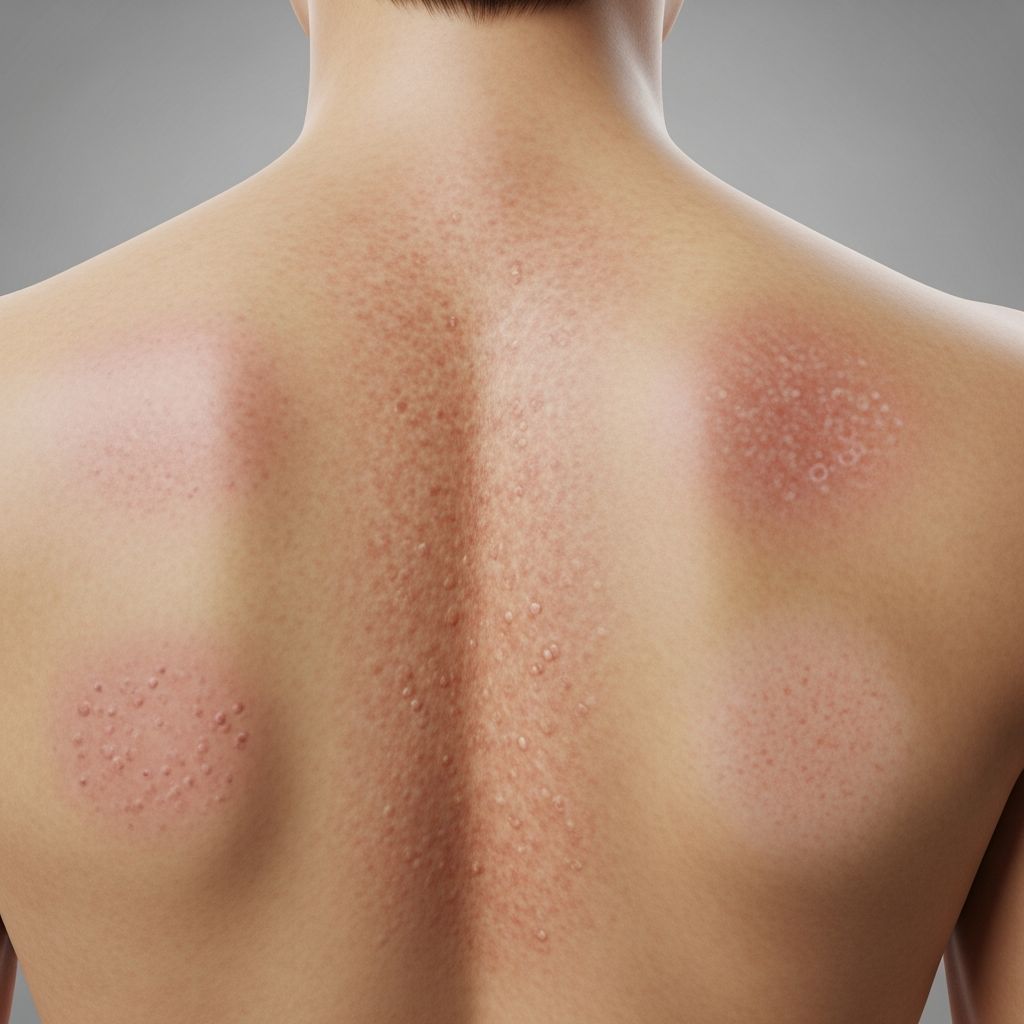
Itch is defined by a desire to scratch. An acute or chronic itchy rash is most often due to dermatitis/eczema. Dermatitis can be primary, or secondary to scratching. Acute itchy skin without rash may be due to dry skin (xerosis cutis), a reaction to cold exposure, or aquagenic pruritus (itching triggered by water exposure). Chronic itch without rash may represent underlying systemic disease.
Questions to consider
To narrow down the differential diagnosis of itchy skin, clinicians should systematically evaluate key factors:
- Duration: Is the itch acute (less than 6 weeks) or chronic (more than 6 weeks)?
- Distribution: Localised or generalised? Specific body sites affected?
- Rash presence: Is there a primary rash, or only secondary changes from scratching (excoriations, lichenification)?
- Skin changes: Erythema, scaling, vesicles, burrows, or nodules?
- Associated symptoms: Fever, weight loss, jaundice, neurological symptoms?
- Triggers: Allergens, irritants, medications, heat, stress?
- Patient history: Atopy, family history, systemic diseases, travel, exposures?
These questions guide the categorisation into very itchy skin with localised/generalised rash, mildly itchy variants, or itch without rash.
Very itchy skin with localised rash
Intensely pruritic localised rashes often stem from hypersensitivity reactions or infestations. Key differentials include:
- Insect bites / papular urticaria: Clusters of firm papules from arthropod bites, common in children, intensely itchy.
- Pompholyx (dyshidrotic eczema): Vesicles on palms/soles, triggers include stress, nickel, cobalt.
- Scabies: Burrows, papules, intense nocturnal itch, affects finger webs, wrists, genitals.
Examine for burrows using dermoscopy. Secondary infection common.
Mildly itchy skin with localised rash
Less severe localised pruritus with rash may indicate:
- Lichen simplex chronicus: Thickened, leathery plaques from chronic rubbing, often on ankles, neck.
- Psoriasis (localised plaques): Well-demarcated erythematous plaques with silver scale.
- Tinea corporis: Annular scaling plaques from dermatophyte infection.
Biopsy may be needed for confirmation.
Very itchy skin with generalised rash
Generalised intense pruritus with widespread rash suggests:
- Atopic dermatitis: Flexural erythema, xerosis, lichenification; worse in atopics.
- Urticaria: Transient wheals, angioedema; triggers include drugs, foods.
- Drug eruptions: Morbilliform rash, often 7-14 days post-medication.
- Mycosis fungoides: Patches/plaques, may mimic eczema.
Skin biopsy and patch testing aid diagnosis.
Mildly itchy skin with generalised rash
Diffuse mild itch with rash:
- Pityriasis rosea: Herald patch followed by Christmas-tree eruption.
- Viral exanthems: e.g., enterovirus, parvovirus.
- Seborrhoeic dermatitis: Greasy scaling on scalp, face.
Localised itchy skin without rash
Notalgia paraesthetica, brachioradial pruritus, or neuropathic itch; burning/stinging sensation. May lead to lichen simplex.
Generalised itchy skin without rash
Pruritus sine materia indicates systemic causes:
- Chronic renal insufficiency: Uraemic pruritus, worse on legs.
- Cholestasis: Bile salt deposition.
- Iron deficiency: Common in elderly.
- Polycythaemia vera: Aquagenic.
- Hyperthyroidism:.
- Lymphoma: Especially Hodgkin.
- Diabetic neuropathy:.
- Multiple myeloma:.
Investigate with FBC, EUC, LFTs, TSH, ferritin, SPEP.
Related Stories



General treatments for itchy skin conditions
Management principles:
- Emollients: First-line for xerosis.
- Topical corticosteroids: Potent for inflammatory rashes.
- Antihistamines: Sedating for nocturnal itch.
- Phototherapy: UVB for chronic pruritus.
- Systemic: Gabapentinoids for neuropathic, immunosuppressants for severe atopic.
Treat underlying cause.
Frequently Asked Questions (FAQs)
Q: When should I see a doctor for itchy skin?
A: Seek medical advice if itch persists >2 weeks, disrupts sleep, or accompanies systemic symptoms like jaundice or weight loss.
Q: Can dry skin cause severe itching?
A: Yes, xerosis is a common cause, graded mild-severe; moisturise frequently.
Q: Is scabies always visible?
A: Burrows may be subtle; dermoscopy helps. Intense itch, especially nocturnal.
Q: How to differentiate atopic dermatitis from other rashes?
A: Flexural distribution, personal/family atopy history, chronicity.
Q: What tests for itch without rash?
A: Bloods (renal, liver, thyroid, iron), consider skin biopsy if needed.
Stages of itch include acute (histamine-mediated) and chronic (neuropathic). Secondary lesions: erosions, purpura, lichen simplex, infection.
| Severity | Description |
|---|---|
| Mild | Scaling confined to skin furrows. |
| Moderate | Scaling beyond furrows, distinct markings. |
| Severe | Plate-like scaling, deep fissures. |
References
- Differential diagnosis of very itchy skin — DermNet NZ. 2016-02-28. https://dermnetnz.org/topics/differential-diagnosis-of-itchy-skin
- Xeroderma — StatPearls, NCBI Bookshelf, NIH. 2023-07-17. https://www.ncbi.nlm.nih.gov/books/NBK565884/
- Lichen simplex chronicus — DermNet NZ. 2023. https://dermnetnz.org/topics/lichen-simplex
- Atopic dermatitis — DermNet NZ. 2024. https://dermnetnz.org/topics/atopic-dermatitis
- Pruritus — DermNet NZ. 2023. https://dermnetnz.org/topics/pruritus
Similar Articles








Read full bio of medha deb