Differential Diagnosis Of Vulval Ulcers: Key Signs And Tests
Comprehensive guide to identifying, diagnosing, and managing vulval ulcers from infectious, traumatic, and systemic causes.
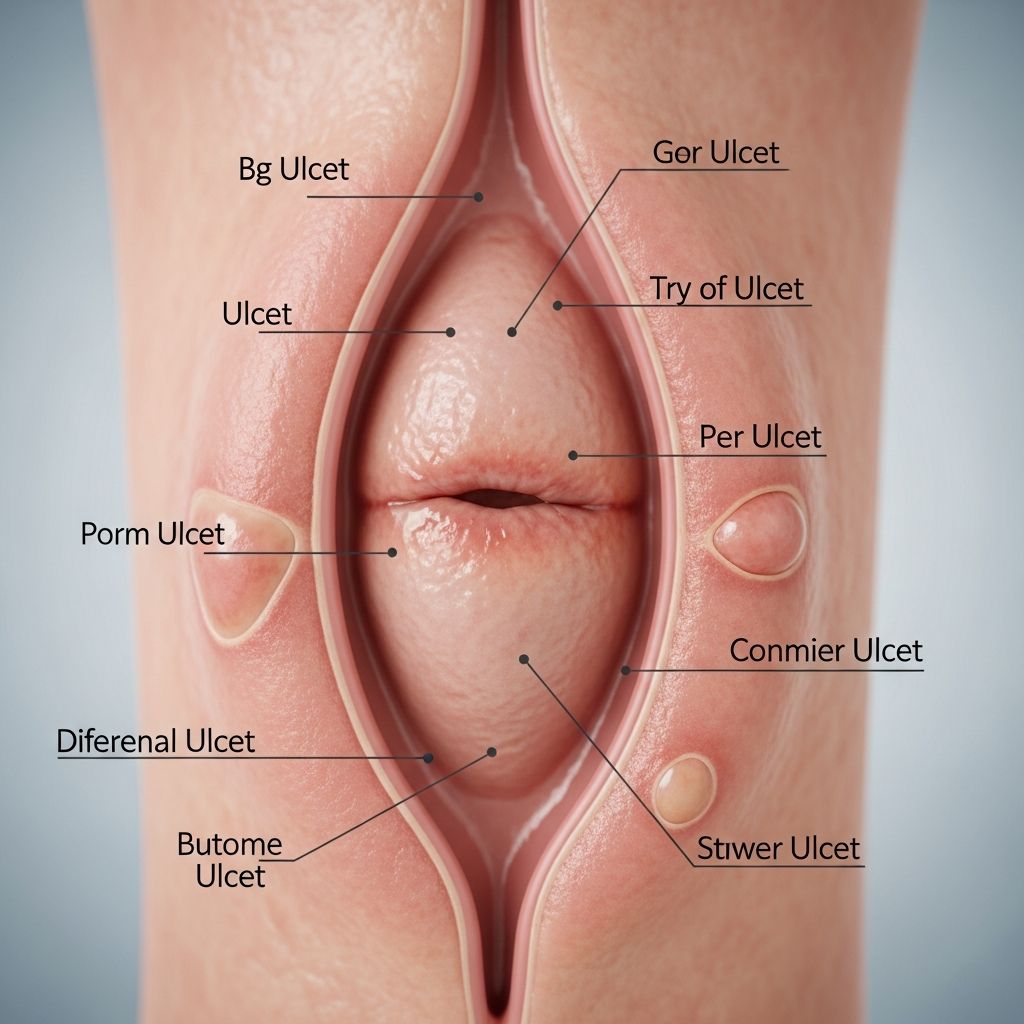
Vulval ulcers are painful or painless erosions or sores on the vulva, often presenting diagnostic challenges due to overlapping features among infectious, traumatic, inflammatory, and neoplastic causes. Accurate differentiation is essential for timely treatment and to prevent complications like scarring or secondary infections.
What are vulval ulcers?
Vulval ulcers refer to breaks in the skin or mucous membranes of the vulva, ranging from shallow erosions to deep craters. They may be single or multiple, painful or indolent, and accompanied by systemic symptoms like fever or lymphadenopathy. Common locations include the labia majora, minora, vestibule, and perineum.
Symptoms often include pain (especially during urination or intercourse), itching, discharge, swelling, and tender inguinal lymph nodes. In severe cases, patients experience difficulty walking or voiding urine.
Who gets vulval ulcers?
Vulval ulcers affect females of all ages, from adolescents to postmenopausal women. Risk factors include sexual activity (for STIs), immunosuppression, autoimmune diseases, trauma, and poor hygiene. Non-sexually active individuals, particularly virgins or prepubertal girls, may develop ulcers from infections like HSV or non-infectious causes like aphthous ulcers (Lipschütz ulcers).
What causes vulval ulcers?
Causes are categorized into infectious (most common), traumatic, dermatological, systemic, and malignant. Sexually transmitted infections account for up to 70% of cases in sexually active adults.
Infectious causes
- Herpes simplex virus (HSV): Most common STI cause; presents with multiple painful vesicles evolving into shallow ulcers. Primary infection causes systemic symptoms; recurrences are milder. Tzanck smear shows multinucleated giants.
- Syphilis (Treponema pallidum): Painless chancre, single indurated ulcer with clean base. Dark-field microscopy or serology confirms.
- Chancroid (Haemophilus ducreyi): Painful, ragged ulcers with undermined edges and suppurative lymphadenopathy. Gram stain shows school-of-fish pattern.
- Lymphogranuloma venereum (LGV, Chlamydia trachomatis): Transient painless papule ulcerating; progresses to buboes. PCR testing required.
- Other STIs: Granuloma inguinale (Klebsiella granulomatis) causes beefy-red ulcers; HIV acute infection may present with ulcers.
Non-sexually acquired infectious causes
- Acute vulval ulcers (Lipschütz): Self-limited, painful ulcers in virgins post-viral illness (EBV, CMV). Resolves in 2 weeks.[10]
- Bacterial: Streptococcus, Staphylococcus from folliculitis or Bartholin abscess.
- Fungal: Candida rarely ulcerates but causes erosions.
Traumatic and iatrogenic causes
- Physical trauma: Straddling injuries, sexual trauma, episiotomy breakdown.
- Chemical: Contact dermatitis from soaps, spermicides, hygiene products.
- Factitial: Self-inflicted from psychiatric disorders.[10]
Dermatological conditions
- Lichen sclerosus: White plaques with fissuring and ulcers from excoriation.
- Lichen planus: Erosive type causes painful vestibulitis and ulcers.
- Pemphigus vulgaris/Pemphigoid: Autoimmune bullae rupturing into ulcers; biopsy shows acantholysis.
Systemic diseases
- Behçet’s disease: Recurrent oral and genital ulcers with uveitis/arthritis.
- Crohn’s disease: Metastatic vulval Crohn’s with deep ‘knife-cut’ ulcers.
- Pyoderma gangrenosum: Rapidly progressive ulcers with violaceous borders.
Malignancy
- Squamous cell carcinoma: Indurated, irregular ulcers in older women.
- Vulval melanoma, lymphoma: Rare pigmented or systemic ulcers.
Clinical features
Key discriminators include number (multiple in HSV, single in syphilis), pain (painful in HSV/chancroid, painless in syphilis), edges (punched-out in aphthous, ragged in chancroid), base (clean in syphilis, necrotic in others), and nodes (tender in HSV, buboes in chancroid/LGV).
| Condition | Ulcer Appearance | Pain | Lymph Nodes | Systemic Symptoms |
|---|---|---|---|---|
| HSV | Multiple shallow | Painful | Tender inguinal | Fever, malaise (primary) |
| Syphilis | Single chancre | Painless | Non-tender | None |
| Chancroid | Ragged, undermined | Painful | Suppurative buboes | None |
| Aphthous (Lipschütz) | Large, deep, necrotic | Very painful | Tender | Flu-like |
| Behçet’s | Recurrent punched-out | Painful | Variable | Oral ulcers, eye disease |
Related Stories



Diagnosis
Diagnosis combines history (sexual history, trauma, systemic illness), examination, and tests. Swabs for HSV PCR, bacterial culture, dark-field for syphilis, serology/PCR for chancroid/LGV/HIV. Biopsy for suspicious or chronic ulcers. Bloods for anaemia, inflammation, autoimmune screen.
In adolescents without sexual history, test for EBV/CMV serology for Lipschütz ulcers.
Treatment
Treatment targets the cause; supportive care includes analgesia, saline Sitz baths, topical anesthetics, barrier creams.
- HSV: Aciclovir 400mg TDS 5 days (primary); suppressive valaciclovir 500mg OD if recurrent.
- Syphilis: Benzathine penicillin IM; doxycycline if allergic.
- Chancroid/LGV: Azithromycin or ceftriaxone.
- Aphthous: Symptomatic; topical/systemic steroids if severe; antibiotics if secondary infection.
- Autoimmune: Topical corticosteroids, immunosuppressants.
- Malignancy: Biopsy, excision, oncology referral.
Complications
Untreated ulcers risk secondary bacterial infection, scarring, dyspareunia, urinary retention, and STI dissemination (e.g., HIV superinfection). Chronic ulcers may indicate malignancy.
Prevention
Safe sex, condom use, STI screening, prompt treatment of partners. Hygiene, avoid irritants. Vaccination: HPV (reduces cancer risk), future HSV vaccines promising.
Frequently Asked Questions (FAQs)
Q: Can vulval ulcers occur in virgins?
A: Yes, non-sexual causes like Lipschütz ulcers (post-viral), trauma, or autoimmune diseases affect non-sexually active females.[10]
Q: How long do vulval ulcers take to heal?
A: Varies by cause; HSV ulcers heal in 7-14 days with antivirals, aphthous in 2 weeks spontaneously, chronic ones longer with treatment.
Q: When should I see a doctor for a vulval ulcer?
A: Immediately if painful, multiple, recurrent, with fever/discharge, or in immunocompromised patients to rule out STIs or cancer.
Q: Are vulval ulcers always from STIs?
A: No, only ~50-70% in adults; trauma, infections, and systemic diseases cause the rest.[10]
Q: Can vulval ulcers lead to infertility?
A: Rarely directly, but untreated STIs like chlamydia (LGV) or scarring from chronic ulcers can cause pelvic issues.
References
- Vulvar ulcers: Causes, symptoms, and treatments — Medical News Today. 2023-10-15. https://www.medicalnewstoday.com/articles/genital-ulcers
- Acute genital ulcers — PMC – NIH (Peer-reviewed). 2014-02-28. https://pmc.ncbi.nlm.nih.gov/articles/PMC3912377/
- 10 Causes of Vulvar Ulcers and How to Treat Them — Healthline. 2023-05-20. https://www.healthline.com/health/womens-health/ulcers-vulva
- Vulvar Ulcers: An Algorithm to Assist With Diagnosis and Treatment — ISSVD (Official society guideline). 2023-01-01. https://www.issvd.org/application/files/6517/0119/7732/vulvar_ulcers__an_algorithm_to_assist_with.87.pdf
- Diagnosis and Management of Genital Ulcers — American Academy of Family Physicians (AAFP). 2012-02-01. https://www.aafp.org/pubs/afp/issues/2012/0201/p254.html
- Genital Ulcers: Causes, Symptoms, Diagnosis & Treatment — Cleveland Clinic (.org health authority). 2023-08-10. https://my.clevelandclinic.org/health/diseases/23320-genital-ulcers
- Non-sexually acquired genital ulceration — DermNet NZ (Dermatology authority). 2024-01-05. https://dermnetnz.org/topics/non-sexually-acquired-genital-ulceration
Similar Articles








Read full bio of medha deb